Wingfield Manor: A Medieval Manor House and Civil War Stronghold


Site at a Glance
- Rating
- 3.5
- Popularity
- Very Low
- Country
- United Kingdom
- Primary era
- Medieval
- External website
- Open
- Eras represented
- Medieval
- Civilizations
- English
- Site type
- Domestic
- Remains
- Manor House
On this page17 sections
History
Wingfield Manor is a medieval manor complex in the United Kingdom, near South Wingfield in Derbyshire. A predecessor castle on the site is associated with the twelfth century, while the present manor was begun in the fifteenth century for Sir Ralph Cromwell, Treasurer to Henry VI. It was completed after Cromwell’s death, when John Talbot, 2nd Earl of Shrewsbury, acquired the property. The Talbot family retained Wingfield for nearly two centuries, and its design has been described as an inspiration for Hampton Court Palace.
Medieval origins and Talbot ownership
The present complex grew from an earlier fortified site into a substantial medieval manor house. Cromwell’s position as Treasurer to Henry VI connected the building with the administration of royal finance, while the later acquisition by the Talbots placed it within one of the leading aristocratic estates of the region. The family’s long ownership shaped Wingfield’s role as a major Derbyshire residence.
Mary, Queen of Scots at Wingfield
Wingfield became one of the Derbyshire residences where Mary, Queen of Scots, was detained from 1569 under the custody of the 6th Earl of Shrewsbury. Mary was the Catholic queen of Scotland who had been forced to abdicate and spent much of her later life in English custody under Elizabeth I. In August 1569, Shrewsbury wanted to move her to Sheffield because more than 240 people were living at Wingfield and the household had become unsanitary.
Mary was still at Wingfield during the Rising of the North in November 1569, an uprising by Catholic nobles against Elizabeth I. Shrewsbury learned of an alleged plan to release her. The proposed escape involved the Countess of Northumberland disguising herself as a nurse attending Christine Hogg, the pregnant wife of Mary’s embroiderer, Bastian Pagez. Mary would then have escaped while the substitution was carried out.
On 14 March 1570, Elizabeth I authorized Shrewsbury to return Mary to Wingfield because Tutbury Castle had an inadequate water supply. Shrewsbury had hoped to take her instead to Chatsworth House and had made preparations there. Mary was again at Wingfield in 1584, when soldiers guarding her carried pistols, muskets, and halberds. The surrounding difficult terrain was considered a deterrent to escape. She was sometimes permitted to exercise in the Great Chamber, while John Somers reported her conversations to Francis Walsingham.
Her accommodation remained uncomfortable. In 1584, her best lodging was judged unsatisfactory because the bedchamber stood too close to the kitchens and was affected by smoke and the smell of cooking meat. She was subsequently due to be moved to Tutbury Castle.
Babington tradition
Anthony Babington’s family lived at nearby Dethick, and he later organized the Babington Plot, a Catholic conspiracy in 1586 to assassinate Elizabeth I and place Mary on the English throne. A local tradition claims that Babington entered Wingfield disguised with walnut juice on his face to meet Mary, and that a walnut tree in the north courtyard grew from one of the associated seeds. The tree is not old enough to support the story, and Babington did not meet Mary at Wingfield.
Civil War capture and destruction
During the English Civil War, the armed conflict between supporters of Parliament and supporters of King Charles I from 1642 to 1651, Wingfield occupied a strategic position. It stood near a major north-south route and an important east-west link at the southern end of the Pennines. Royalist forces captured the manor in 1643, but Parliament retook it in August 1644 after a short siege interrupted by the Battle of Marston Moor.
Four borrowed 32-pounder guns were used in the siege. A 32-pounder was a cannon firing a projectile of approximately 32 pounds. The guns were first placed on the hill east of the manor, but this position proved too distant. They were moved to Manor Top on the west, where their fire demolished the southern part of the west curtain wall and helped bring about the Royalist surrender.
After the war, Parliament ordered partial demolition so that Wingfield could not again be used defensively, although it had originally been built as a manor house rather than a castle. Stone was later removed for Wingfield Hall in the valley below, causing further damage. The Great Hall was renovated some years after the Civil War for Immanuel Halton, an astronomer. By the eighteenth century the complex had been abandoned except for the central farmhouse, and it has been deserted since the 1770s. Wingfield Manor is now a Grade I listed building and is included on Historic England’s Heritage at Risk Register. English Heritage cares for the site but does not own it.
Remains
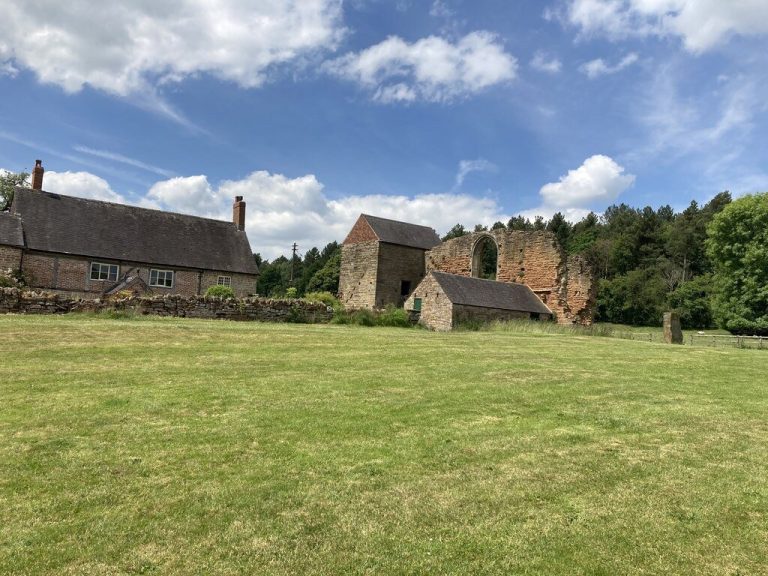
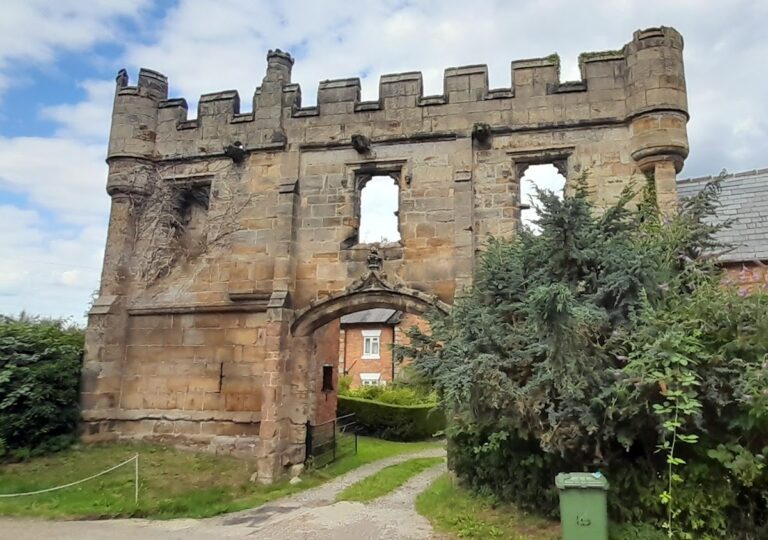
Wingfield Manor survives as a ruined manor house incorporating a working farm on part of the former estate. Its remains are arranged around courtyards and include enclosing walls, towers, the Great Hall, kitchens, an undercroft, a gate, and a large stone barn. A curtain wall is an enclosing defensive wall joining towers or other strongpoints. Cannonball damage remains visible on the walls and towers, linking the surviving fabric to the fighting of 1644.
Residential and service buildings
Great Hall
The Great Hall was formerly one of the largest halls in the country. Its surviving fabric includes an oriel window, a projecting upper-story window supported by brackets or corbels. Colored light from the window would have illuminated the high table. The hall was renovated for Immanuel Halton after the Civil War, preserving a later phase in the building’s use.
Undercroft and kitchens
An undercroft, a supported lower space beneath a principal room, lies beneath the Great Hall. It was used to store wine, beer, and food. Stairs at each corner led upward to the hall, while a passage connected the kitchens with the principal room. In the kitchen area, the remains of two bread ovens and two large fireplaces survive.
Great stone barn
A large stone barn also survives within the former manor estate. Its internal timbering is a notable part of the remaining structure and reflects the agricultural functions that continued around the ruined residence.
Walls, towers, and entrance works
Towers and curtain walls
One tower remains usable, while parts of a larger tower also survive. Before the Civil War, the larger tower contained one of England’s early flushing toilet systems. A cistern at the top released water through the toilet area and into the moat. The curtain walls and towers retain cannonball damage, including a mark on the north wall that preserves the shape and direction of fire from the 1644 siege.
North court gate
The gate above the entrance to the north court bears a carved representation of moneybags. This was the symbol of the Exchequer, the English institution responsible for royal finance and revenue administration, and was associated with Lord Cromwell.
Half-moon battery
Outside the main gate, the overgrown remains of a half-moon battery survive. This defensive work was damaged during the initial bombardment from the eastern hill. Its position preserves part of the military setting created during the 1644 siege.
Siege landscape and north courtyard
Eastern artillery position
The hill east of the manor is identified as the site of an old Roman fort. During the Civil War siege, Parliament’s guns were first positioned there before being moved to Manor Top on the west because the eastern position was too distant for effective fire.
Walnut tree
A walnut tree stands in the north courtyard and is associated with the tradition about Anthony Babington’s alleged visit. Its age does not support the claim that it grew from a seed connected with that story, while the historical account places Babington elsewhere and records that he did not meet Mary at Wingfield.