Worcester Cathedral: A Historic Cathedral Church in England


Site at a Glance
- Rating
- 4.8
- Popularity
- Medium
- Country
- United Kingdom
- Primary era
- Medieval
- External website
- Open
- Eras represented
- Medieval, Modern
- Civilizations
- British, English, Norman
- Site type
- Religious
- Remains
- Cathedral
On this page23 sections
History
Worcester Cathedral, formally the Cathedral Church of Christ and Blessed Mary the Virgin, is a historic cathedral in Worcester, United Kingdom, founded in 680 as an Anglo-Saxon Christian institution. The first bishop was the Northumbrian priest Tatwine, who died before his consecration, so Bishop Bosel is generally regarded as Worcester’s first serving bishop. The present building developed from the Benedictine priory church begun by Bishop Wulfstan in 1084, and its principal construction and rebuilding phases continued until 1504.
Foundation and Benedictine reform
The first cathedral community included several clerical orders. Its church was dedicated to Saints Peter and Paul, while a formal Benedictine organization emerged during the reforms of the later tenth century, dated variously to 969 or to 974–977. Bishop Oswald of Worcester, who held office from 961 to 992 and had been professed at Fleury Abbey in France, introduced Fleury’s monastic practice to the community he established at Worcester around 966. That monastery was dedicated to Saint Mary.
Wulfstan’s priory church formed the foundation of the cathedral that followed. Wulfstan was the last surviving Anglo-Saxon bishop after the Norman Conquest. He remained bishop until his death in 1095 and was later canonized. The building campaign begun in 1084 therefore connected the new Norman ecclesiastical order with an older English episcopal tradition.
The medieval priory and its community
During the medieval period, the priory was a major landowner and economic force in Worcester and the surrounding county. Its holdings included the manor of Bromsgrove. The community also operated as a centre of learning and schooling, maintained connections with hospitals, received part of local taxation, administered ecclesiastical discipline, and developed political relationships with the gentry and aristocracy. A Benedictine priory was governed by the Rule of Saint Benedict, but a cathedral priory also combined monastic worship with diocesan administration, education, landholding, and pastoral authority.
Worcester became a pilgrimage centre through the shrines associated with Saint Wulfstan and Saint Oswald. King John, who ruled England from 1199 to 1216, asked to be buried at Worcester and was interred between their shrines after his death in 1216. The cathedral consequently held both religious importance as a centre of devotion and dynastic importance through the burial of a king.
The medieval diocese also had a hostile relationship with Worcester’s small Jewish community. Around 1190, Peter of Blois was commissioned, probably by Bishop John of Coutances, to write Against the Perfidy of Jews. In 1219 Bishop William de Blois imposed strict regulations on Jews in the diocese, including enforcement of the requirement to wear rectangular white badges. In 1229 he sought stronger papal measures against Jewish usury. Pope Gregory IX responded by requiring Christians not to work in Jewish homes and by reaffirming enforcement of the badges.
Dissolution and religious change
The priory ended during the Dissolution of the Monasteries, Henry VIII’s suppression of England’s monastic houses and transfer of their property to the Crown or other owners. Prior William More resigned in 1535 and was replaced by Henry Holbeach amid administrative problems and divisions within the community. At the dissolution, probably on 16 January 1540, the priory contained 35 Benedictine monks and the prior. Eleven immediately received pensions, while the others became secular canons of the new Royal College, with Holbeach as its first dean. Five more former monks were pensioned in July 1540.
The former monastic establishment was reconstituted as a cathedral served by secular clergy. Hugh Latimer was bishop from 1535 to 1539 and preached Protestant reform and iconoclasm, the deliberate destruction or removal of religious images. He resigned after Henry VIII’s theological change toward Catholicism in the Six Articles. John Bell, a moderate reformer, served as bishop from 1539 to 1543, followed by Nicholas Heath, a conservative Catholic.
Civil War damage and later restoration
During the English Civil War, the conflict between supporters of King Charles I and Parliament, Worcester supported the Crown and received additional Royalist forces. The cathedral was used to store arms and munitions, possibly from September 1642. When the Earl of Essex briefly retook the city, Parliamentary troops ransacked the building, smashing stained glass and destroying the organ, library books, and monuments.
The Worcester bishopric was abolished during the Commonwealth and Protectorate, approximately from 1646 to 1660. The bell tower was demolished in 1647, and the cathedral was used as a prison after the battle of 1651. Major restoration followed from 1857 to 1874 under W. A. Perkins and Sir George Gilbert Scott as part of the Gothic Revival. Worcester Cathedral is now a Church of England cathedral, the seat and mother church of the Diocese of Worcester, administered by its dean and chapter. It is a Grade I listed building and forms part of a scheduled monument.
The former monastic library was dispersed among collections in Cambridge, the British Library in London, the Bodleian Library in Oxford, and Worcester Cathedral Library. A cathedral library has occupied the loft above the south nave since the nineteenth century. The building’s later cultural associations include Edward Elgar, whose portrait appeared with the cathedral’s west facade on the reverse of the Bank of England’s Series E twenty-pound note issued from 1999 to 2007. The note remained legal tender until 30 June 2010.
Remains
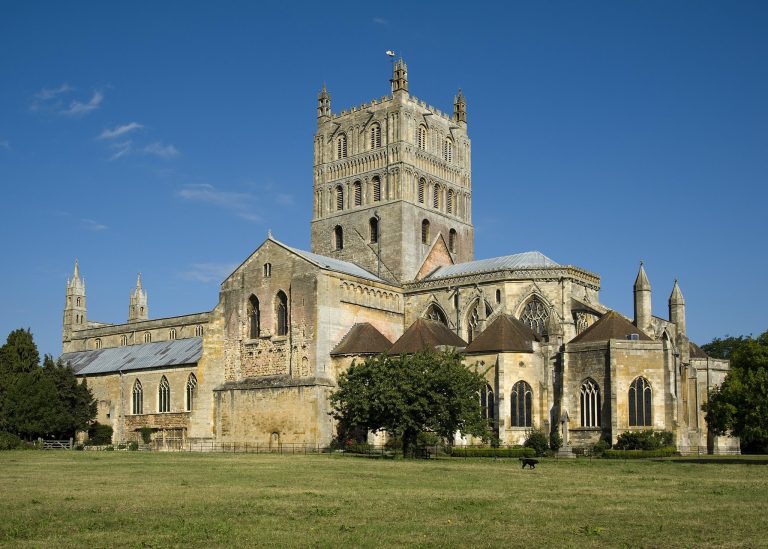
Standing beside the River Severn, Worcester Cathedral combines Norman, Gothic, Early English, and Perpendicular Gothic work. Important parts of the building date from every century between the eleventh and sixteenth. The cathedral is approximately 130 metres long and 44 metres wide. Its tower is about 52 metres high, with its top reaching approximately 62 metres. The plan includes two transepts, or cross-arms, crossing the nave, as well as a chapter house and cloister. This arrangement provided separate space for many clergy or monks to recite or sing the Holy Office, the cycle of daily prayers. The entrance porch is on the north side, where it helped reduce draughts caused by open western doors.
Norman foundations and eastern church
Crypt
The earliest surviving fabric is the multi-columned Norman crypt beneath the cathedral. Norman architecture was the Romanesque style introduced and developed in England after the Norman Conquest. The crypt has cushion capitals and belongs to the monastic church begun by Saint Wulfstan in 1084. Its position beneath the cathedral links the later medieval building with Wulfstan’s original construction campaign.
Chapter house
The circular Norman chapter house dates from 1120. A chapter house was the room where a religious community met for business. Its exterior was changed to an octagonal form when the walls were reinforced in the fourteenth century. John Clyve later strengthened the building further, added buttresses, and altered its vault.
Eastern end
The eastern end was rebuilt over the Norman crypt between 1224 and 1269 under Alexander Mason in the Early English Gothic style. This phase belongs to a successive stage of English Gothic architecture distinguished by pointed and lancet-based forms. Its design is notably similar to that of Salisbury Cathedral.
Nave, tower, and cloister
Nave
The nave was built and rebuilt piecemeal by several architects over approximately two centuries, from 1170 to 1374. Some bays preserve an unusual decorative transition between Norman and Gothic architecture. The oldest sections contain alternating layers of green sandstone from Highley in Shropshire and yellow Jurassic limestone from the Cotswolds.
Central tower
From 1360, John Clyve completed the nave and constructed its vault, the west front, the north porch, and the eastern range of the cloister. He also worked on the chapter house and built the central tower, completed in 1374. The tower originally supported a timber spire covered with lead. The present Perpendicular tower is noted for its refined proportions and is especially prominent when viewed across the River Severn.
Cloister
The north and south cloister ranges were added between 1404 and 1432 by an architect whose name is not known. John Chapman completed the enclosure with the western range in 1435–1438. A cloister is a covered ambulatory enclosing an open court. The ranges therefore form a surviving part of the cathedral’s former monastic layout.
Chapels, choir stalls, and memorials
Prince Arthur’s Chantry Chapel
The last major medieval addition was Prince Arthur’s Chantry Chapel, built beside the south choir aisle between 1502 and 1504. A chantry chapel was associated with prayers for the dead. This chapel commemorates Arthur Tudor, Prince of Wales, the elder brother of Henry VIII and heir to the English throne before his death. Arthur is buried in the cathedral.
Misericords
The cathedral contains 39 medieval misericords dated 1379. Misericords are small projecting seats in choir stalls, often carved beneath with religious, everyday, mythological, or humorous scenes. Worcester’s surviving cycle includes the Labours of the Months together with biblical, mythological, and folkloric subjects. One, numbered N-07, shows the Clever Daughter as a naked woman draped in a net, riding a goat and carrying a rabbit. Three misericords are Victorian replacements, including N-02, which depicts Judas in the jaws of Satan. The medieval carvings are incorporated into Victorian choir stalls.
Tombs and memorials
The chancel contains the tomb of King John, positioned between the former shrines of Saint Wulfstan and Saint Oswald. Other burials and memorials commemorate Stanley Baldwin and his wife Lucy, Bishop Godfrey Giffard, Bishop John Gauden, Bishop Philip Goodrich, Bishop Alfred Barry, Bishop Robin Woods, organist and choirmaster Ivor Atkins, Royalist commander William Hamilton, 2nd Duke of Hamilton, Sir Thomas Lyttelton, 1st Baronet, Richard Edes, William Henry Reed, and Francis Brett Young. The cathedral-associated educators Henry Bright and Ernest Bird are also remembered, and an epitaph to Henry Bright is located near the north porch.
Library and manuscript tradition
The Cathedral Library occupies the loft above the south nave. It contains 289 medieval manuscripts, 55 incunabula, about 6,600 post-medieval printed books, approximately 19,000 archived documents, and a music collection that includes works by Edward Elgar and Thomas Tomkins. Notable holdings include the Worcester Antiphoner, the will of King John, and a 1225 copy of Magna Carta.
Worcester’s medieval scriptorium, a room or institutional workshop where manuscripts were copied and produced, generated numerous manuscripts. Its associated scribes included the chronicler John of Worcester and an unidentified monk known from his distinctive handwriting as the Tremulous Hand of Worcester.
Bells, clock, and organs
Bells and clock
The bell installation comprises twelve swinging bells, four semitone bells, and a 4.1-tonne non-swinging bourdon. The present ringing bells were cast in 1928 by John Taylor & Co. of Loughborough from metal from the 1869 ring. The bourdon was cast in 1869 and retuned in 1928. The bells hang in a wooden frame constructed in 1869. The cathedral also has a purpose-built teaching centre with eight training bells linked to computers, and a ring of ten bells tuned in a harmonic minor key. A new clock by J. B. Joyce & Co. was installed in 1871 to designs by Edmund Beckett, 1st Baron Grimthorpe, using the double three-legged gravity escapement.
Organs and choirs
The cathedral’s organ history extends at least to 1417. Earlier instruments and rebuilds involved Thomas Dallam, William Hill, and Robert Hope-Jones. Hope-Jones’s 1896 organ had four manuals, 61 speaking stops, a Gothic Revival case, decorated front pipes, and two smaller cases beside the quire. Harrison & Harrison extensively rebuilt it in 1925, followed by major work by Wood Wordsworth and Co. in 1978. Most of the Hope-Jones organ was removed in 2006 to make way for a new instrument by Kenneth Tickell, completed in summer 2008. The large transept case and pedal pipes remained, while the nave contains a separate three-manual Rodgers organ.
Worcester Cathedral has three choirs: the principal Worcester Cathedral Choir, with boys’ and girls’ sections normally working independently; the Worcester Cathedral Voluntary Choir; and the Worcester Cathedral Chamber Choir. The principal choir has participated in the Three Choirs Festival since the eighteenth century. This annual choral festival is associated with the cathedrals of Worcester, Hereford, and Gloucester and is one of the world’s oldest continuing music festivals.
Elgar and the cathedral’s musical heritage
Edward Elgar, an English composer strongly associated with Worcestershire, is commemorated in a stained-glass window containing his portrait. The revised version of his Enigma Variations, the version generally performed, received its first performance at the cathedral during the 1899 Three Choirs Festival. The cathedral’s musical remains therefore include both long-established choral traditions and instruments connected with successive periods of organ building.
Early seventeenth-century screens and panelling removed from the choir and organ case in 1864 were transferred to Holy Trinity Church in Sutton Coldfield. Most of the present fittings and stained glass date from the extensive restoration carried out between 1857 and 1874, when the cathedral was reshaped through the work of the Gothic Revival.