Wildkirchli: Caves, Hermitage, and Pilgrimage Site in Switzerland


Site at a Glance
- Rating
- 4.7
- Popularity
- Low
- Country
- Switzerland
- Primary era
- Early Modern
- External website
- Open
- Eras represented
- Stone Age, Early Modern, Modern
- Civilizations
- Swiss
- Site type
- Religious
- Remains
- Sanctuary
On this page11 sections
History
Wildkirchli is a group of three caves beneath Ebenalp in Switzerland that became a Christian pilgrimage site and hermitage during the seventeenth century. The caves lie in the Alpstein massif, in the canton of Appenzell Innerrhoden, and their name was first recorded by Joachim Vadian, a reformer and mayor of St. Gallen.
From devotional site to pilgrimage destination
Before 1621, farmers of Ebenalp probably used Wildkirchli as a small place of devotion. In that year, the monk Philipp Tanner found the prayer site neglected and established a chapel in one of the caves with support from the authorities of Appenzell Innerrhoden. A wooden altar and a wooden tower carrying a large cross were erected outside the cave. Dedicated to the Archangel Michael, the chapel was intended to attract pilgrims.
Tanner left Appenzell in 1624, after which the chapel again fell into neglect. In 1658, the Appenzell priest Paulus Ulmann abandoned his parish and became the first hermit to settle at Wildkirchli. He developed the site into a popular pilgrimage destination, placing a chapel in the lower cave and establishing a hermitage in the upper cave.
The hermitage and its foundation
In 1679, Ulmann founded the Wildkirchli Foundation to safeguard the hermitage after his death. The foundation owned land around the caves, and its revenues were intended to maintain the buildings and support the hermits. The foundation charter is preserved in the Appenzell Innerrhoden State Archives.
About two dozen hermits lived continuously at Wildkirchli between 1658 and 1853. The hermitage ended after the hermit Anton Fässler died in a fatal fall in 1853. During the nineteenth century, the former hermits’ accommodation was replaced by an inn. The present Berggasthaus Aescher belongs to the Wildkirchli Foundation and is leased.
Public recognition and archaeological discovery
The growing development of the Alpstein as a tourist region from the beginning of the nineteenth century brought Wildkirchli wider public attention. Johann Gottfried Ebel described the site in a travel account published in 1798. Johann Baptist Isenring published two views of it in 1830, and the poet Annette von Droste-Hülshoff visited and described it in 1836.
Wildkirchli gained recognition beyond the region through Joseph Victor von Scheffel’s 1855 novel Ekkehard. In the novel, the title character becomes a hermit at Wildkirchli after a disappointed love.
In the early twentieth century, the St. Gallen natural scientist Emil Bächler discovered prehistoric remains in the caves, including worked stone, flint tools, and bones. These finds demonstrated Neanderthal occupation of the Alpstein. Neanderthals were an extinct human group that lived in Europe and western Asia during the Paleolithic. Later excavations identified three layers of deposits in the Altar Cave, and the evidence brought Wildkirchli international attention.
The caves preserve evidence of Paleolithic Neanderthal activity dating to approximately 40,000 years ago, as well as evidence of cave bears dating from about 90,000 to 40,000 years ago. Animal remains indicate that the caves may have served as summer hunting sites. In 1972, a reconstruction of a hermit’s house was built at Wildkirchli and became a small museum for archaeological finds, including a cave-bear skeleton recovered from one of the caves. Additional finds are exhibited in the museum in Appenzell.
Wildkirchli, together with the Chapel of St. Michael, appears on the canton of Appenzell Innerrhoden’s list of cultural properties of national importance.
Remains
Wildkirchli consists of three interlinked caves at elevations of approximately 1,477 to 1,500 metres. The cave system formed in Schratten limestone, a soluble rock shaped into cavities by water, and extends for about 150 metres. The three sections are known as the Altar Cave, the Lower Cave, and the Upper Cave. One section forms a continuous passage with two entrances and can be traversed by a hiking path.
Religious and residential caves
Altar Cave
The Altar Cave was adapted by the hermits for Christian worship. Its cave chapel and altar remain associated with the religious life of the hermitage, and Masses are still celebrated there. The early chapel complex also included the wooden altar and the wooden tower with a large cross erected outside the cave. The chapel was dedicated to the Archangel Michael.
Lower Cave
The Lower Cave housed the hermits’ chapel. It formed part of the religious arrangement created at Wildkirchli after Paulus Ulmann settled there in 1658, when the site was developed as a pilgrimage destination.
Upper Cave
The Upper Cave served as the hermits’ summer residence. Its use formed the residential part of the hermitage, alongside the worship space in the lower cave.
Aescher-Wildkirchli inn
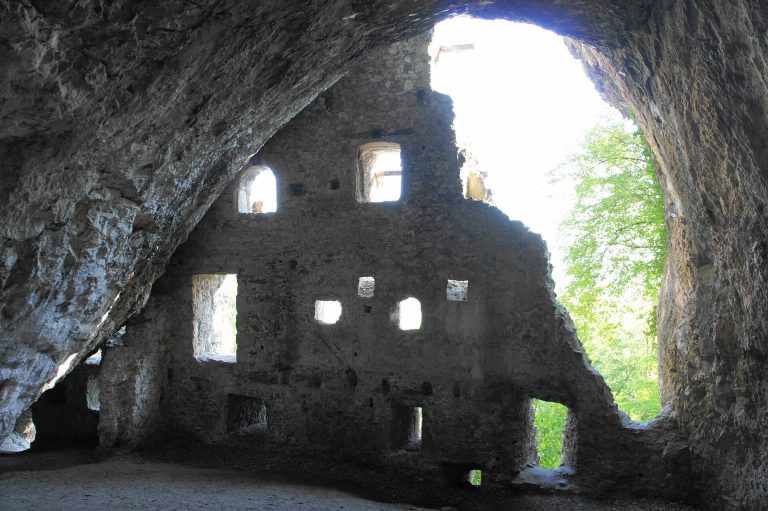
The third cave has housed the mountain inn Aescher-Wildkirchli since 1846. The former hermits’ accommodation was replaced by the present Aescher building in 1860. The inn is built into the cliff and belongs to the Wildkirchli Foundation.
Prehistoric layers and finds
Excavations in the Altar Cave revealed three layers of deposits. The lowest, dated to approximately 90,000 to 40,000 years ago, contained mainly cave-bear bones. An upper layer contained flint tools attributed to the final phase of the Mousterian, a Paleolithic stone-tool tradition commonly associated with Neanderthals, together with bones of chamois, ibexes, and wolves.
The prehistoric remains include worked stone, flint tools, and animal bones. A cave-bear skeleton is displayed in the reconstructed hermit’s house museum at Wildkirchli, while further finds are held in the museum in Appenzell.