Hohensax Castle: A Medieval Hill Castle in Switzerland


Site at a Glance
- Rating
- 4.6
- Popularity
- Very Low
- Country
- Switzerland
- Primary era
- Medieval
- External website
- Open
- Eras represented
- Medieval
- Civilizations
- Holy Roman Empire
- Site type
- Military
- Remains
- Castle
On this page8 sections
History
Foundation and the Sax family
Hohensax Castle is a medieval hill castle in Switzerland, built around 1200 by the barons of Sax, a noble family of Rhaetian origin. It was first mentioned around 1210 as Sax Castle, while the name Hohensax appears from 1393. The castle controlled a domain that included the villages of Sax, Salez, and Gams.
In 1248, the division of the Sax family’s possessions transferred the castle to Ulrich von Sax, who established the Sax-Hohensax branch of the family. The castle later gave its name to the lordship of Hohensax, which covered present-day Gams and parts of Sennwald south of Sax.
Feudal changes and family inheritance
A family feud in 1393 led to the plundering of the castle. Ulrich Eberhard III of Sax-Hohensax then sold Hohensax, together with Sax and Gams, to the dukes of Austria. The Austrian rulers installed Ulrich Eberhard IV as their feudal vassal in the lordship of Hohensax. His alliance with the people of Appenzell helped spare the castle from destruction during the Appenzell Wars.
Through Elisabeth of Sax-Hohensax, Hohensax and Frischenberg castles, along with Gams and Sax, passed to Kaspar von Bonstetten. After the Appenzellers conquered the area in 1405, the Bonstettens recovered Hohensax Castle and Gams in 1411. These possessions then formed the lordship of Hohensax.
Destruction and territorial reorganization
During the Old Zürich War, a fifteenth-century conflict involving Zürich, the Swiss Confederacy, and their allies, the Appenzellers captured and destroyed Hohensax Castle in 1446. The barons of Hohensax subsequently lived at nearby Forstegg Castle in Salez.
The lordship changed hands and political status several times after the destruction. The Appenzellers returned it to the Bonstettens in 1461. At the request of its subjects, Schwyz and Glarus acquired its rights in 1497 and incorporated it into the bailiwick of Gaster. The ruins became part of the lordship of Sax-Forstegg in 1640. That territory later belonged to the canton of Linth in the Helvetic Republic, established in 1798, and subsequently became part of the canton of St. Gallen.
Ownership and preservation
Hohensax Castle is owned by the Ortsbürgergemeinde of Gams, a local civic corporation whose members hold historic communal citizenship rights and may own communal property. The ruins lie politically within the municipality of Sennwald. In 2008, the Pro Hohensax und Frischenberg Foundation secured the remains.
Remains
Layout and central fortifications
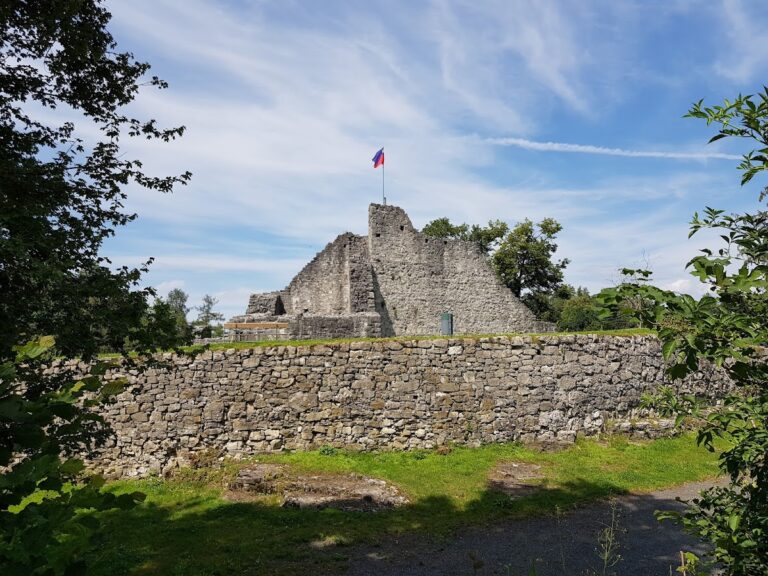
The ruined castle occupies a rocky ridge above the hamlet of Sax, between Gams and Sennwald, about 300 metres above the Alpine Rhine valley and at an elevation of approximately 750 metres. The complex extends for about 90 by 50 metres. Residential buildings stood in the central area behind a moat and a shield wall, a particularly strong defensive wall protecting the most vulnerable side of a fortification. A cistern and the principal fortified tower, or keep, were also located there.
Keep and residential buildings
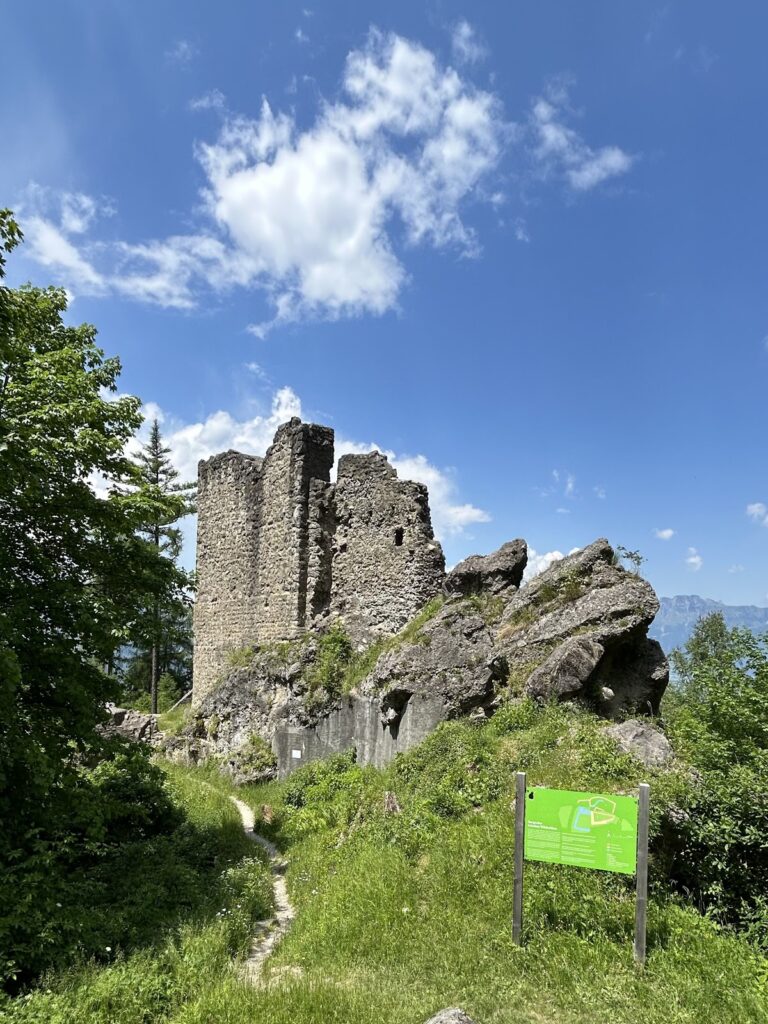
The keep rises about 22 metres and measures 9 by 9 metres. Its walls are up to 2.5 metres thick, and its entrance was elevated on the southern side. One side of the tower collapsed when the castle was destroyed in 1446. The palas, the principal residential or representative building of a medieval castle, measured approximately 35 by 5 metres. Agricultural buildings probably occupied additional space within the walled courtyard.
Nearby sites