Wichenstein Castle: A Medieval Cave Castle in Switzerland

Site at a Glance
- Rating
- 4.6
- Popularity
- Very Low
- Country
- Switzerland
- Primary era
- Medieval
- External website
- Open
- Eras represented
- Medieval
- Civilizations
- Holy Roman Empire
- Site type
- Military
- Remains
- Castle
On this page7 sections
History
Wichenstein Castle is a medieval cave castle in Switzerland, west of Oberriet in the canton of St. Gallen. Its construction is tentatively dated to the thirteenth century. A cave castle is a fortified residence or refuge built into or in front of a natural cave, incorporating the rock into its defensive setting. Wichenstein is listed as a Swiss heritage site of national significance.
The Wichenstein and Ramschwag Families
The Wichenstein family, recorded under the name “Wichinstain,” first appears in written evidence in 1270. Burkart of Wichenstein is mentioned in 1284, although it is not known whether the family built the castle. Later documents associate Wichenstein with Blatten Castle. This connection suggests that Wichenstein may also have been a fief of the Abbey of St. Gallen, a monastery governed by an abbot, and used by the Lords of Ramschwag. A fief was property granted by a superior institution or lord to a subordinate holder in return for service or other obligations.
The last definite evidence of the castle’s use is a document written and sealed at Wichenstein in 1368. This document is sometimes incorrectly dated to 1386. In 1405, rebellious Appenzellers destroyed the complex after their victory at the Battle of Stoss, a major success in their uprising in northeastern Switzerland. It remains uncertain whether Wichenstein was rebuilt afterward.
Ownership and Ruin
Financial difficulties led Walter Heinrich and Ulrich of Ramschwag to sell Blatten Castle and the Kriessern estate to Jakob Mangold of Constance in 1458. Wichenstein probably changed ownership at the same time. In 1486, the Abbey of St. Gallen, then under Abbot Ulrich Rösch, bought Blatten Castle and the Kriessern estate back. Wichenstein was described at that point only as a Burgstock, meaning a ruined castle site.
Restoration and Local Tradition
Initial restoration work took place in 1943. Archaeological excavation and conservation of the masonry followed in 1976 and 1977, preserving the surviving structure and clarifying the character of the former castle.
Local traditions connect Wichenstein with underground passages leading from the cave to the plain and portray it as a haunt of ghosts and robber knights. One legend concerns the knights Adrian, Udalrich, and Beno, whose souls were supposedly confined by the Devil in the large black dogs that had protected them in life. Another tells of Rofahans of Oberriet, who entered Wichenstein at night after hearing his name called. He supposedly found the three knights seated beside a chest of money, guarded by a toad. When the toad swelled frighteningly as he tried to take the treasure, he fled, leaving the knights condemned to wait another hundred years for release from their guilt and evil deeds.
Remains
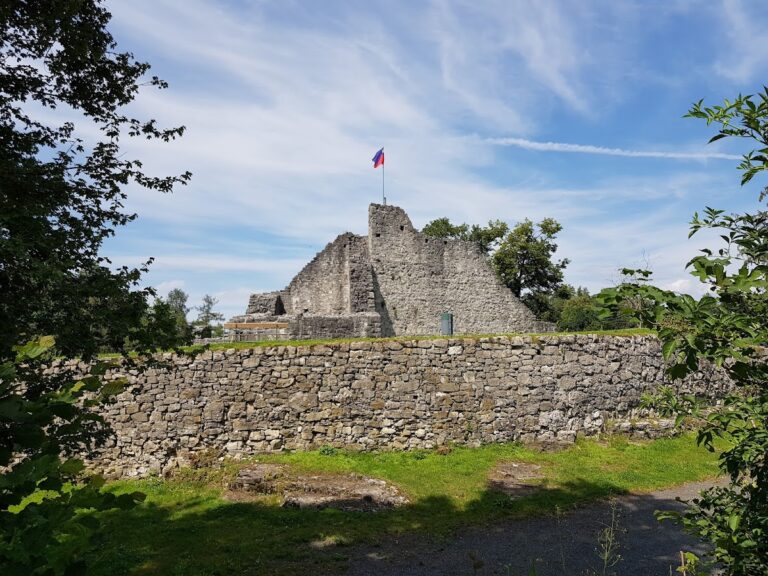
Wichenstein survives as a four-storey front wall on the eastern slope of the Semelenberg. The wall is 2.1 metres thick and closes the entrance to a natural cave about 15 metres deep. The rock of the Semelenberg forms the cave’s interior and the defining natural setting of the former castle, while the masonry provided its principal built defensive element.
Front Wall and Cave
The front wall is the principal surviving part of the ruin. Its position across the cave entrance created a fortified enclosure that used the rock formation as part of the castle’s architecture and protection. The cave behind the wall preserves the physical setting of the former residence or refuge.
Archaeological Evidence
Excavation inside the cave recovered medieval ceramic fragments and animal bones. Below the castle, archaeologists also found the remains of a lime kiln, an installation used to produce lime for building or other activities. The surviving masonry was conserved during the archaeological intervention of 1976 and 1977.