Clanx Castle Ruin: A Medieval Abbey Stronghold in Switzerland
Site at a Glance
- Rating
- 4.9
- Popularity
- Very Low
- Country
- Switzerland
- Primary era
- Medieval
- Eras represented
- Medieval
- Civilizations
- Holy Roman Empire
- Site type
- Military
- Remains
- Castle
On this page9 sections
History
Clanx Castle Ruin, also known as the Castle of Appenzell, is a medieval stronghold in Switzerland, located north of Appenzell. Built in the early thirteenth century by Ulrich von Sax, Abbot of St. Gall, and his brother Heinrich von Sax, the abbey bailiff, it became the administrative center of the Abbey of St. Gall’s lands in Appenzell. The Abbey of St. Gall was a Benedictine institution whose abbot held both religious and territorial authority.
Foundation and Sax Family Control
The castle was first mentioned in 1219 under the Latin designation in arce Clanx. Its name came from the Sax family’s possessions in the Calanca Valley. In 1236, Heinrich III von Sax, a knight and minnesinger, took possession of the castle. A minnesinger was a medieval German-speaking poet and singer who performed courtly songs. Clanx served as a base from which the abbey’s authority in Appenzell was exercised.
Habsburg Intervention and Rebuilding
During the disputed election of the Abbot of St. Gall in 1272, Ulrich von Güttingen obtained Habsburg support by promising to remove Clanx and its lands from Sax family control. The Habsburgs were a powerful ruling dynasty that expanded its regional influence during the Middle Ages. In 1274, Heinrich III von Sax was expelled, and the Habsburg knight Ulrich von Ramschwag received the castle.
In 1277, Abbot Rumo von Ramstein exchanged Blatten Castle and other estates with Ulrich von Ramschwag, bringing Clanx back under the Abbey of St. Gall. The Appenzellers revolted against the abbot in 1278 and unsuccessfully attacked the stronghold. In 1289, Habsburg forces besieged it for six weeks in an effort to control Appenzell. The defenders were bribed to open the gates, departed peacefully, and the castle was burned.
After the abbot’s eventual victory in the war against the Habsburgs, Clanx was rebuilt in 1298. The abbot continued to administer Appenzell from the castle, preserving its role as a center of territorial control.
Destruction and Rediscovery
Relations between the Abbey of St. Gall and Appenzell worsened during the following century. In 1401, Appenzell revolted, beginning the Appenzell Wars, a conflict in which Appenzell challenged the authority of the Abbey of St. Gall. Clanx was among the first targets and was apparently captured quickly. It returned to the abbot’s control a few months later, but a combined force from Appenzell and the city of St. Gall captured and burned it the following year. This destruction ended the castle’s use.
The Abbey of St. Gall retained the ruined castle and its hill after the wars, until selling the ruins and surrounding land to a private owner in 1491. The remains were rediscovered in 1885 during construction of a restaurant. The building was completed, but a storm destroyed it that same year. Excavations in 1949 exposed the castle foundations and wall remains. These were repaired, and the gate was reconstructed. Clanx is now preserved as a ruin.
Remains
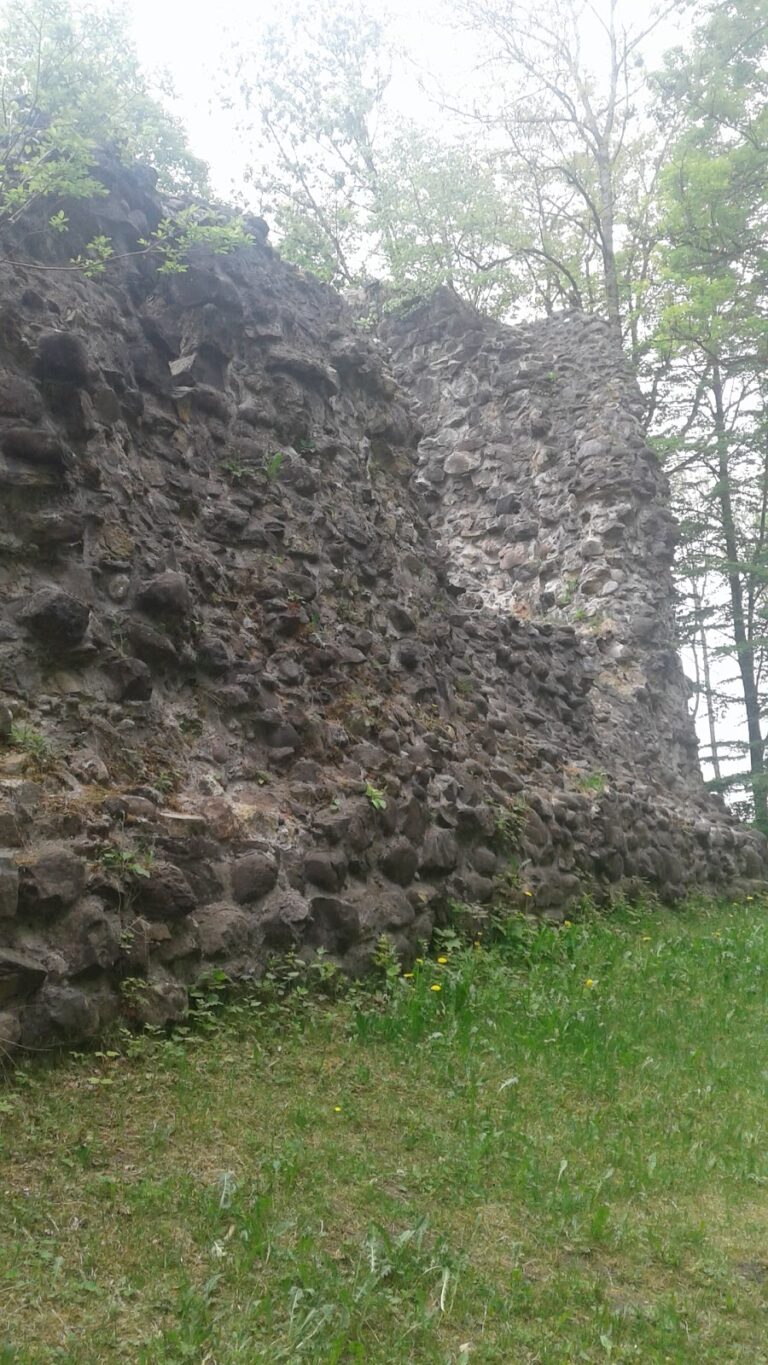
Clanx stood on the summit of the Lehns, a hill north of Appenzell overlooking the Appenzell valley basin, at approximately 1,004 metres above sea level. Excavation covers the eastern half of the castle and part of the western wall. The surviving fabric consists of repaired foundations, wall sections, towers, the remains of the main residential and ceremonial building, and a reconstructed entrance. The excavated structures probably belong to the rebuilding carried out after the fire of 1289.
Fortifications and Principal Buildings
Main Tower
The substantial square main tower forms the principal surviving structure. It measures 10.3 by 10.15 metres, and its walls are up to 2 metres thick. Its foundations and remaining wall sections demonstrate the heavy construction of the castle’s central defensive building.
Corner Tower and Ring Wall
A smaller corner tower occupied the highest point of the hill. Sections of the ring wall, the enclosing defensive wall around the fortified site, survive around the excavated area and show how the towers and enclosing defenses were arranged.
Palas and Castle Gate
Remains of the palas, the principal residential or ceremonial building of a medieval castle, are preserved within the excavated area. The gate lies southeast of the main tower and was reconstructed in 1949. Together with the repaired foundations and wall remains, these features define the surviving form of Clanx as an excavated and stabilized ruin.
Nearby sites