Pieve di San Valentino: A Historic Parish Church in Castellarano, Italy
Site at a Glance
- Rating
- 4.5
- Popularity
- Very Low
- Country
- Italy
- Primary era
- Medieval
- External website
- Open
- Eras represented
- Medieval, Early Modern
- Civilizations
- Holy Roman Empire
- Site type
- Religious
- Remains
- Church
On this page7 sections
History
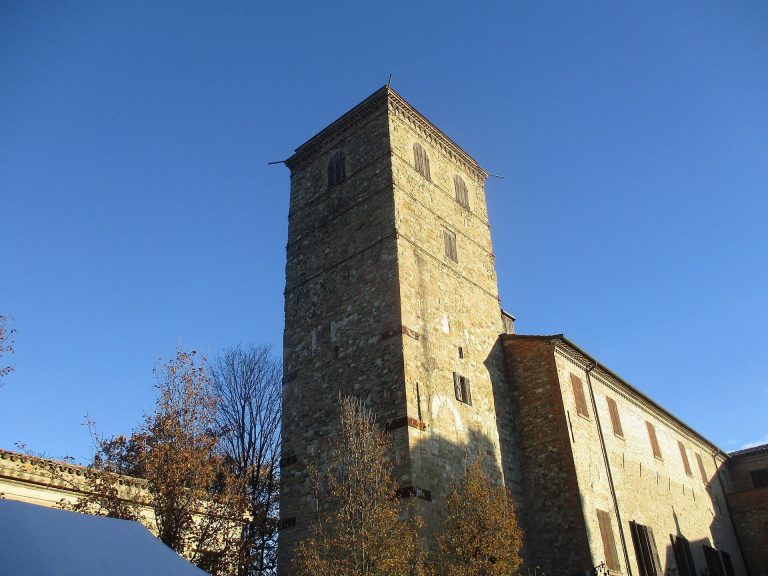
Pieve di San Valentino is a historic parish and patronal church in San Valentino, a hamlet of Castellarano in Italy. Its first place of worship dates to the seventh century, and the church belongs to the Roman Catholic Diocese of Reggio Emilia-Guastalla. As a pieve, or parish church serving a surrounding rural area, it held religious and pastoral importance beyond the settlement itself.
Early origins and medieval rebuilding
The church was originally dedicated to Eleucadius of Ravenna, identified as the third-century bishop and third holder of that episcopal office. This early dedication makes a Romanesque construction around the seventh century probable. The building’s development is associated with the model of San Vitale at Carpineti, regarded as the first Romanesque religious building in the province of Reggio Emilia.
The pieve is among the oldest churches in the Diocese of Reggio Emilia. It appears in written evidence from 960, when it was included in privileges issued by Otto II, the tenth-century ruler of the Ottonian dynasty and Holy Roman Emperor. Bishop Alberio consecrated the church in 1160, marking an important stage in its medieval history.
Later alterations and changing dedication
Various modifications took place at the beginning of the fifteenth century. Their progress was noted during a pastoral visit by Marco Vergnanini, the vicar general. In 1626, the dedication to Saint Valentine was added to the original dedication. Valentine, identified as a Roman presbyter martyred in 270, gradually became the figure by which the church was primarily known.
During Bishop Marliani’s pastoral visit in 1664, the church was described as having three naves, five altars, a bell tower, a sacristy, an internal portico, and a rectory. Slightly more than a decade later, the central nave was lengthened. These changes shaped the building’s later internal arrangement while retaining its role as the parish church of San Valentino.
Modern religious identity and conservation
The church is known by several related names, including the parish church of San Valentino, the Church of Saints Eleucadius and Valentine, the Pieve of San Valentino, and the Church of San Valentino. Since 1997, when the remains and relics of Blessed Rolando Rivi were placed there, it has also been called the Sanctuary of Blessed Rolando Rivi. Rivi was an Italian seminarian killed in 1945 and beatified by the Catholic Church in 2013.
Liturgical alterations required after the Second Vatican Council, the Roman Catholic council held from 1962 to 1965 whose reforms included changes to worship and church arrangements, were completed in 1975. Structural-adaptation work began during the final years of the twentieth century because of stability problems and was completed in 2010.
Remains
Exterior and overall form
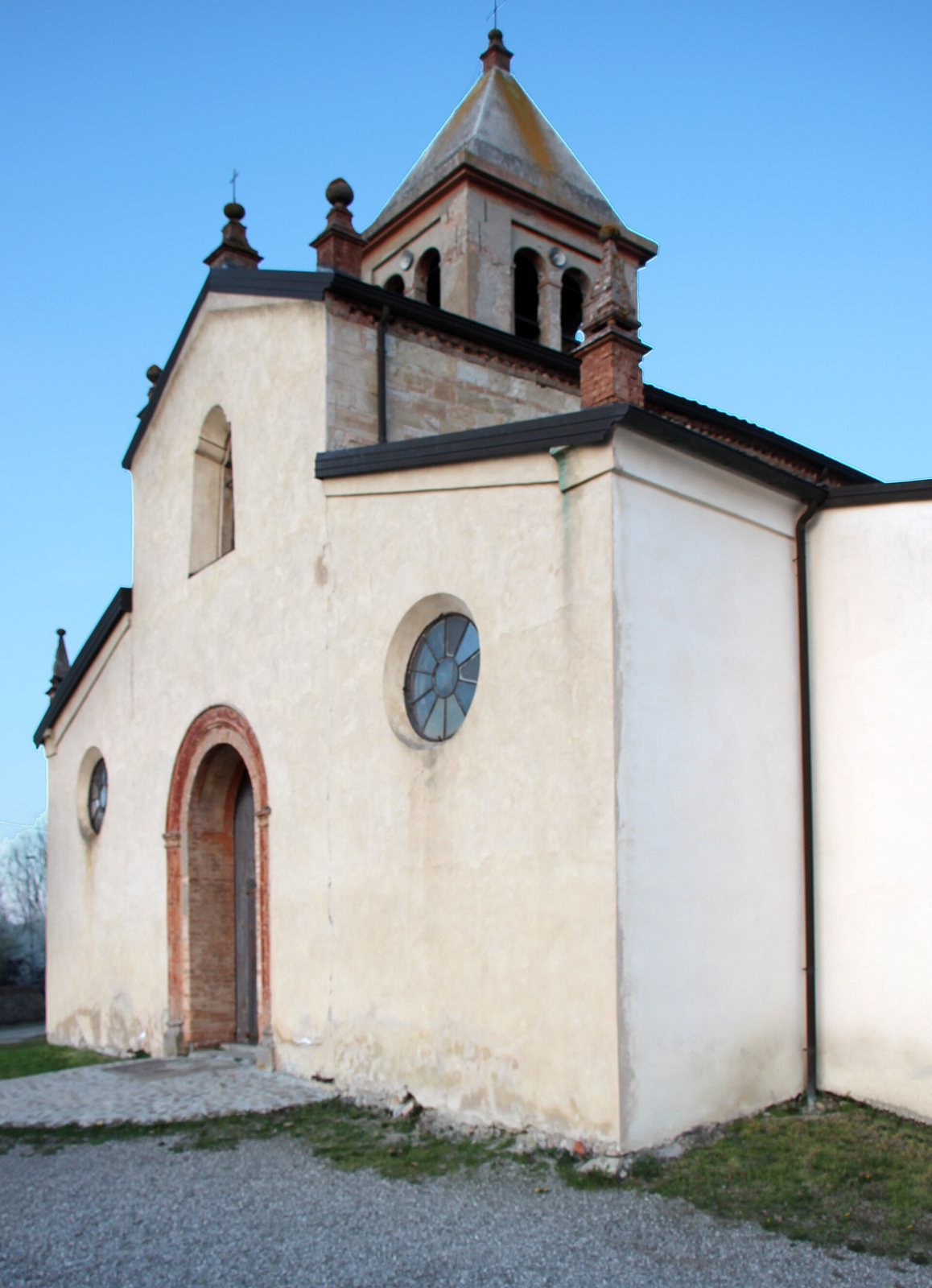
Pieve di San Valentino has a traditional eastward orientation and a basilical facade, meaning that its front reflects the division of the interior into a central nave and lower side aisles. Pinnacles decorate the facade. The central entrance portal aligns with the window above it, while two rose windows occupy the areas to either side.
The bell tower stands in a set-back position on the left side of the nave. The roof is covered with terracotta tiles. Together, the facade, tower, and roof preserve the church’s principal external elements and express its long development as a parish building.
Interior furnishings and devotional features
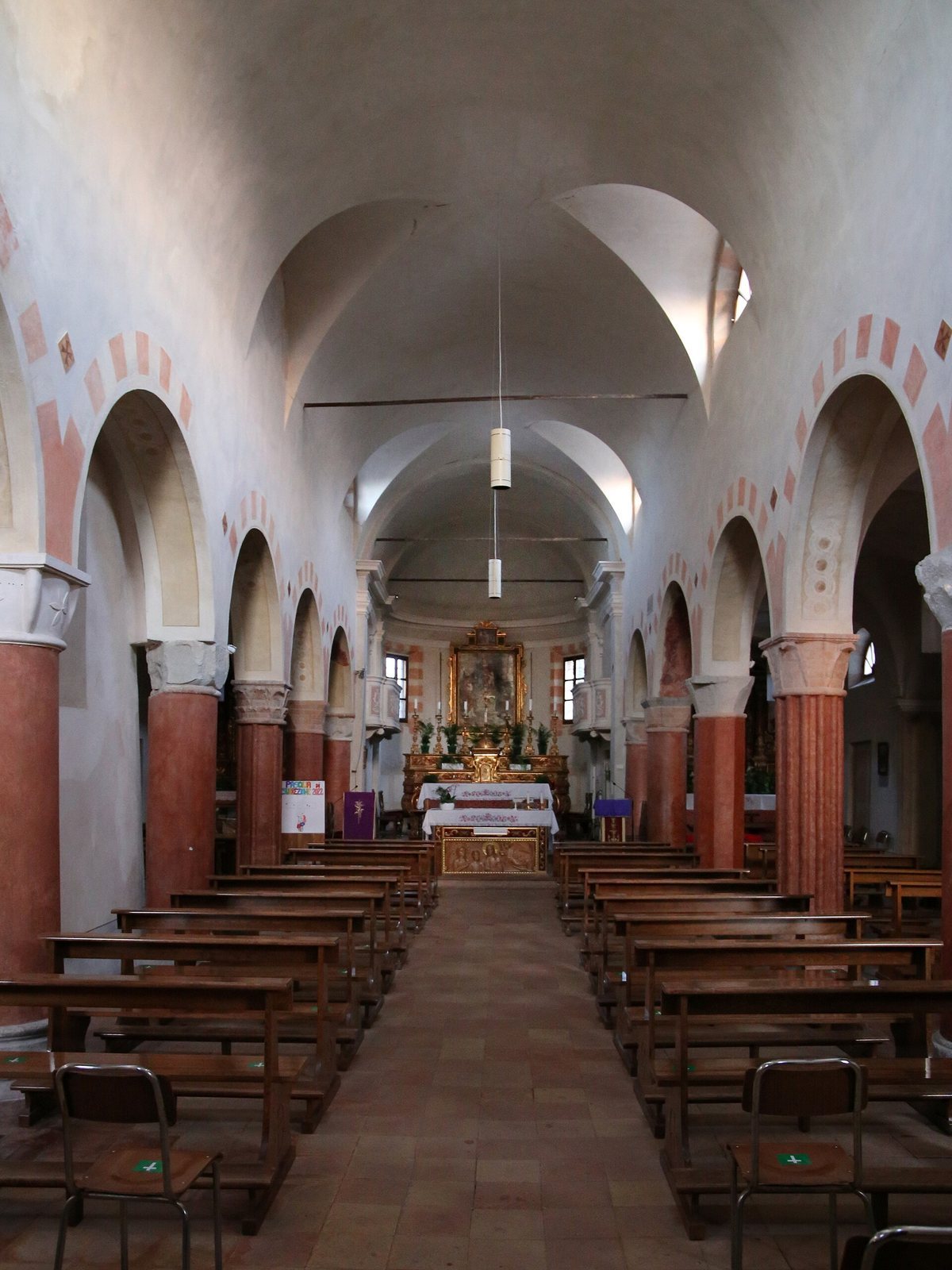
The interior is arranged in three naves. The high altar carries an altarpiece showing the Madonna and Child with Saints Eleucadius and Stephen the Protomartyr. The work is attributed to Benvenuto Tisi da Garofalo. At the ends of the two side naves are altars dedicated to Our Lady of Mount Carmel and to Saints Valentine and Anthony of Padua.
A baptismal font made by Lazzaro Tondelli dates to 1842. Beneath the high altar lies the body of Blessed Rolando Rivi, whose remains and relics have been preserved in the church since 1997. This burial gives the historic parish church an additional devotional focus alongside its older dedications to Eleucadius and Valentine.