Wildegg Castle: A Habsburg Fortress and Baroque Residence in Switzerland


Site at a Glance
- Rating
- 4.7
- Popularity
- Medium
- Country
- Switzerland
- Primary era
- Medieval
- External website
- Open
- Eras represented
- Medieval, Early Modern
- Civilizations
- Habsburg, Holy Roman Empire
- Site type
- Domestic
- Remains
- Castle
On this page10 sections
History
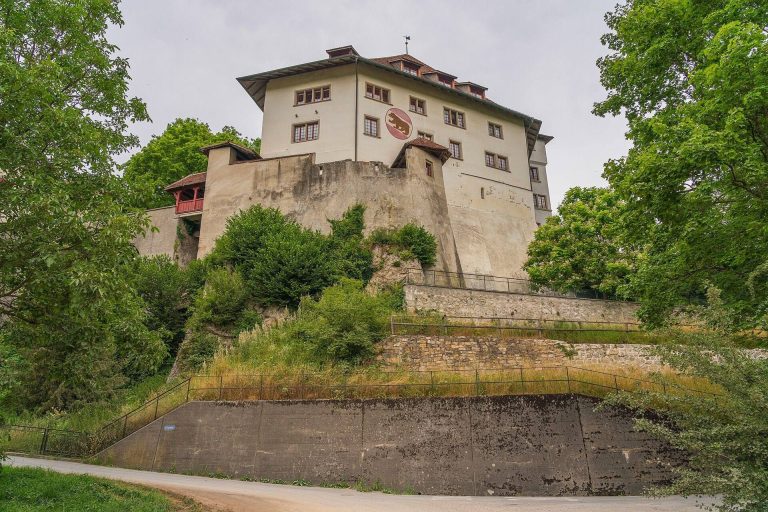
Wildegg Castle is a medieval castle in Switzerland, built by Habsburg ministerials in the first half of the thirteenth century on a strategic position above the Aare. These members of the lower nobility served the Habsburg dynasty in administrative and military roles. The castle protected the southwestern corner of the Eigenamt, a Habsburg core territory, and controlled an important point near the rivers Aare and Bünz. It was first mentioned in 1242 and became the seat of the Truchsessen of Habsburg and Wildegg, a Habsburg ministerial family.
From Habsburg fief to Bernese possession
After the Truchsessen line became extinct, Wildegg passed to Johann I of Hallwyl around 1340. Peter von Gryffensee acquired the castle from the Hallwyl family in 1437, then returned the Wildegg fief to the city of Bern in 1457. A fief was an estate granted by a superior authority to a vassal in return for service. Around 1462, Bern transferred the fief to the brothers Hans, Hans Heinrich, and Hans Thüring von Ballmoos.
Albin von Silenen, an Inner Swiss knight, acquired Wildegg around 1480, but Bern objected and confiscated the fief. In 1483 or 1484, the city granted Wildegg to Kaspar Effinger of Brugg for 1,730 gulden. The grant also included the patronage and lower jurisdiction of Holderbank and Möriken. Patronage gave the holder rights connected with supporting or appointing clergy, while lower jurisdiction covered local civil and minor criminal justice. The Effinger family retained Wildegg for eleven generations.
Fire, rebuilding, and the Effinger estate
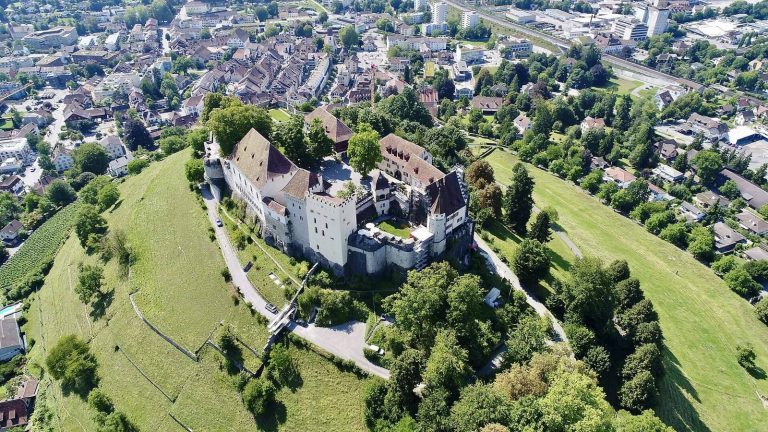
A lightning strike caused the castle to burn almost completely in 1552, leaving its masonry standing. The buildings were made habitable again in the following years. From 1684, the complex was remodelled and enlarged as a Baroque residential castle. Baroque architecture, prevalent in the seventeenth and eighteenth centuries, used formal planning and elaborate decoration to shape grand residences.
The later estate developed beyond the medieval castle. The Erlach House was built beside it in 1825, and a villa in the style of a small country château was erected opposite the Erlach House in 1886. In 1830, Wildegg and its associated estates passed to the Effinger family foundation.
Transfer to public care
Julie von Effinger, the last of her line, died without descendants in 1912. She bequeathed the castle, nearly all its furnishings, and the associated domain to the Swiss Confederation. The Confederation placed the estate under the administration of the Swiss National Museum. Under Eduard Vischer’s direction, repairs were completed by 1917 and the castle was prepared for museum use. The inheritance also contained an archive covering several centuries, which was transferred to the Aargau State Archives in 2011.
On 1 January 2011, ownership passed to a foundation established by the Canton of Aargau, while Museum Aargau took over museum operations. A renovation financed by the Swiss Confederation was completed in summer 2011. Since that year, the Stiftung Schlossdomäne Wildegg has administered the estate, while Museum Aargau has used and maintained the castle, outbuildings, and gardens. The domain is a cultural landscape of national significance and is protected as a Swiss monument of Class A.
Remains
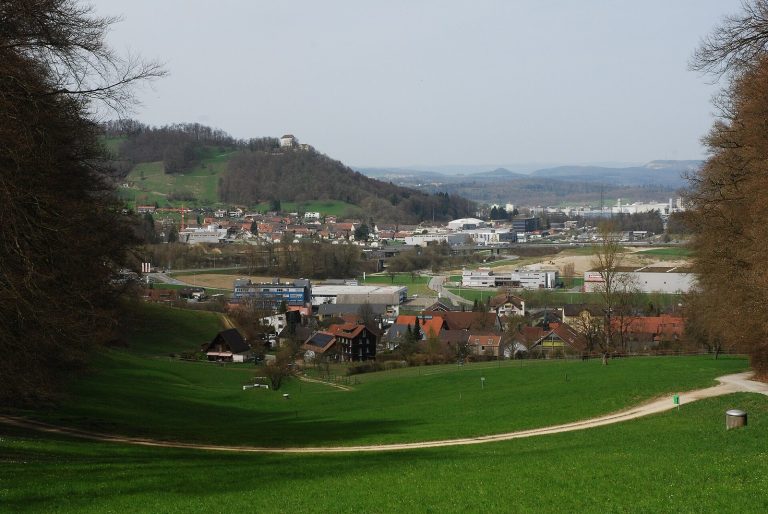
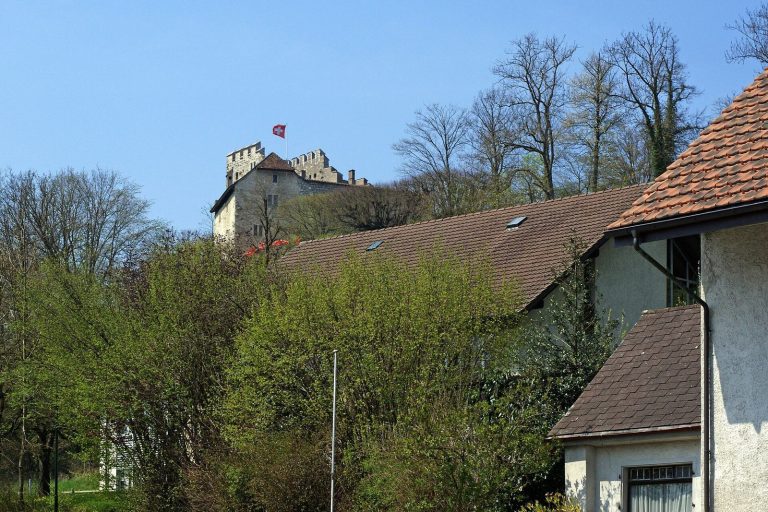
Wildegg Castle stands about 80 metres above the village of Wildegg, at the end of a rocky spur of the Chestenberg. Its position lies above the Bünz and Aare rivers, near the point where the Bünz flows into the Aare. The surviving medieval core is formed by a keep and a main residential hall, while the late seventeenth-century remodelling gave the complex its later Baroque residential character.
Medieval castle core
Keep
The keep, the principal fortified tower of the medieval castle, belongs to the first half of the thirteenth century. It forms part of the well-preserved castle core on the rocky spur. Its masonry survived the fire caused by lightning in 1552 and remains integrated into the later residential complex.
Main residential hall
The castle’s palas, or main residential and representational building, was also part of the thirteenth-century core. Together with the keep, it provided the principal medieval elements of Wildegg Castle. The complex was later remodelled and enlarged from 1684 as a Baroque residence, retaining the older castle fabric within the expanded estate.
Estate buildings and landscape
The wider domain includes a farm complex, gardens, parks, woodland, vineyards, and manufactories. The Erlach House, standing beside the castle, dates from 1825. Opposite it is the villa built in 1886 in the style of a small country château. These buildings form part of the estate that developed around the medieval castle and its later residential use.
Historical-crop garden
A large garden terrace contains a historical-crop garden maintained for museum use. It holds 300 old crop plants, including vegetables, grain and berry varieties, scented plants, culinary herbs, and medicinal herbs. Seedlings are obtained from ProSpecieRara, an organization devoted to conserving biological diversity. The garden preserves cultivated plant varieties as part of the wider historic estate.