Wiesneck Castle: A Medieval Hilltop Castle in Germany


Site at a Glance
- Rating
- 4.3
- Popularity
- Very Low
- Country
- Germany
- Primary era
- Medieval
- Eras represented
- Medieval
- Civilizations
- Holy Roman Empire
- Site type
- Military
- Remains
- Castle
On this page6 sections
History
Wiesneck Castle is a medieval hilltop castle ruin in Germany, located in Buchenbach. It first appears in records in 1079, although it may have existed earlier, and was held by the Counts of Haigerloch. In 1096, Count Adalbert of Haigerloch became the first member of the family to adopt the territorial name “von Haigerloch-Wiesneck.” The castle stood at the edge of territory dominated by the Zähringens, a medieval German ruling dynasty centred in the southwestern German region of the Breisgau and adjoining areas. This position made its lords immediate rivals of the Zähringens.
Haigerloch-Wiesneck and the Zähringens
In 1118, Bruno of Haigerloch-Wiesneck founded St. Märgen Abbey. Three years later, in 1121, the Zähringens destroyed Wiesneck Castle. The stronghold was rebuilt soon afterward, continuing the family’s presence in this contested area.
The Haigerloch-Wiesneck line died out around 1170, after which the castle and its estate passed to the Counts of Hohenberg. They sold it in 1293 to Burkhard Turner. Ownership then moved to the Schnewlin of Landeck in 1318 and to the Blumenegger family in 1372. The Schnewlin of Landeck recovered one half of the castle in 1450–1451 and acquired the other half after 1460.
War, destruction, and later care
During the Peasants’ War, the major uprising of peasants and other lower-status groups in the German lands in 1524–1525, rebels led by Hans von Bulgenbach overran and destroyed the castle complex. It was partly rebuilt soon afterward. In 1577, Wiesneck passed to the Barons of Sickingen-Hohenburg.
French forces destroyed the castle in 1646 during the Thirty Years’ War, a European conflict fought from 1618 to 1648 amid religious, dynastic, and political struggles. The ruins were subsequently used as a quarry for the surrounding area. The village of Wiesneck had developed around the castle at an early date and became part of the municipality of Buchenbach in 1837. In 2002, the Burg Wiesneck association was founded to care for the ruins.
Remains
Setting and surviving layout
Wiesneck Castle occupies a hilltop at 537 metres above sea level in the Wiesneck district of Buchenbach, in the Southern Black Forest. The ruins stand in the Zarten Basin at the entrance to the Höllental, Wagensteig, and Unteribental valleys. The castle was positioned beside the road through the Wagensteigbach valley toward the Thurner, giving the site a strategically advantageous location.
Castle structures
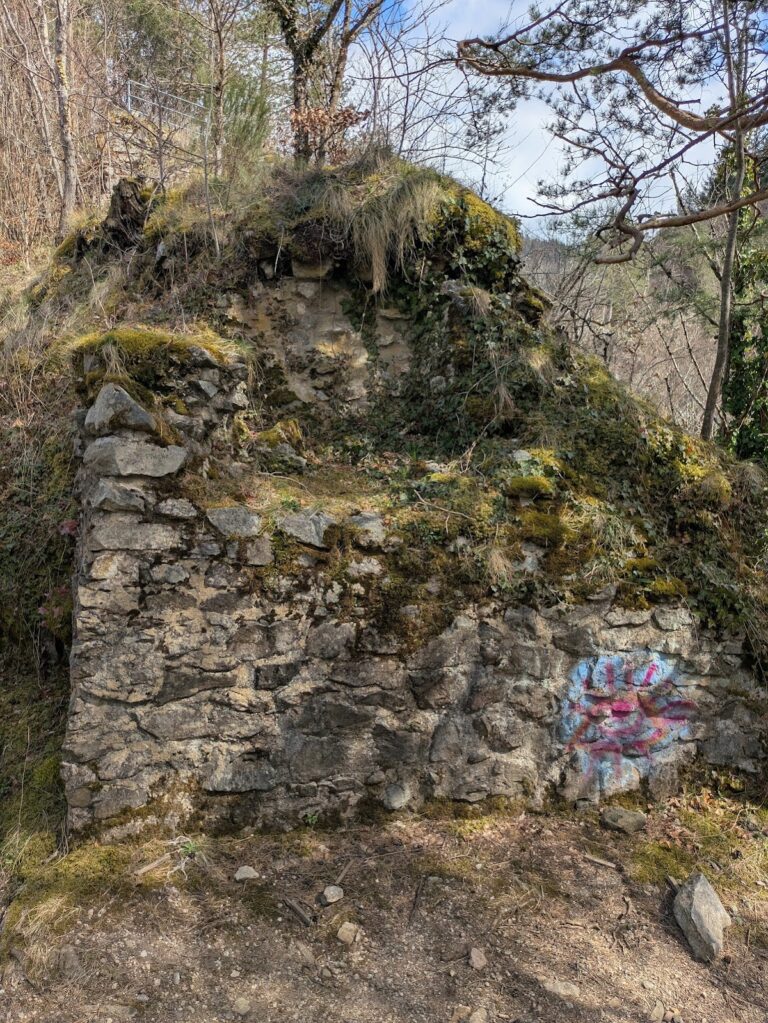
Only the entrance area and a few sections of wall survive. These remains still distinguish the former outer ward, the enclosed area outside the main stronghold, from the inner ward, its principal fortified enclosure, and the palas, the castle’s main residential or representative building. Their arrangement indicates that Wiesneck was among the larger castles in the region. The surviving complex remains in a ruinous condition.
Nearby sites