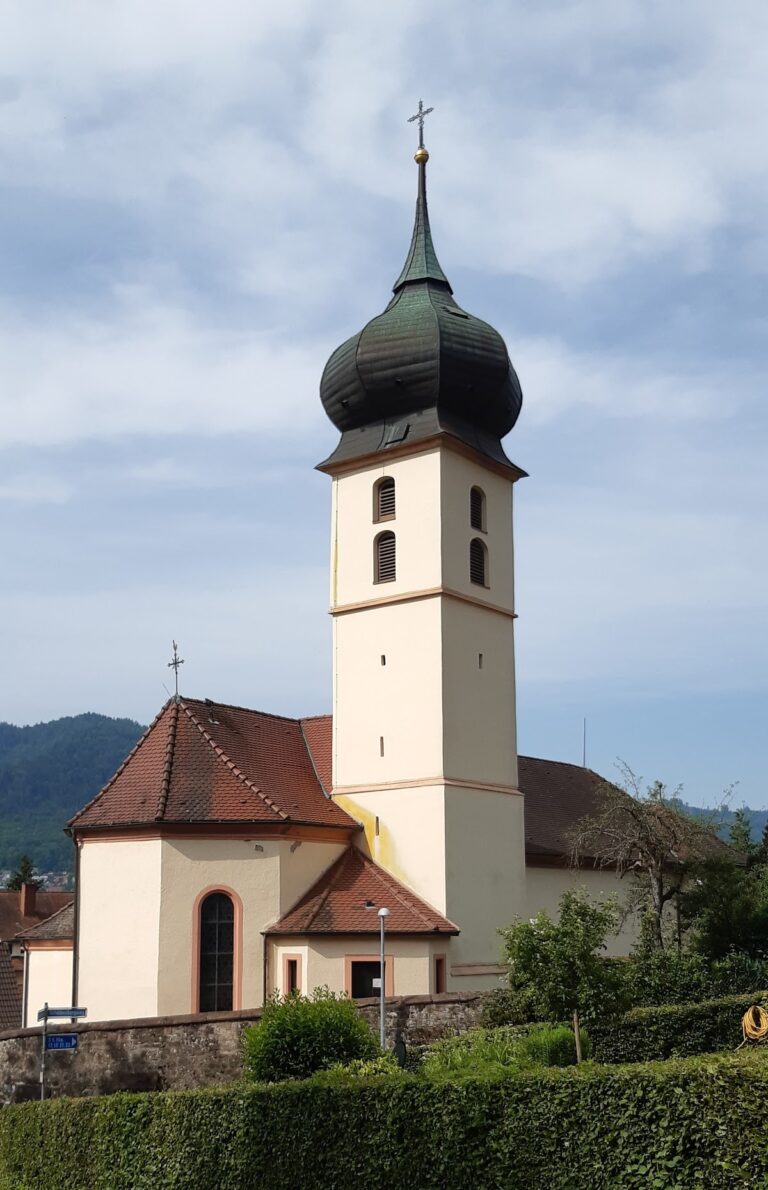
St. Märgen’s Abbey: An Augustinian Monastery and Marian Pilgrimage Church in Germany


Site at a Glance
- Rating
- 4.6
- Popularity
- Very Low
- Country
- Germany
- Primary era
- Early Modern
- External website
- Open
- Eras represented
- Medieval, Early Modern
- Civilizations
- Habsburg, Holy Roman Empire
- Site type
- Religious
- Remains
- Monastery
On this page15 sections
History
St. Märgen’s Abbey is a former Augustinian canons’ monastery in St. Märgen, Germany, founded around 1118 as Cella Sanctae Mariae during the medieval period. Its canons were priests who followed the Rule of St. Augustine while serving liturgical and pastoral needs. The foundation became a religious centre, a landholding institution, and a strategic presence near routes crossing the Black Forest.
Foundation and early development
Bruno of Haigerloch-Wiesneck established the monastery. He was a canon of Strasbourg Cathedral and later became chancellor to Emperor Henry V. The foundation had spiritual and political purposes. Bruno’s family competed with the dukes of Zähringen, a medieval noble dynasty whose rulers held ducal authority in parts of southwestern Germany, for influence in the Breisgau and Black Forest. The monastery’s position near the sources of the Wagensteigbach and Ibenbach also helped control an important route through the forest.
Through Bishop Richwin of Toul, Bruno brought canons from St. Leo in Toul to settle the new community. German canons soon replaced these Lorraine visitors. Local tradition says that the first canons brought a miraculous image of the Virgin Mary, a devotional image believed to be associated with answered prayers. The image became the centre of a Marian pilgrimage, meaning a pilgrimage focused on Mary, and is still venerated in the church.
The monastery already existed by 1121, when a document settled a boundary dispute with St. Peter’s Abbey, a Benedictine monastery in the Black Forest. Its name changed gradually from the German form Maria-Zell through Marienzell and Sante Merien to St. Mergen and finally St. Märgen, which became the name of both the monastery and the settlement.
At first, the monastery’s possessions consisted chiefly of cleared land in the surrounding country. Boundaries with St. Peter and St. Gall required negotiation. The canons supplied parish clergy in St. Märgen, Hüfingen, Wyhl, Scherzingen, and Haslach in Freiburg. The community lost Haslach during the Reformation, but received the parish of Zähringen in Freiburg through a donation in 1615. It also held civic rights in Endingen, Villingen, and Freiburg.
Bailiffs and medieval crisis
Although the monastery’s bailiffs were theoretically to be freely elected, that principle was not respected. The bailiwick, an office combining protection and authority over the monastery, passed from the Haigerloch-Wiesneck family to the counts of Hohenberg, Burkard Thurner of Freiburg, the Schnewlin family, the lords of Blumeneck, and again the Schnewlin family. Disputes between these powerful families and the monastery damaged the community during the fourteenth and fifteenth centuries.
Three abbots died violently during these conflicts. Konrad III was killed by a Schnewlin knight at Ebnet in 1355. Members of his own convent murdered Berthold Schultheiß in 1385. Johannes II Schlegele was killed by the Blumeneck family near Merdingen in 1401.
A severe crisis around 1322 forced the canons to leave the monastery with its ornaments and liturgical books. For two years they survived by begging. The church, refectory, dormitory, cellar, and other buildings were left unlocked and largely empty. The canons eventually returned, an episode remembered in a painting made in 1752 or 1753.
Poverty led St. Märgen and the Augustinian canons’ foundation of Allerheiligen in Freiburg’s Neuburg suburb to form a union in 1370. Werner of Weisweil, the abbot of St. Märgen, resigned, and Berthold Schultheiß became both abbot of St. Märgen and provost of Allerheiligen. A provost was the head of a collegiate or canons’ foundation, while an abbot headed an abbey.
Sale to Freiburg and institutional decline
The monastery suffered five destructive fires, in 1284 or shortly before, 1430, 1560, 1704, and 1907. Each was followed by rebuilding or repair, although the scale and speed of the work depended on available resources. The church and, during periods of exile in Freiburg, a house for the parish priest received priority.
After the fire of 1430 and continuing disputes with the bailiffs, Abbot Johannes VI Fähr sold nearly all the monastery’s possessions in the Black Forest, the Wagensteig Valley, and the Zartens Basin to Freiburg on 29 April 1462 for 4,800 florins. St. Märgen retained its church and tithe, while Freiburg assumed the bailiwick in 1463. The few remaining canons moved to Allerheiligen, and Mass was celebrated at St. Märgen only at irregular intervals for decades.
Erhart Rotkopf of Rottweil succeeded Johannes VI Fähr and recovered some rights from Freiburg. He restored the church in 1493, sixty-three years after the fire of 1430. His efforts to reform the community failed because of resistance from the convent and from St. Ulrich and Afra Kreuzlingen.
When Allerheiligen burned in 1518, its abbots and provosts increasingly administered both institutions from Freiburg. In 1546, the abbot of Kreuzlingen ordered that their superiors should govern as administrators rather than abbots. An administrator directed a religious community without holding the full title of abbot. Under Administrator Heinrich of Jestetten, St. Märgen was destroyed by fire for a third time in 1560. Rebuilding began in 1578 under Ulrich Stehelin, who was allowed to use the title provost from 1583.
War, exile, and rebuilding
The Thirty Years’ War, a European conflict from 1618 to 1648 that brought military campaigns and political struggles across the German lands, further weakened the united community. When Provost Jakob Geiger died in 1635, only three members remained. His successor, Konrad Henny, fled to Austria in 1638 and never returned.
Allerheiligen was demolished in 1644 because its position near Freiburg’s walls might have sheltered attackers. The former foundation was later completely destroyed during the fortification of Freiburg by the French military engineer Sébastien Le Prestre de Vauban, carried out on the orders of Louis XIV from 1678. Meanwhile, St. Märgen’s pilgrimage image was temporarily housed with Augustinian hermits in Freiburg.
Provosts Adam Schmid, Melchior Knoll, and Dominik Simonis acquired land in Freiburg for a new Augustinian canons’ foundation and recovered St. Märgen’s principal farm. Schmid also compiled a chronicle, diary, and register describing the possessions of St. Märgen and Allerheiligen. These efforts helped preserve the institutions’ administrative continuity while their buildings and community life remained disrupted.
During the War of the Spanish Succession, an early-eighteenth-century European conflict that affected territories around the Breisgau, soldiers burned many farms near St. Märgen in 1704. The church and parish house also burned, in this case after a parish servant failed to take sufficient care. Freiburg made its small St. Märgen house available as an emergency church.
After Dominik Simonis died in 1713, Andreas Dilger became provost of both Allerheiligen and St. Märgen. He completed the new Allerheiligen foundation in Freiburg, consecrated in 1717, and then directed the complete rebuilding of St. Märgen. Construction began in late 1715 or early 1716. The pilgrimage image returned to the church on 10 October 1723, and the church was consecrated on 28 and 29 April 1725. Dilger and the canons moved into the new monastery on 2 and 3 September 1729, and on 8 September they celebrated their first solemn conventual Mass there in 270 years.
Eighteenth-century prosperity and secularization
Peter Glunk succeeded Dilger in 1736, Michael Fritz became provost in 1766, and Josef Kurz followed in 1797. Glunk and Fritz continued Dilger’s rebuilding programme, and the two united institutions enjoyed relative prosperity during the eighteenth century. Dilger rebuilt the chapel on the Ohmen in 1734 and dedicated it to Judas Thaddaeus. Glunk rebuilt the chapel on the Thurner in 1757 and dedicated it to Wolfgang of Regensburg.
Michael Fritz entered the prelates’ estate of the Breisgau in 1770 and became director of the theology faculty at the University of Freiburg. In 1779, St. Märgen received the body of Constantius, a catacomb saint whose purported relics were taken from the Roman catacombs and venerated in the early modern period.
State control increasingly restricted the monastery under the enlightened absolutism of Maria Theresa and Joseph II. This form of monarchical government combined centralized authority with selected administrative and intellectual reforms. Their governments limited monastic rights, imposed additional taxes, and treated monasteries as economically and administratively unnecessary. A government commissioner attended Josef Kurz’s election in 1797.
The clergy temporarily abandoned St. Märgen in 1800 during the First Coalition Wars, leaving servants and refugees behind. The Imperial Deputation’s settlement of 1803 ordered the secularization of monasteries, meaning the transfer of monastic institutions and property to secular government. After the Peace of Pressburg assigned the Breisgau to Baden in 1805, St. Märgen was secularized in August 1806 and, with its possessions including Allerheiligen, transferred to the Grand Duchy of Baden. Fifteen members of the community were affected. Josef Kurz moved to Freiburg, while several former canons continued serving the old monastery parishes.
The pilgrimage continued after secularization for religious and political reasons, as well as because local inns depended heavily on pilgrims. The former south-eastern monastic wing became the parish house, and part of the monastic library became the parish library. Allerheiligen became Freiburg’s first Protestant parish church.
Fire, restoration, and later use
Lightning caused the fifth major fire on 12 September 1907 because the church had no lightning conductor. The church and several ancillary buildings burned, but the church was promptly rebuilt in its earlier style. The pilgrimage image and the altar figures survived.
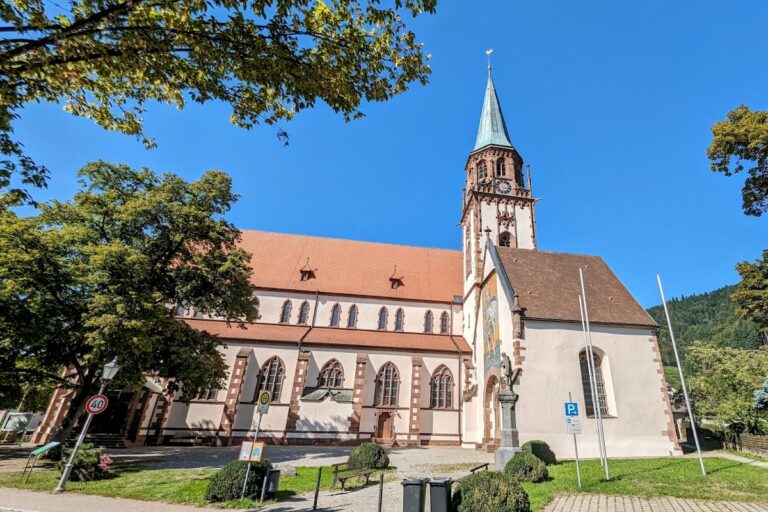
Monks of the Pauline Order, a Catholic order with an eremitical tradition, occupied the monastery in 1995 and took over pastoral care. Their settlement ended on 31 August 2011 after one monk was found to have embezzled money. The Baroque church of St. Mary of the Assumption now serves as the Roman Catholic parish church of St. Märgen and remains one of the important Marian pilgrimage churches in the Archdiocese of Freiburg. The north-eastern monastic wing contains a monastery museum with permanent and changing exhibitions on local cultural life and history.
St. Märgen also has a place in the art history of southern Germany because Matthias Faller, a major Rococo woodcarver, lived and worked there for a period. Rococo art is known for delicate ornament, curved forms, and elaborate decorative detail.
Remains
The surviving complex reflects five main building generations on the same site: the foundation building from around 1118, reconstructions after the fires of 1284 and 1430, rebuilding begun after the fire of 1560, and the large Baroque reconstruction of 1716–1729. The eighteenth-century arrangement continued to shape the complex after the fire of 1907, which led to restoration with relatively little alteration to that layout. Water for the monastery still comes from springs north of the Rankmühle in St. Märgen.
Early architectural evidence
Material from the earlier building phases survives in the monastery museum. It includes a Gothic pointed arch of red sandstone and a Gothic metal grille, possibly associated with the rebuilding completed in 1493.
The earliest surviving visual representation is a monochrome yellow-brown painting made by Franz Ludwig Hermann in 1752 or 1753 for the abbots’ gallery at St. Peter. The scene depicts the canons returning after their departure around 1322. Its architecture is largely imaginary because the buildings shown had already disappeared, but it may preserve a local memory of an earlier arrangement, possibly a church with a single tower and two-storey convent buildings forming a horseshoe around it.
Baroque church
Andreas Dilger rebuilt the church from its foundations. Johann Mathis of Mittelberg in Vorarlberg prepared the design in autumn 1715 after an earlier builder had disappointed Dilger. The plan was more modest than Dilger’s original ideal and was generally followed. The western facade was intended to end in a segmental-arched gable decorated with figures. Work began in late 1715 or early 1716, Mass was celebrated in the partly completed choir by the end of 1716, and the church was provisionally complete in 1719.
Between 1735 and 1744, Johann Martin Hermann of Villingen made the church’s altars and Matthias Faller carved their wooden decoration. The church’s Baroque western gable was demolished in 1790. The 1907 fire destroyed the church, but it was rebuilt in the old style. The altar figures were saved from the flames, and the Marian pilgrimage image was preserved and returned to the church after the 1704 fire.
Monastic buildings
The principal buildings of Dilger’s monastery were designed as three-storey structures, except for the two-storey western wing above the cellars. Single-storey ancillary buildings stood to the north. Between 1724 and 1730, the convent or collegiate building was erected south of the nave around the Convent Court. Its southern wing contained the refectory, or dining hall, and the abbot’s residence. The eastern wing held the sacristy, where liturgical vessels and vestments were kept, while the western wing contained the gate. Johann Mathis directed this work, and the completed buildings had two storeys rather than the three shown in the first design. Dilger and the canons moved into them in 1729.
Prelate’s South Wing
Franz Joseph Vogel of Wettenhausen built the Prelate’s South Wing between 1738 and 1742, east of the refectory wing and south of the Prelate’s Court. It contained representative rooms and guest apartments. Vogel had previously worked at St. Märgen as a stucco artist. After secularization, the wing became the parish house and continues to serve that purpose. A fire wall erected by parish priest Adolf Albicker against the refectory wing saved it during the fire of 1907.
Prelate’s East and North Wings
Johann Baptist Häring of Immendingen built the Prelate’s East and North Wings from 1761 to 1763. They provided additional guest apartments and contained the chapter house, the monastery’s meeting room for communal administrative and disciplinary matters. Häring also constructed the arched passage linking the Prelate’s North Wing with the church choir. The municipality bought both wings in 1858; some rooms were used for administration and others were rented. The Prelate’s North Wing and the upper floor of the East Wing now house the monastery museum.
The surviving Prelate’s South, East, and North Wings retain rooms with furnishings from the rebuilding period. The former chapter house, now part of the museum, has a stuccoed door and ceiling. An elaborately decorated upper-floor corner room at the junction of the South and East Wings was called the “best guest room” in 1771. Peter Glunk commissioned stucco artists from Wessobrunn in Bavaria, working in the workshop of Josef Wagner, to decorate its ceiling with the four seasons in the corners. An old tiled stove remains in the room.
Alterations to the complex
Secularization changed the arrangement of the monastery. Most of the convent building was sold to private owners in 1813. The section of the gate wing adjoining the church was demolished across the width of two rooms to create a passage. Between 1859 and 1860, much of the ancillary construction around the Outer Court was demolished to allow the cemetery to be extended northward.
The 1907 fire destroyed the church and the buildings around the Convent Court. The sacristy wing was not rebuilt except for the sacristy itself, leaving a unified court. The surviving monastic wings, the museum rooms, the courtyard sundial, and the church together preserve elements from the eighteenth-century rebuilding and from the later history of the former abbey.
Associated chapels
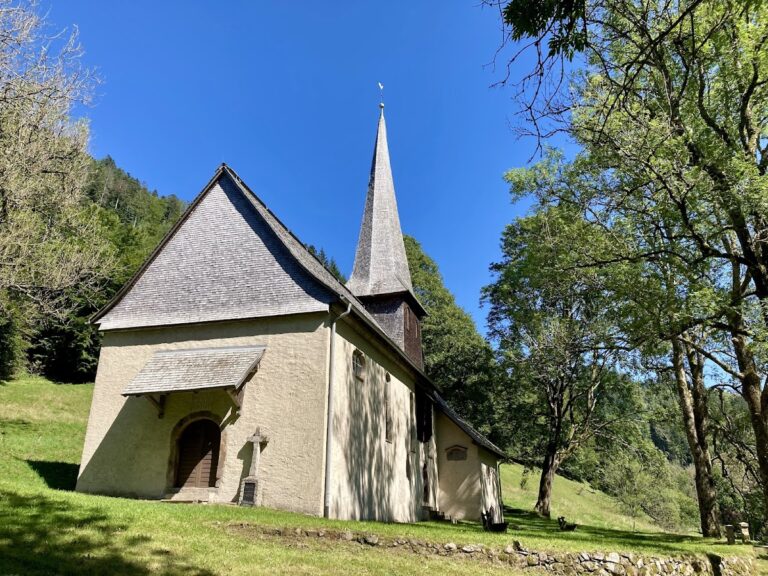
The wider monastic complex includes the Ohmen Chapel, rebuilt in 1734 and dedicated to Judas Thaddaeus, and the chapel on the Thurner, rebuilt in 1757 and dedicated to Wolfgang of Regensburg. Their rebuilding formed part of the eighteenth-century programme associated with the renewed prosperity of St. Märgen and Allerheiligen.