St. Oswald: A Historic Chapel in the High Black Forest
Site at a Glance
- Rating
- 4.2
- Popularity
- Very Low
- Country
- Germany
- Primary era
- Medieval
- Eras represented
- Medieval, Early Modern
- Civilizations
- Habsburg, Holy Roman Empire
- Site type
- Religious
- Remains
- Chapel
On this page8 sections
History
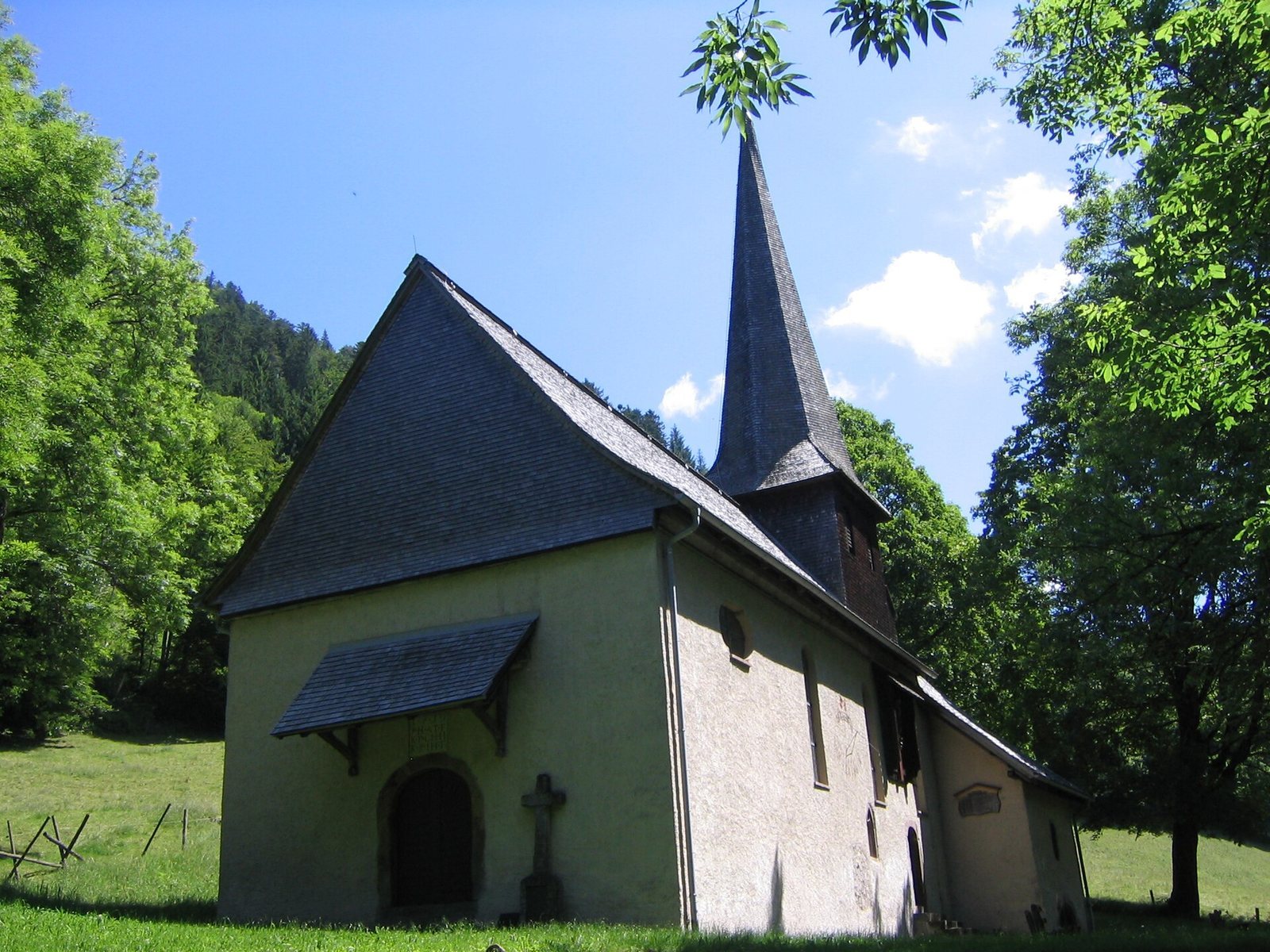
St. Oswald is a chapel in Germany near Breitnau, in the High Black Forest, whose Romanesque core was consecrated in 1148. Hermann I, Bishop of Constance, established it as the proprietary church of the Lords of Falkenstein, the noble family whose castle stood in the Höllental. The chapel was founded during the clearing and settlement of the valley and stands near its eastern end, close to the Ravenna Bridge.
Foundation and early settlement
The chapel’s foundation has long been connected with the development of settlement in the Höllental. Ekkehard Liehl described St. Oswald as the starting point of settlement in the surrounding region, the mother church of Hinterzarten and Breitnau, and the oldest surviving parish church in the High Black Forest. A later interpretation places the beginning of settlement on the uplands and proposes that Breitnau already possessed a parish church before St. Oswald was founded. These interpretations present different explanations for the chapel’s place in the early organization of the region.
From the thirteenth century, St. Oswald functioned as a filial church, meaning a dependent church, of Breitnau. Regular services of the joint Hinterzarten-Breitnau parish continued there until 1788. Hinterzarten received its own church in 1416, the present parish church of Maria in der Zarten, and St. Oswald subsequently belonged to the Hinterzarten parish.
Changes in use and preservation
The cemetery around the chapel continued in use until 1863. In 1812, the Grand Ducal government in Karlsruhe stopped attempts to abandon the building as an unnecessary chapel, allowing it to remain part of the religious landscape of the valley.
The chapel was damaged during the Second World War, when Allied bombing targeted the Höllental, especially the Ravenna Bridge, to disrupt the railway supply route through the valley. Repairs were carried out in 1951 and 1952. A further renovation took place in 1980. After a second burglary on 7 June that year, a choir screen was installed and stolen figures and other objects were replaced with copies. Police recovered the originals in Munich in August 1983, and they are now kept in the parish church at Hinterzarten.
St. Oswald is dedicated to Oswald of Northumbria, a seventh-century Anglo-Saxon king who was venerated as a Christian saint. The chapel is used for weddings, its patronal festival, and Christmas services associated with Hofgut Sternen. Since 2012, one midday Mass has been held there each month during the summer half-year, and the building has also hosted musical events.
Remains
The surviving chapel has a small rectangular choir, a nave, and a wooden tower rising above the choir. The building accommodates approximately 250 people. Its fabric brings together the Romanesque structure consecrated in 1148, medieval additions, and substantial changes made during the seventeenth and eighteenth centuries.
Chapel fabric and additions
The small rectangular choir, its stone altar table, the two side-altar tables, and the eastern half of the south wall belong to the Romanesque building. Herringbone masonry in the south wall remains a visible feature of this early construction. At the beginning of the thirteenth century, a sacristy with a groin vault, formed by the crossing of two barrel vaults, was added together with an ossuary, a structure for human bones. The lintel above the sacristy door bears the date 1208 in Arabic numerals, while the ossuary can be viewed from the south side.
The choir was extended northward in the mid-fourteenth century. In the early sixteenth century, a four-light window with tracery, the decorative stone framework of a Gothic window, was inserted into the east wall in connection with the installation of the Oswald Altar. A wooden tower was erected around 1674. Around 1719, the chapel was extended westward and northward, its walls were raised, and the nave received a gallery carried on wooden columns. Three rows of capital letters beneath the date 1719 above the west entrance commemorate donors associated with this extension.
A sundial on the south side of the nave carries the painted inscription “19 – Renov – 51” and the year 1951, recalling the postwar repair of the chapel. The figures now displayed inside are copies, as a plaque in the choir explains. On the north side of the nave stands a copy of a crucifix carved in 1617 by Georg Hauser, who died around 1653.
Altarpiece and bell frame
Oswald Altar
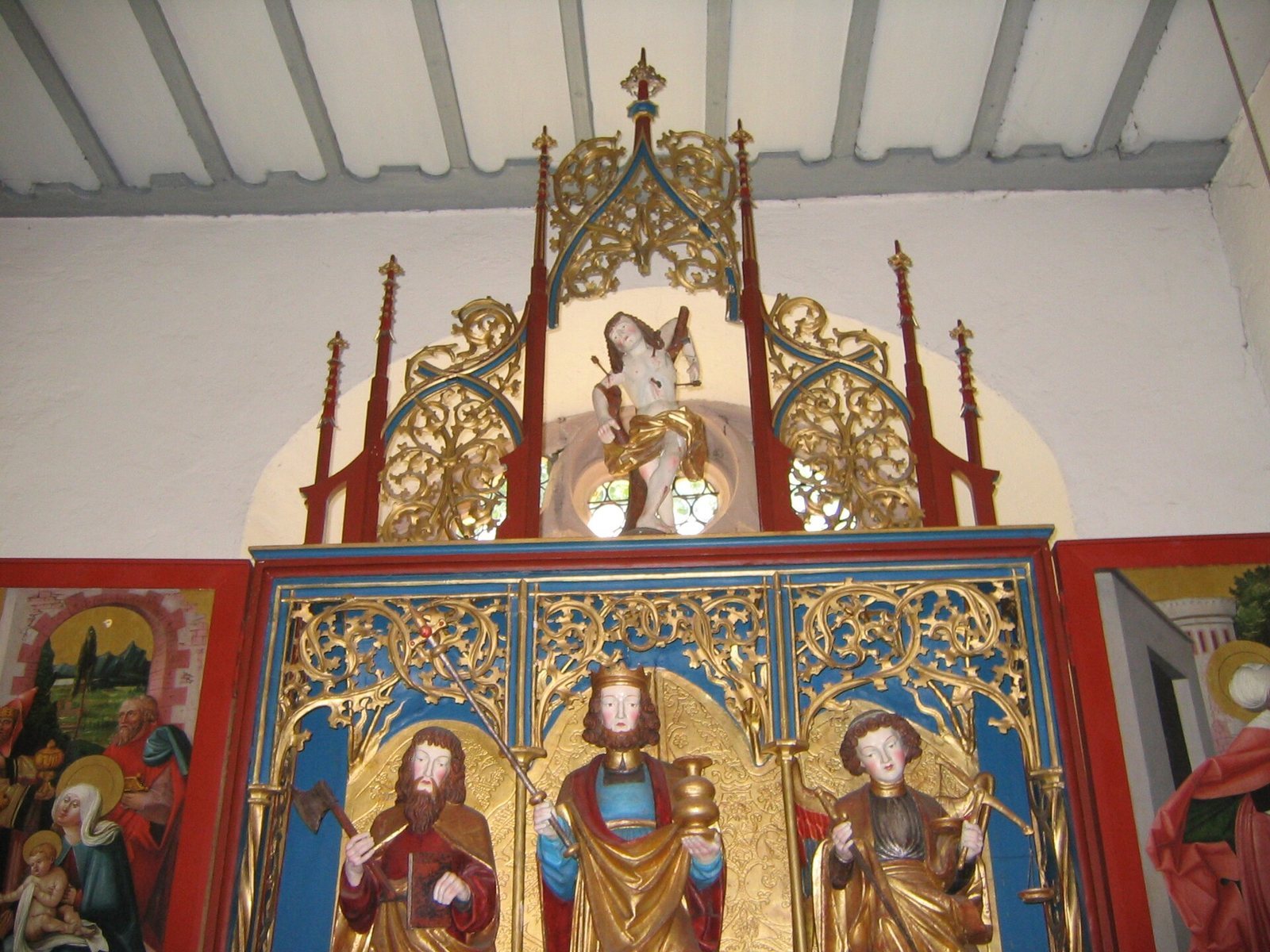
The late Gothic Oswald Altar is a winged high-altarpiece, an altar structure with hinged panels that open and close. Dating from around 1515, it was attributed in 1998 by Andreas Curtius to workshop associates of the Freiburg painter Hans Baldung Grien and the Freiburg woodcarver Hans Wydyz. The closed wings show Saint Matthias and Saint Oswald on the left, and Saint Sebastian and Saint Michael holding the scales for weighing souls on the right. Each figure stands before a landscape.
When the wings are opened, their painted panels show the Adoration of the Magi and the Visitation of Mary to Elizabeth. The scenes are set in landscapes against gold grounds. The original central shrine contains copies of three fully rounded figures, Saint Matthias, Saint Oswald, and Saint Michael with his scales, while the originals are held at Hinterzarten. The original superstructure contains a figure of Saint Sebastian, represented in the chapel by another copy. Beneath the altarpiece, the painted predella, or lower section, depicts the twelve apostles.
The paintings reflect influences associated with Albrecht Dürer, Lucas Cranach, the Danube School, and the Upper Rhine School, artistic traditions of the late Gothic and early Renaissance periods. The retable has been described as the only surviving late Gothic winged altar with painted panels in the High Black Forest and as an important regional example of the Upper Rhine School in the early sixteenth century.
Historic bells
Three bronze bells from the sixteenth century hang in a medieval wooden bell frame in the tower above the choir. Their clappers date from the eighteenth century. The bell installation was restored according to heritage-preservation standards between 2009 and 2011. The bells are rung by hand because the chapel has no electrical connection.