Castillo de Santa Ana: A Coastal Fortification in Roquetas de Mar, Spain


Site at a Glance
- Rating
- 4.4
- Popularity
- High
- Country
- Spain
- Primary era
- Early Modern
- External website
- Open
- Eras represented
- Medieval, Early Modern
- Civilizations
- Nasrid, Spanish
- Site type
- Military
- Remains
- Castle
On this page12 sections
History
Castillo de Santa Ana is a coastal fortification in Roquetas de Mar, Spain, built between the late sixteenth and seventeenth centuries to protect inhabitants near the port. Formerly called Castillo de Las Roquetas, it defended the salt trade and the coast against pirate attacks.
Earlier towers and the early fortification
A tower stood on the site in the early fourteenth century, during the rule of Yusuf I, a Nasrid ruler of the Emirate of Granada. Another tower was built in the sixteenth century to protect the production and shipment of salt from nearby saltworks.
The later fortification provided refuge for people living near the port. Its principal purpose was military, since pirates operating along the Almerian coast attacked salt cargoes and abducted people for enslavement.
Seventeenth- and eighteenth-century changes
During the seventeenth century, the Crown abandoned the fortification because of financial difficulties and the repeated earthquakes that damaged the complex. Luis de Castro Inestrosa later rebuilt the enclosure walls, towers, and residential buildings, and added a new parapet, a protective raised wall for defenders using artillery. He also undertook the rebuilding of the coastal watchtowers at Rambla Honda, Cerrillos, Entinas, Guardia Vieja, and Alhamilla.
After the death of the castellan Andrés Antonio de Castro, the official responsible for a castle’s command and administration, his son Juan Diego de Castro petitioned the Crown to own the office. Philip V, the first Bourbon king of Spain, granted the request. Eighteenth-century defensive projects gave artillery a greater role, and the fortress received an additional cannon.
Major restoration works took place in 1710, between 1753 and 1756 following proposals by Jerónimo Amicis, in 1777, and in 1784. The last of these repairs addressed damage caused by the explosion of the fortress’s powder magazine.
Earthquake damage and reconstruction
The Almería earthquake of 1804 left Castillo de Santa Ana in ruins and halted its restoration for many years. Most interior buildings were destroyed, while the towers and artillery bastion, a projecting platform designed for positioning guns, suffered comparatively little damage. Around 1817, two Russian cannons reached the castle after being acquired under the Treaty of Madrid, although the cannons now displayed there are not the originals.
In early 1997, the Municipality of Roquetas de Mar began reconstructing the castle from its original plans to recover its historical memory. The work was completed in 2003, and the building was then developed as a cultural center and museum. It now accommodates exhibitions, conferences, concerts, theatrical performances, and other cultural activities.
Castillo de Santa Ana has been recognized as an Asset of Cultural Interest since 29 June 1985 and forms part of Spain’s system of coastal watchtowers.
Remains
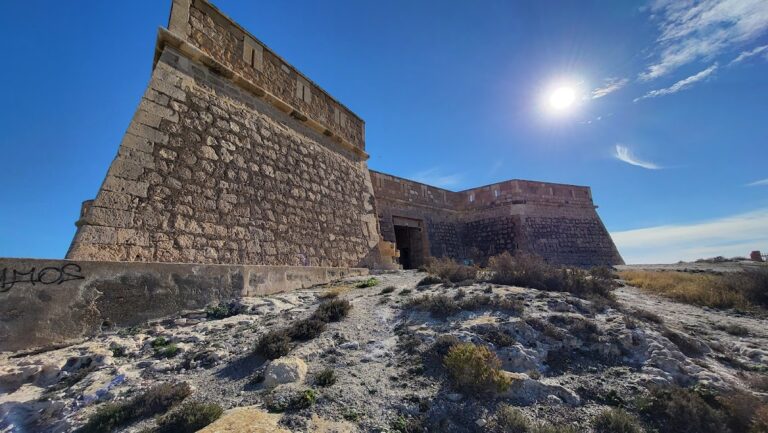
The castle has an oblong plan near the port of Roquetas de Mar. Its reconstructed interior is arranged on three principal levels and spaces: the courtyard, the first floor, and the second floor, which occupies the keep. A lighthouse stands outside the fortification, close to the castle.
Interior spaces and collections
Courtyard
The courtyard contains an interpretation center, two rooms for temporary exhibitions and cultural conferences, a cloister used for institutional and musical events, a projection room, administrative offices, and services. The interior courtyard also provides space for sculptures, concerts, and theatrical performances.
First floor
The first floor houses permanent exhibitions. These include Jesús de Perceval’s photographic work Fragments of a Passing Life, display cases containing objects and personal effects associated with the artist, and engravings connected with the Game of the Goose. Works donated by Carmen Pinteño, Luis Cañadas, Miguel Cantón Checa, Julio Visconti, Ouka Leele, and Garren are also displayed.
This level contains a collection of 82 etchings by Francisco de Goya y Lucientes called The Disasters of War. An etching is a print made by transferring an image from an acid-bitten metal plate. The floor also includes a room for children’s and youth workshops, the entrance to the artillery bastion, and offices for management and staff services.
Keep and battlements
The second floor occupies the keep. Its shape and decoration resemble a ship’s cabin, and it contains the exhibition Bow to Naval Modeling, which presents naval models from different periods. The battlements are accessible and provide views toward the sea and the municipality.
Defensive remains and lighthouse
Tower and artillery bastion
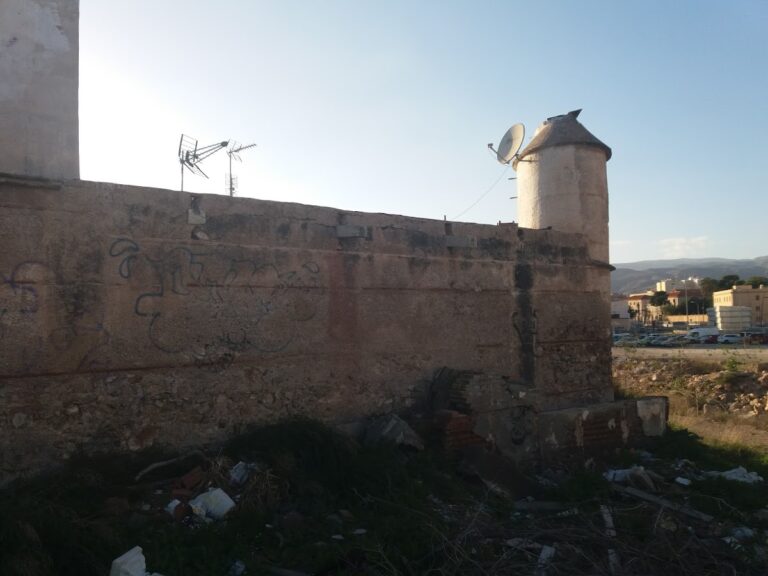
The 1804 earthquake destroyed much of the castle’s built fabric, particularly the interior buildings. A tower and the raised level area survived and were later conserved and recovered. The towers and artillery bastion also retained comparatively little earthquake damage, allowing these elements to remain part of the recovered fortification.
Lighthouse
The lighthouse outside the castle functioned for many years as a working lighthouse. A later restoration returned it to its original appearance, and it now contains two exhibition rooms for paintings, sculptures, and photographs.
Nearby sites