Church of St Martin the Bishop in Podwilcze: A Roman Catholic Filial Church
Site at a Glance
- Popularity
- Very Low
- Country
- Poland
- Primary era
- Medieval
- Eras represented
- Medieval, Early Modern, Modern
- Civilizations
- Duchy of Pomerania, German, Holy Roman Empire
- Site type
- Religious
- Remains
- Church
On this page6 sections
History
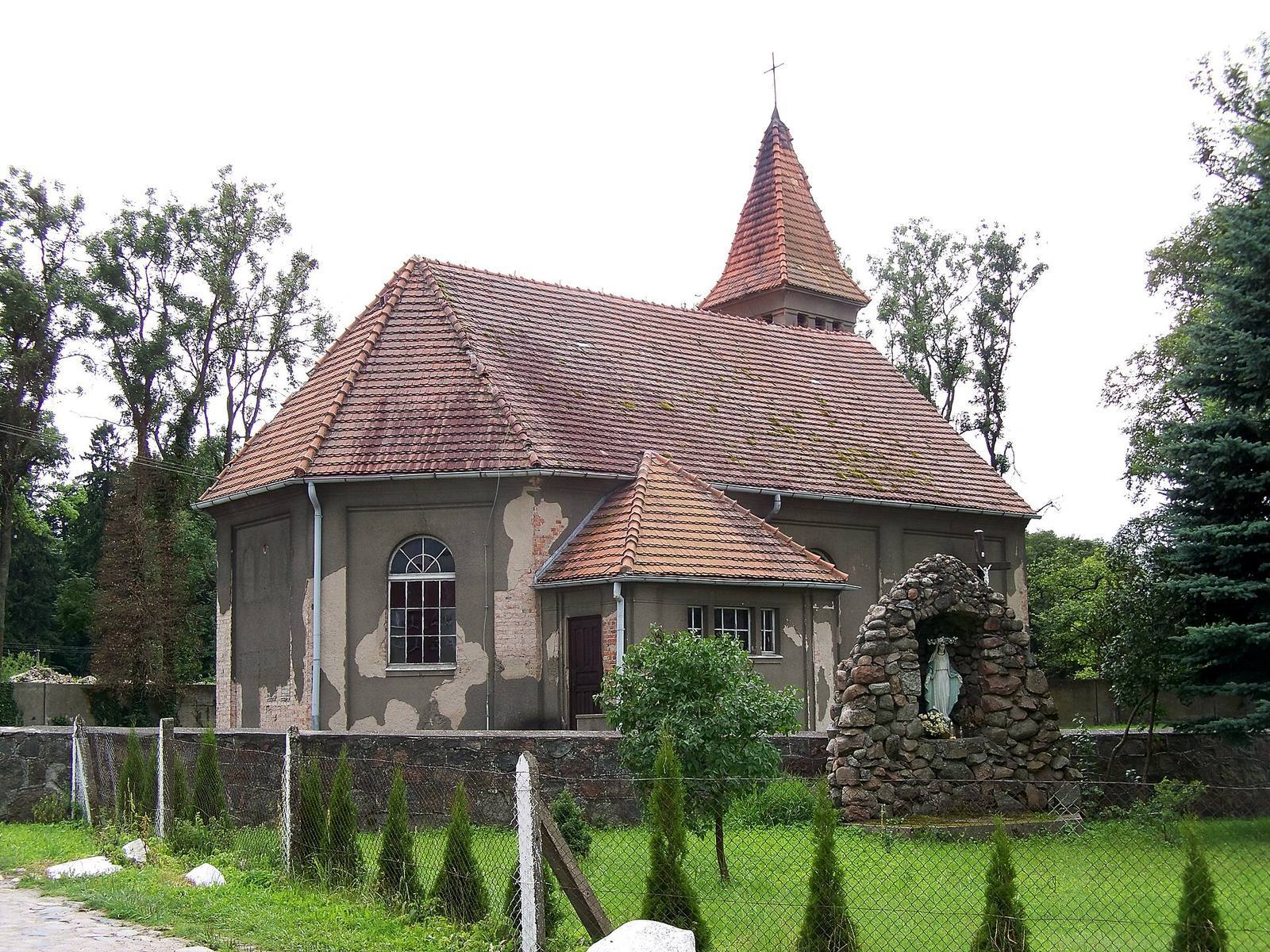
The Church of St Martin the Bishop in Podwilcze is a Roman Catholic filial church in Poland, meaning a dependent church served by a parish rather than the parish church itself. Its origins date to the 15th or 16th century, and it combines Gothic and Neoclassical styles.
Origins and later construction
The church was originally Evangelical. Its main nave was built after 1891.
Parish role and dedication
The church belongs to the Parish of the Exaltation of the Holy Cross in Stanomino. The parish is part of the Białogard Deanery, a grouping of parishes, within the Koszalin-Kołobrzeg Diocese; the diocese belongs to the Szczecin-Kamień Ecclesiastical Province, a grouping of dioceses. The church is dedicated to Martin of Tours, a fourth-century Christian bishop venerated as a saint, and its annual patronal feast is held on 11 November, his feast day. The church entered Poland’s register of historic monuments on 30 October 1956.
Remains
The church stands within a stone enclosure. Its construction combines natural fieldstone bonded with lime mortar and brick walls in the main nave, on both the interior and exterior.
Tower, enclosure, and entrance
The tower dates to the 15th or 16th century. A chapel is built into part of the surrounding wall and contains a statue of the Virgin Mary. The church has a Renaissance-style bell dated 1567, while the gate grille dates to about 1900.
Interior furnishings
The furnishings include an Art Nouveau stained-glass window from the first half of the 20th century, ceiling decoration, and an organ gallery with a harmonium dating to about 1900. The altar table and main altar retable, an ornamental structure behind an altar, date to the 1930s. Other fittings include a Baroque-style baptismal font from the 17th century, a holy-water stoup from the 1890s, and a crucifix from about 1900.