Walsrode Abbey: A Historic Evangelical Women’s Convent in Germany


Site at a Glance
- Rating
- 4.7
- Popularity
- Low
- Country
- Germany
- Primary era
- Early Modern
- External website
- Open
- Eras represented
- Medieval, Early Modern
- Civilizations
- Holy Roman Empire
- Site type
- Religious
- Remains
- Monastery
On this page12 sections
History
Foundation and Medieval Development
Walsrode Abbey is a historic women’s religious foundation in Walsrode, Germany, founded in the tenth century by Count Walo and his wife Odelint as a house for canonesses. A canoness belonged to a religious community organized around a rule without necessarily living as a nun in a fully enclosed order. The foundation’s exact year is unknown, but its first documentary mention appears in a donation charter issued by King Otto III in 986. Otto III was a medieval German king and Holy Roman Emperor who reigned from 983 to 1002.
The abbey became the oldest women’s foundation in the former Principality of Lüneburg and forms part of the historic Lüneburg monasteries on the Lüneburg Heath. Its patron saint is John the Baptist. Although it was not founded as part of the Benedictine Order, the community adopted the Rule of Saint Benedict in 1255. This rule, attributed to Benedict of Nursia, regulated communal religious life through principles including prayer, discipline, and obedience.
Fire, Reformation, and War
A lightning strike caused a major fire in 1482, after which much of the foundation was rebuilt. The chapel received a late Gothic rebuilding in this period. During the Reformation, conversion to Lutheranism began in 1528. The convent resisted the change, but the transition was complete by 1570, after which the institution operated as an Evangelical women’s convent with a maximum of 11 residents.
In 1626, during the Thirty Years’ War, a major European conflict fought from 1618 to 1648, troops commanded by Johann Tserclaes, Count of Tilly, plundered the abbey. Tilly was a leading Catholic commander in the war. From about 1700, severely deteriorated monastic buildings were demolished and replaced with new construction on their original foundations.
Social Role and Continuing Life
In 1699, Guelph Duke Georg Wilhelm decreed, also under pressure from the nobility, that every place in the convent should be reserved for noblewomen. This restriction remained in force until 1980, when women from non-noble backgrounds were admitted.
From 1812 to 1815, the convent was suspended and Napoleon occupied the abbey for three years. Napoleon was the French emperor and military ruler associated with this occupation. Afterward, the convent and its members became strongly involved in social welfare in Walsrode and the surrounding area. Abbess von Marschalck founded a school for poor children in 1842, Prioress Amalie von Stoltzenberg established the town’s first hospital in 1875, and Therese von Plato founded a nursery school in 1890.
Walsrode Abbey now functions as an Evangelical-Lutheran women’s convent administered by the Hanover Monastic Chamber.
Remains
Buildings and Architectural Fabric
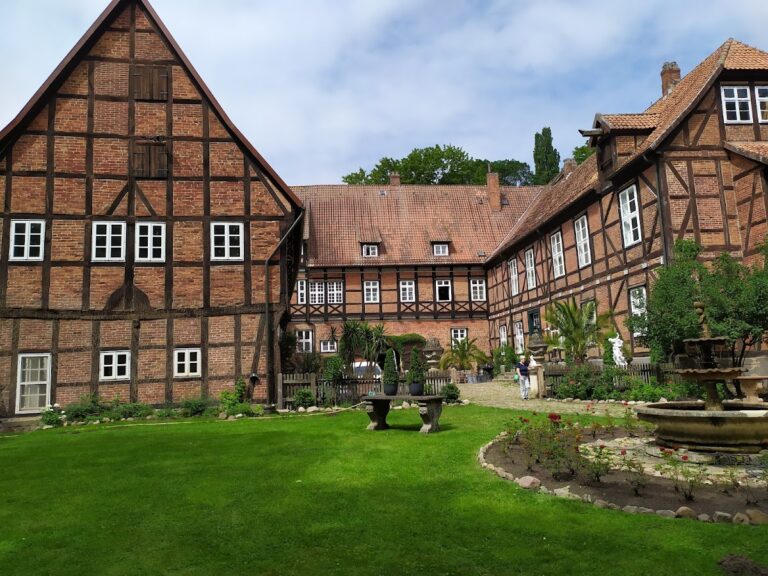
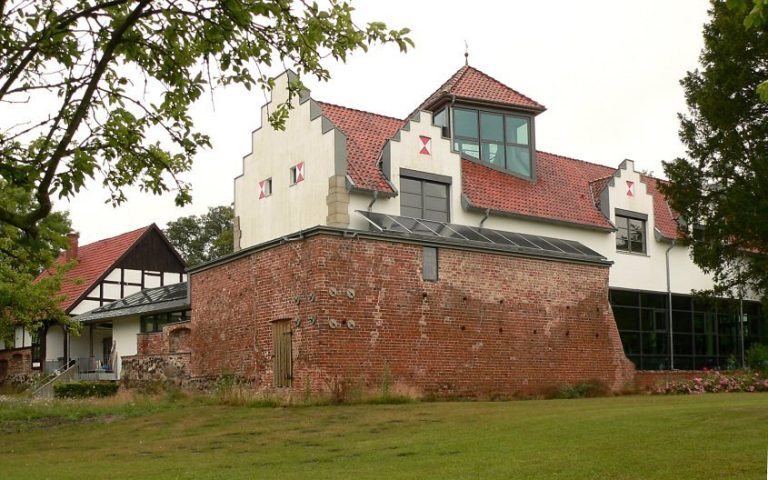
The surviving complex is composed predominantly of eighteenth-century buildings, many of them erected on the foundations of earlier monastic structures. Parts of the chapel’s brick masonry and stained-glass windows survive from the late Gothic rebuilding that followed the fire of 1482.
The Chapel
The chapel preserves sections of late Gothic brickwork and stained-glass windows dating from the rebuilding after the 1482 lightning fire. These elements form part of the surviving medieval fabric within a complex otherwise dominated by later construction.
The Long House
The Long House, or Lange Haus, is a notable surviving building dating from 1720. It belongs to the period when deteriorated monastic buildings were replaced with new construction on their original foundations.
The Refectory
The refectory, a communal dining hall traditionally called a Remter, is another surviving feature of the abbey. It was endowed by Wilhelm II, the last German emperor, and his wife.
Surviving Sculptures
Figure of Count Walo
A nearly life-sized figure of Count Walo survives at the abbey. Dating from around 1300, it represents the founder traditionally associated with the foundation of Walsrode Abbey.
The Bambino
The abbey also preserves a dressed wooden figure of the Christ Child known as the Bambino. The figure is approximately 500 years old and forms part of the convent’s surviving religious artwork.