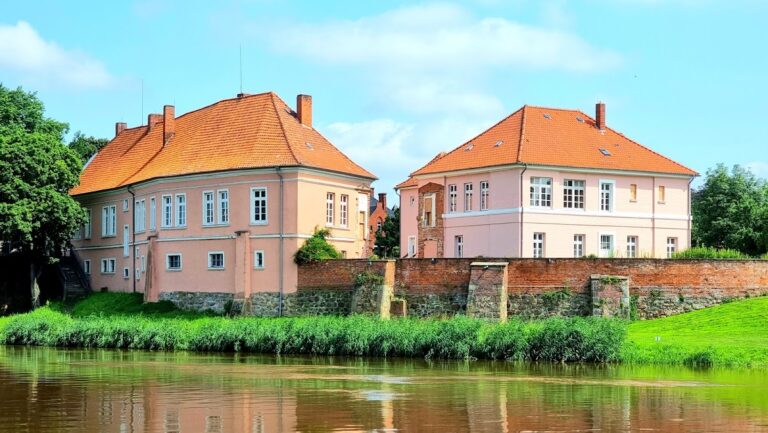
Ahlden House: A Water Castle and Place of Exile in Germany


Site at a Glance
- Rating
- 4.7
- Popularity
- Low
- Country
- Germany
- Primary era
- Early Modern
- External website
- Open
- Eras represented
- Early Modern
- Civilizations
- Holy Roman Empire
- Site type
- Military
- Remains
- Castle
On this page12 sections
History
Ahlden House is a sixteenth-century water castle in Ahlden, Germany, built from 1549 on the bank of the Aller in Lower Saxony. It later became known chiefly as the place where Sophia Dorothea of Brunswick-Lüneburg spent her lifelong confinement after divorcing George Louis, later King George I of Great Britain, and where she died in 1726.
Medieval predecessors and the Lords of Ahlden
The history of the site reaches back before the present house. Bunkenburg, a predecessor on the opposite bank of the Aller, is believed to have originated in the thirteenth century. The Lords of Ahlden appear in records from 1198, initially as administrators of estates belonging to the bishops of Minden. In 1285 they received the local bailiwick, an office combining authority over local administration and jurisdiction. A fortified residence on their estate was recorded in 1344, although its exact relationship to the later Ahlden House is uncertain.
The main Ahlden fortification probably replaced Bunkenburg during the second half of the fourteenth century. The Lords of Ahlden used privileges granted to regional knights to conduct feuds and raids. The dukes of Lüneburg temporarily confiscated the castle in the early fifteenth century, returning it in 1414 on the condition that no further feuds or raids would be launched from it. After a later conflict involving the bishop of Minden, the dukes seized it again in 1431. The Lords of Ahlden then permanently lost their property, which passed to the Duke of Lüneburg. From 1443 to 1575, the estate was mortgaged to the von Mandelsloh family.
Princely administration and wartime occupation
A princely administrative office was established at Ahlden in 1431. Its official, known as an Amtmann, administered a princely district and was responsible for taxation, estate management, and jurisdiction. The office supervised the state-owned estate attached to the house, including its agricultural resources and castle administration. Justice had been administered at Ahlden since 1310.
Ahlden House was drawn into the Thirty Years’ War, the major European conflict fought between 1618 and 1648. Imperial troops commanded by Johann T’Serclaes von Tilly, an imperial and Catholic League commander, occupied the house after a one-day siege. The garrison later defended it successfully against 800 Danish attackers.
From 1726, the house served as the official residence of the state seneschals, senior territorial officials associated with administration and estate management. Extensive changes made from 1784 adapted the complex for administrative purposes, and it also housed a prison. The Ahlden district court occupied the building from 1852 until 1972. The administrative office itself was dissolved in 1884, when its functions passed to the district of Fallingbostel.
Sophia Dorothea’s confinement
Sophia Dorothea of Brunswick-Lüneburg was a seventeenth-century German princess who became the wife of George Louis, Elector of Brunswick-Lüneburg and later King George I of Great Britain. After the Königsmarck affair and her divorce from George Louis, she was confined at Ahlden from 1694 until her death in November 1726. During her years there, she became associated with the titles “Princess of Ahlden” and “Duchess of Ahlden.”
She was first held at Lauenau during the divorce proceedings. George Louis then ordered her lifelong exile at Ahlden after she was sentenced for adultery. He confiscated her marriage property but granted her an annual allowance. She was assigned the north wing of the house, while a guard force of 40 men was established, with between five and ten on duty around the clock. Her contacts and correspondence were strictly controlled. Her mother, however, had unlimited permission to visit, and Sophia Dorothea maintained a household that included two ladies-in-waiting, several chamber women, and domestic and kitchen staff.
Her restrictions were severe at first, and she could move only within the house. She was later allowed into the grounds under escort, and after two years she could travel by carriage for about two kilometres along a prescribed route. She made no escape or rescue attempt. War and building work interrupted her confinement several times, requiring stays at Celle Palace or Essel. When a village fire struck Ahlden in 1715, she contributed substantial sums toward reconstruction.
Sophia Dorothea received visitors, including musicians, and later corresponded with her daughter, Sophie Dorothea, Queen of Prussia, in the hope of securing her release. She never saw her two children again. Restricted movement contributed to marked weight gain, and she suffered a stroke early in 1726. After her death in November, an autopsy found a diseased liver and 60 gallstones. She was buried in the family crypt at Celle.
Later preservation and cultural memory
Major renovation work was completed in 1975. The property was subsequently sold from state ownership to an art auction house, which uses it as a representative headquarters and private auction house. The courtyard was required to remain open to the public during the day, while interior access is mainly connected with auction previews.
The story of Sophia Dorothea carried Ahlden House into German literary and popular culture. Works associated with the site include writings by Theodor Fontane and Arno Schmidt’s 1954 novel Das steinerne Herz. Her life was also represented in the 1948 film Königsliebe.
Remains
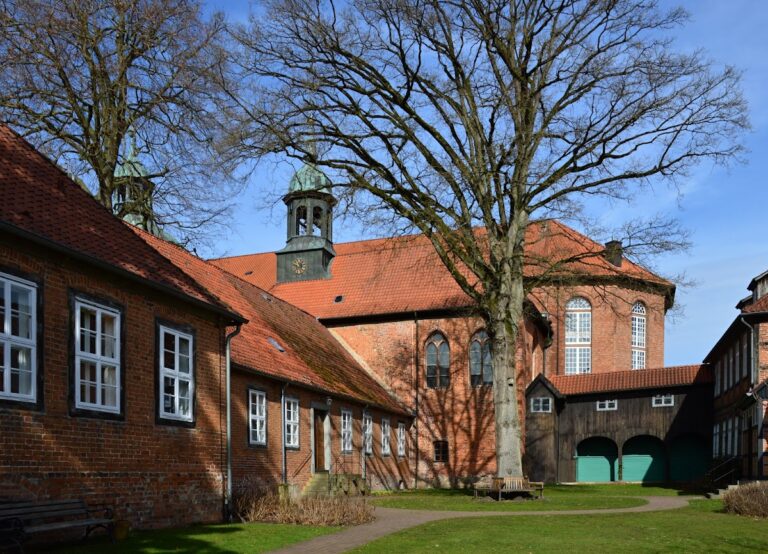
Ahlden House survives as a two-storey, three-winged timber-framed complex arranged in a horseshoe shape. The wings developed from 1549 onward and formerly enclosed an interior courtyard almost completely. Residential rooms occupied the complex alongside stables and coach houses. Brick forms part of the ground floor of the west wing, while the south wing contains brick infill between its timber framing.
Moats, rampart, and river setting
The castle was originally defended by a double water-filled moat and a rampart. The rampart was levelled in 1690 to make way for a formal French-style pleasure garden, organized around geometric layouts and controlled views. A section of the rampart survives to the north, while parts of the moat remain to the south and east. Other sections of the moats were filled during the nineteenth century.
The surrounding water landscape also changed. A flood in 1618 caused the Aller to shift eastward. After an embankment was constructed downstream, the Leine followed the former Aller channel past Ahlden. Since 1648, this channel, known as the Old Leine, has partly dried into an oxbow lake, so the house now stands beside the former river course rather than beside the active Aller.
Principal wings
South wing
The south wing is the oldest surviving part of the complex. It was completed in 1579 under Duke William the Younger of Brunswick-Lüneburg, a date preserved by an inscription on one of its beams. Its courtyard-facing side carries an elaborately decorated Renaissance facade, using the period’s architectural language of rich decorative treatment.
West wing
The west wing is the principal building. Duke Christian the Elder of Brunswick-Lüneburg commissioned it through his seneschal, Johann Behr, in 1613. Its ground floor is built of brick. Recesses for the former drawbridge remain visible in the entrance passage leading toward the courtyard. During construction, a roof beam became detached and seriously injured 14 workers.
North wing
The north wing is a two-storey timber-framed structure redesigned in 1705 by the architect Johann Caspar Borchmann after the building had fallen into disrepair. Sophia Dorothea occupied this wing during her confinement, giving the surviving structure its closest physical association with her years at Ahlden.
Entrance buildings and Bunkenburg
A detached gatehouse and entrance passage once controlled access to the house. The gatehouse appears as a separate building in a 1654 engraving by Merian and was probably demolished around 1800. Its former relationship with the entrance passage reflects the defensive organization of the earlier complex.
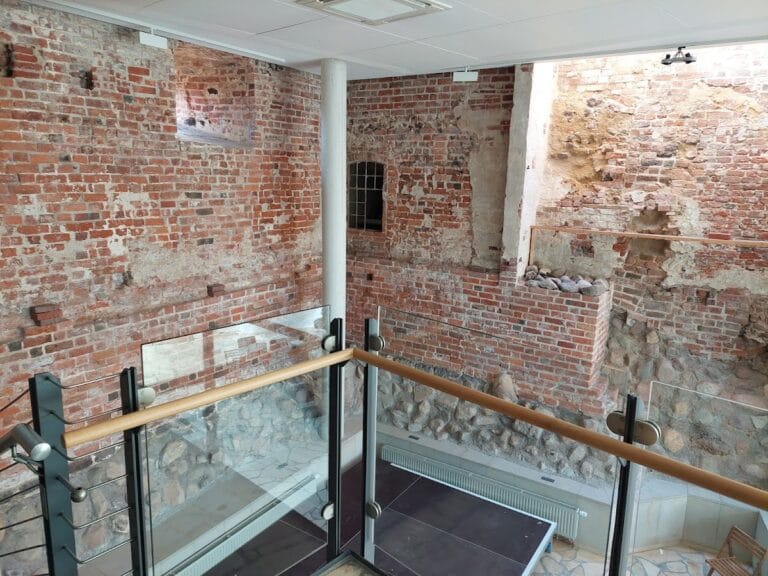
Across the former river setting, Bunkenburg occupied a low-lying area on the opposite bank. The predecessor fortification survives in ruins or partial remains, preserving a physical reminder of the earlier stronghold associated with the Lords of Ahlden.