Rikan Castle: A Japanese Mountain Fortress in Hyogo


Site at a Glance
- Rating
- 4
- Popularity
- Very Low
- Country
- Japan
- Primary era
- Early Modern
- External website
- Open
- Eras represented
- Early Modern
- Civilizations
- Tokugawa
- Site type
- Military
- Remains
- Castle
On this page8 sections
History
Rikan Castle is a Japanese mountain castle in Japan, founded in 1349 by Bessho Atsunori on Mount Rikan during the Nanboku-cho period, the fourteenth-century conflict between the Northern and Southern Imperial Courts. Built as a yamashiro, a castle whose defensive enclosures occupy a hill or mountain, it protected the northern flank of Shirahata Castle, the Akamatsu clan’s stronghold. The castle remained in use through the Sengoku period, the later age of prolonged warfare among regional military powers.
Foundation and Akamatsu control
Rikan Castle overlooked Hirafuku-juku, a prosperous post town on the Inaba Kaido. This highway linked Kyoto and Osaka with Inaba Province, giving the castle a position above an important route. Hirafuku’s association with morning mist also gave Rikan Castle the name Cloud-Piercing Castle. It was additionally known as Hirafuku Castle.
Bessho Atsunori belonged to the Bessho branch of the Akamatsu military house. In 1441, the Kakitsu Incident brought the defeat and temporary destruction of the Akamatsu and Bessho clans by the Yamana clan, which received support from the Ashikaga shogunate. Bessho Harusada recovered Rikan Castle in 1466, restoring the family’s control during a period of renewed military competition.
Warfare and changing lordship
During the conflicts connected with Hashiba Hideyoshi’s campaigns in western Japan, control of the castle moved away from the Bessho family. Hashiba Hideyoshi, later known as Toyotomi Hideyoshi, was a leading commander under Oda Nobunaga who extended Oda authority across western Japan. In 1578, Rikan Castle fell to Amago Katsuhisa and Yamanaka Yukimori, commanders aligned with Nobunaga.
Later that year, the Mori clan captured Kozuki Castle, and Rikan Castle then passed to the Ukita family. The Ukita family retained it until 1600. It subsequently came under Toyotomi authority and fought for the Western Army at the Battle of Sekigahara, the decisive conflict in which Tokugawa Ieyasu defeated the forces opposing his rise. After the Western Army’s defeat, the victorious Tokugawa regime confiscated the Ukita lands.
Ikeda reconstruction and dismantling
Following Sekigahara, Tokugawa Ieyasu awarded Harima Province, including Rikan Castle, to Ikeda Terumasa. In 1601, Terumasa granted his nephew Ikeda Yoshiyuki estates producing 22,000 koku, a unit used to express a domain’s assessed agricultural yield, and established a cadet branch of the Ikeda family at Hirafuku.
Yoshiyuki carried out a major renovation over five years. The work gave the castle stone-faced enclosures, connecting corridors, and a large three-story main tower called a tenshu. He also established a lord’s residence at the foot of the hill, a castle town, and a merchants’ district along the highway.
Ikeda Terumasa is said to have been alarmed by the renovated castle’s magnificence. Fearing that it might arouse suspicion from the Tokugawa shogunate, he ordered the tenshu dismantled. Yoshiyuki was transferred to Shimotsui Castle in Bizen Province in 1609. By then, the three-story tower and other principal buildings had been demolished.
Hirafuku Domain and abandonment
In 1615, Ikeda Terumasa’s sixth son, Ikeda Teruoki, received a 25,000-koku domain and established Hirafuku Domain at Rikan Castle. In 1631, after inheriting Ako Domain when his brother died without an heir, Teruoki moved his seat to Ako Castle. Hirafuku Domain was then abolished, and Rikan Castle was abandoned.
After abandonment, the area became territory administered directly on behalf of the Tokugawa government by a Matsudaira-clan retainer. A jinya, a smaller administrative residence or headquarters, was established in part of the post town. The ruins were designated a National Historic Site of Japan in 2017. Restoration and maintenance, including work to stabilize the stone walls, had begun in 2015 because their poor condition created a risk of collapse.
Remains
Castle on Mount Rikan
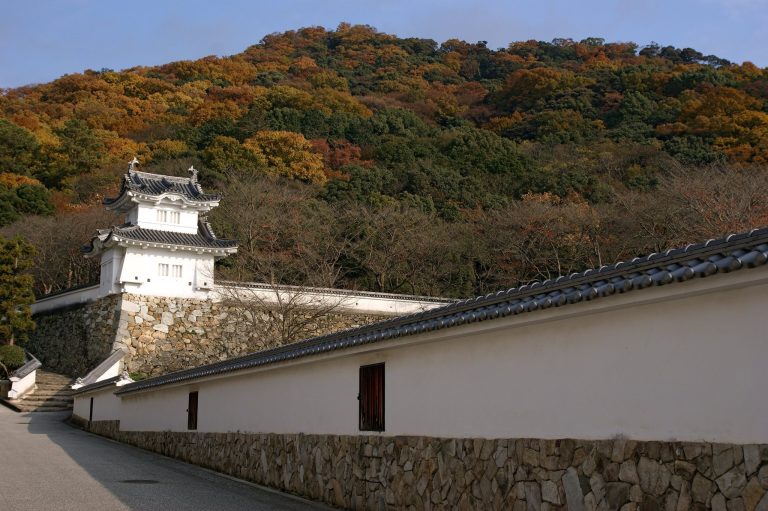
Rikan Castle occupied the summit of 373-meter Mount Rikan northeast of Hirafuku-juku. Its connected-line plan arranged successive defensive enclosures along the mountain slope and ridge. The Honmaru, the principal bailey, stood at the highest point. The Ninomaru, a secondary bailey, lay to its south, with the Baba, an area associated with horse riding, farther down in the same direction. The Karasu-maru extended to the northeast, while the Osaka-maru lay west of the Honmaru. The Sannomaru occupied a much lower position on the western side.
The renovated castle had stone walls around all of its enclosures, with corridors linking the defensive areas. Surviving remains include these stone walls, the enclosures, and dry moats. The walls are in poor condition and face the danger of collapse. The large three-story tenshu no longer survives, but its foundation stones remain among the archaeological evidence of the rebuilt castle.
Foot settlement and residence
At the foot of the hill, the former palace-residence area contains foundation stones and traces of post-built structures. Moat remains, roof tiles, ceramics, and other domestic artifacts have also been found there. Together, these remains represent the residential and administrative area associated with the castle below the mountain enclosures, as well as the material life of the lord’s establishment at Hirafuku.