Our Lady of Perpetual Help Church in Winda: A Brick Gothic Parish Church


Site at a Glance
- Rating
- 4.3
- Popularity
- Very Low
- Country
- Poland
- Primary era
- Medieval
- Eras represented
- Medieval, Modern
- Civilizations
- Crusader, German, Teutonic Order
- Site type
- Religious
- Remains
- Church
On this page12 sections
History
Our Lady of Perpetual Help Church in Winda, Poland, is a Roman Catholic parish church whose present Brick Gothic building dates from the first half of the fifteenth century. The church was founded in the former Wenden during the pre-Reformation period, traditionally at the end of the fourteenth century, and the existing structure probably replaced an earlier wooden church.
From Wenden church to Lutheran parish
The sixteenth-century Reformation, a religious movement that brought large parts of Europe into Protestant traditions, led to the church becoming Lutheran. Until 1945, it served the Evangelical parish of Wenden within the Rastenburg church district of the East Prussian ecclesiastical province of the Church of the Old Prussian Union. This was the Protestant organization formed in the Prussian territories through the union of Lutheran and Reformed congregations.
In 1925, the parish had 1,930 members spread across a district containing more than 20 villages, settlements, and residential places. Patronage belonged to the owners of the Elisenthal and Wenden estates, who held responsibility for the church’s formal patronage.
The parish’s Evangelical pastors before 1945 included an unidentified pastor recorded in 1557, Michael Pauli from 1567 to 1579, Andreas Graß in 1619, Michael Bernhardi the Elder from 1624 to 1659, Michael Bernhardi the Younger from 1659 to 1698, and Christian Bernhardi from 1694 to 1705. Later pastors were Johann Schwartz, Johann Heinrich Saft, Carl Friedrich Natius, Carl Christian Suchland, Christian Fr. Suchland, Theodor Leopold Henne, August Heinrich Hildebrandt, Christoph Wilhelm Kuhnke, Friedrich Samuel Richter, Joh. Gottlieb Mallettke, Kurt Raeder, and Herbert Degenhardt. Their recorded periods of service extend from 1711 through Degenhardt’s ministry from 1929 to 1945.
Records of the former Wenden parish are preserved at the Evangelical Central Archive in Berlin-Kreuzberg. They include baptismal registers from 1659 to 1944, marriage registers from 1681 to 1752 and from 1765 to 1944, burial registers from 1766 to 1944, confirmation registers from 1917 to 1944, and communicant registers covering 1719 to 1731, 1765 to 1775, and 1833 to 1865.
Postwar Catholic parish
The Evangelical congregation ended as local inhabitants fled or were expelled between 1945 and 1950. Evangelical residents who now live in the area belong to the congregation in Barciany, a filial congregation of the parish in Kętrzyn within the Masuria Diocese of the Evangelical-Augsburg Church in Poland.
Before 1945, the relatively small Catholic population of the Wenden area attended the church in Rastenburg, in the Diocese of Warmia. The settlement of Polish newcomers after 1945 greatly increased the Catholic population, and a Catholic parish was established at Winda in 1946. The church was then converted to Catholic worship, thoroughly restored, and substantially altered internally to meet Catholic liturgical practices. It was dedicated to Our Lady of Perpetual Help.
The church is now a Roman Catholic parish church in the Warmian-Masurian Voivodeship. It belongs to the Kętrzyn II, or Northeast, deanery of the Archdiocese of Warmia and has a filial church at Podławki.
Remains
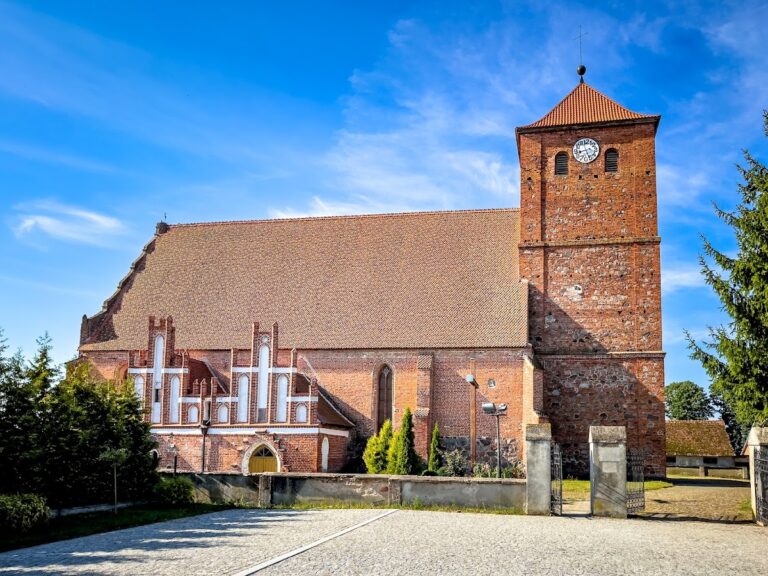
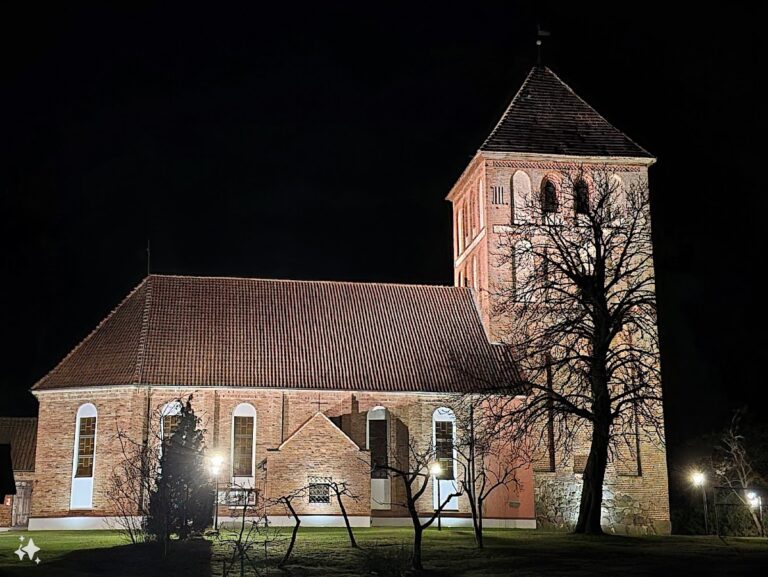
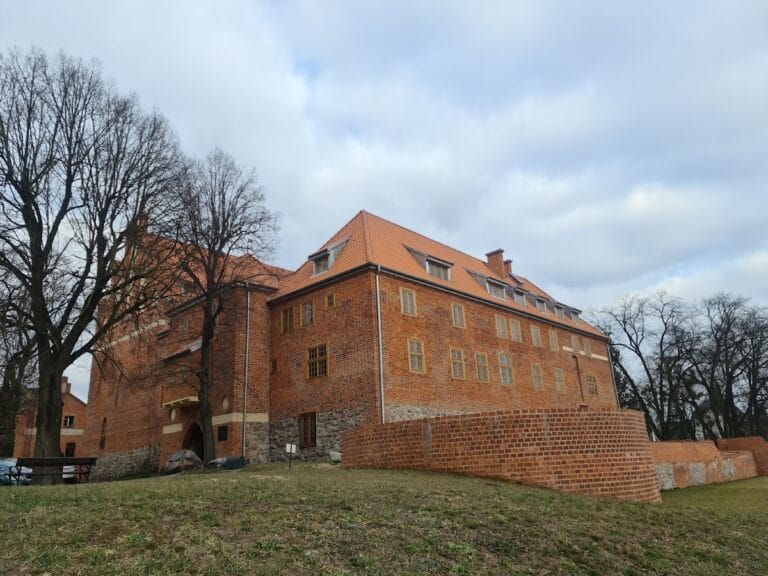
The church is a brick structure standing on a fieldstone foundation and follows the Brick Gothic tradition. Its exterior is marked by prominent gables, while its interior preserves architectural and furnishing elements from several periods, including changes made after its conversion to Catholic use.
Exterior and tower
Brick church and eastern gable
The eastern free-standing stepped gable rises in red brick, with its sloping edges arranged in successive steps. Ascending and descending blind arcading, decorative arches applied to the wall without open passages, animates the gable. White-plastered niches provide a contrasting surface within the red-brick composition.
Western tower
A massive western tower was added in 1834 after a wooden tower was destroyed by a violent storm on 17 January 1818. The replacement retains a recessed octagonal upper story, which is capped by a pointed roof with a flared profile.
Interior architecture and furnishings
Vault and galleries
A barrel vault was inserted into the interior around 1800. Beneath it are notably deep side galleries, which form a major part of the church’s internal arrangement.
Pulpit altar
The sparsely decorated pulpit altar dates from around 1740 and incorporates the earlier altar of 1726. A pulpit altar combines the pulpit and altar in one vertically organized structure, a form associated particularly with some Protestant churches. The composition is strictly architectural. A figural crowning element stood above the upper section, which was flanked by one figure on each side.
Baptismal furnishings and epitaph
Interior furnishings generally date from the beginning of the eighteenth century. They included a brass baptismal bowl and a suspended baptismal angel made by an unidentified artist. The church also contained an epitaph for Carl Friedrich Naze, who died in 1746. An epitaph is a commemorative monument or inscription honoring a deceased person, often placed inside a church.
Organ and bells
An organ was installed between 1766 and 1768 by Johann Christoph Unger, whose recorded dates are approximately 1740 to 1766. The instrument was enlarged in 1883. The church’s bell set consisted of three bells cast in 1821, 1835, and 1878.
After the building became a Catholic church, its interior furnishings were extensively modified. These changes adapted the existing interior to the liturgical practices of its new congregation while leaving a building that reflects its medieval foundation, later Protestant use, and postwar Catholic history.