Vraćevšnica Monastery: A Serbian Orthodox Monastery in Serbia


Site at a Glance
- Rating
- 4.9
- Popularity
- Low
- Country
- Serbia
- Primary era
- Early Modern
- External website
- Open
- Eras represented
- Medieval, Early Modern, Modern
- Civilizations
- Ottoman, Serbian
- Site type
- Religious
- Remains
- Monastery
On this page10 sections
History
Vraćevšnica Monastery is a Serbian Orthodox monastery in Vraćevšnica, Serbia, founded by the medieval Serbian nobleman Radič Postupović in the early fifteenth century. Its foundation is generally dated to 1428–1429 or 1431, while another tradition places construction before 1428. The church is dedicated to Saint George, a Christian martyr widely venerated in Eastern Orthodox Christianity, and the monastery belongs to the Eparchy of Žiča, the Serbian Orthodox diocesan jurisdiction responsible for this area.
Foundation in the Serbian Despotate
Radič Postupović was a high-ranking noble and court officeholder who served Stefan Lazarević and his successor, Đurađ Branković, the rulers known as the Serbian despots. He was the son of the voivode Milutin of Gruža, had been raised at the court of Prince Lazar, and was associated with Lazar’s son Stefan. The early fresco cycle in the church was completed in 1431, soon after the monastery’s foundation.
The foundation tradition connects the monastery with the Battle of Kosovo, the 1389 conflict between Serbian-led forces and the Ottoman army that became a central event in Serbian historical tradition. Radič was said to have fought there at the age of seventeen and vowed to establish a monastery dedicated to Saint George if he survived. The monastery and neighboring village were traditionally understood to commemorate the return of local men alive from the battle.
Ottoman-period destruction and rebuilding
Following the Ottoman conquest, Vraćevšnica was damaged and abandoned. Sixteenth-century Ottoman registers of the Smederevo Sanjak indicate this interruption in the monastery’s life. Before 1579, the complex was restored through the efforts of Diomidije, Metropolitan of Rudnik. A further destruction took place in 1682, after which the monastery was completely rebuilt in 1737 under Abbot Mihailo, with the approval of Valjevo Bishop Dositej Nikolajević.
The rebuilding of 1737 repaired the church and replaced damaged earlier wall paintings with new frescoes. Another Ottoman incursion in 1739 briefly interrupted monastic life, but monks returned several years later. The eighteenth-century rebuilding established much of the form of the church and complex that later restorations would preserve and modify.
The monastery during the Serbian uprisings
In the early nineteenth century, Vraćevšnica became a political center during the First and Second Serbian Uprisings, the major Serbian revolts against Ottoman rule that began in 1804 and 1815. In 1805, monks from Studenica brought the relics of Saint Simeon to the monastery. They remained there until 1813, when they were transferred to Fenek Monastery.
On 17 September 1810, Karađorđe, Milan Obrenović, Spiridon Filipović, and Dositej Obradović met at Vraćevšnica to discuss continuing the uprising. An assembly was held there on the Feast of the Dormition in 1812. Karađorđe also read the Treaty of Bucharest at the monastery, the agreement that ended the Russo-Turkish War of 1806–1812. An envoy of Tsar Alexander I attended, and Russian medals were awarded to Serbian fighters.
Vraćevšnica was also connected with the beginning of the Second Serbian Uprising. On Palm Sunday, 11 April 1815, Melentije Pavlović celebrated the liturgy and gave communion to Prince Miloš Obrenović and the insurgents. They then crossed the mountain toward Takovo and initiated the uprising. Melentije later took part in the Battle of Ljubić on 6 June 1815, organizing an attack on Ottoman troops after the death of the commander Tanasko Rajić.
In spring 1818, Prince Miloš convened a national assembly at Vraćevšnica. The assembly decided that Kragujevac would become the capital of the Principality of Serbia. That same year, Archimandrite Melentije Pavlović purchased a copy of Vuk’s Serbian Dictionary. The monastery’s intellectual and political associations continued in the following decades. Archimandrite Gavril Popović published Conversations for the Education of the Heart and Soul in Belgrade in 1845.
Nineteenth-century reconstruction and cultural life
A residence building was rebuilt in 1834. Further restoration took place in 1841–1842 under the supervision of Nastas Stefanović, when a bell tower was added above the narthex, the entrance vestibule of the church. The tower later collapsed and damaged the church. Prince Miloš financed repairs in 1860, and an inscription on the western side commemorated his mother, Višnja Obrenović.
A new residence was constructed in 1868–1870. Prince Mihailo Obrenović initiated the work, it was completed during the reign of Prince Milan, and Abbot Vikentije Krasojević directed the effort. Much of the monastery’s present appearance derives from Prince Miloš’s work in 1860. The painter Đura Jakšić spent summer holidays at Vraćevšnica while serving as a guest teacher at the Kragujevac Gymnasium. During his stays, he painted several historical portraits and donated them to the monastic brotherhood.
Višnja Obrenović was buried in the monastery courtyard, where a monument was erected in 1901. A record published in 1889 described the monastery’s property as 144 hectares of arable land and 321 hectares of forest. These holdings formed part of the material setting of the monastery before the severe disruptions of the twentieth century.
Twentieth-century changes and protection
After the May Coup of 1903, the Serbian coup in which King Alexander Obrenović and Queen Draga were killed at the Old Palace, Abbot Mihailo Urošević acquired the royal salon of King Alexander in Belgrade. He brought its bloodstained curtains and carpet to Vraćevšnica, where they remained for approximately nine decades. In 1995, the objects were donated to the Museum of the Rudnik-Takovo Region.
A fire on 26 November 1920 destroyed the Miloš residence and many monastery valuables, including paintings by Đura Jakšić. Joakim Milošević built a replacement residence in 1921, and its original appearance was restored in 1966. The monastery fell into debt after 1923. An earthquake cracked its walls in 1928, and repairs were needed in 1934, although available funds were insufficient despite contributions from the king and the administrative authorities of the banovina.
Vraćevšnica became a women’s monastery in 1935. The nuns improved the previously run-down property, which had been inventoried because of tax debt, and became known for producing high-quality honey. Abbesses associated with the monastery include Ana Adžić, who served from 1900 to 1975, Marija Mladenović from 1975 to 1980, Stefanija Vukas from 1980 to 1986, and Evdokija Šutić from 1996 to 2014.
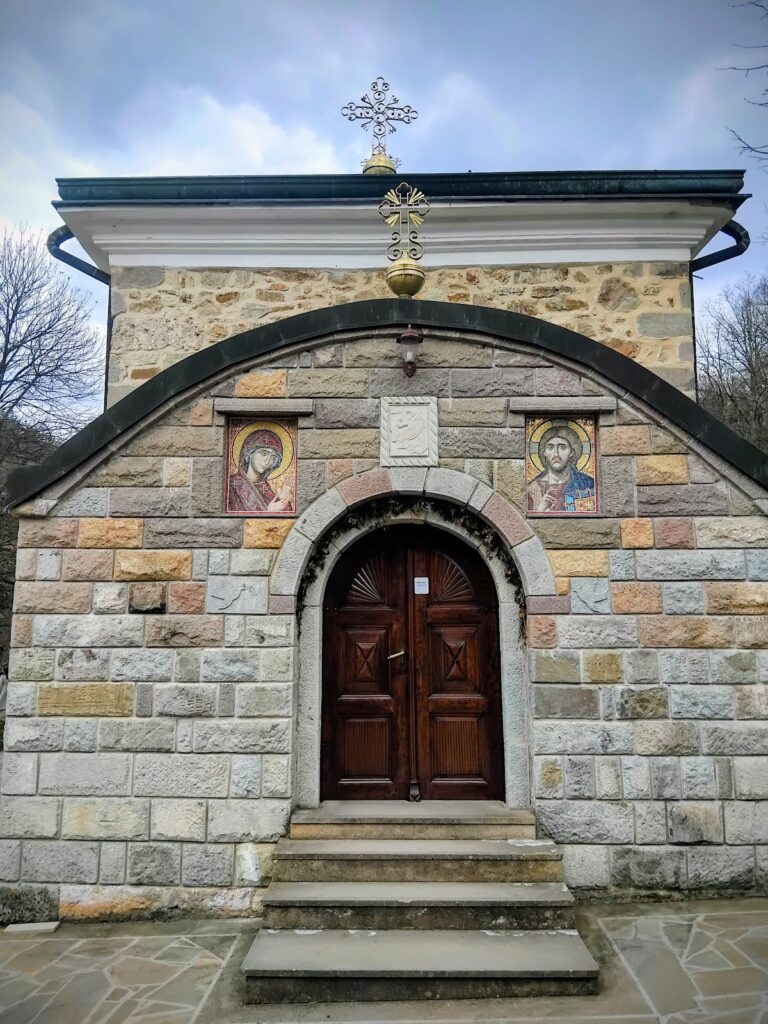
In 1978, a building was constructed on the western side of the complex for the treasury, with a winter chapel on its upper floor. The chapel was frescoed by Žarko Vučković, a painter and university professor from Gornji Milanovac. Vraćevšnica is protected as a cultural monument of great importance in Serbia and is owned by the Serbian Orthodox Church.
Remains
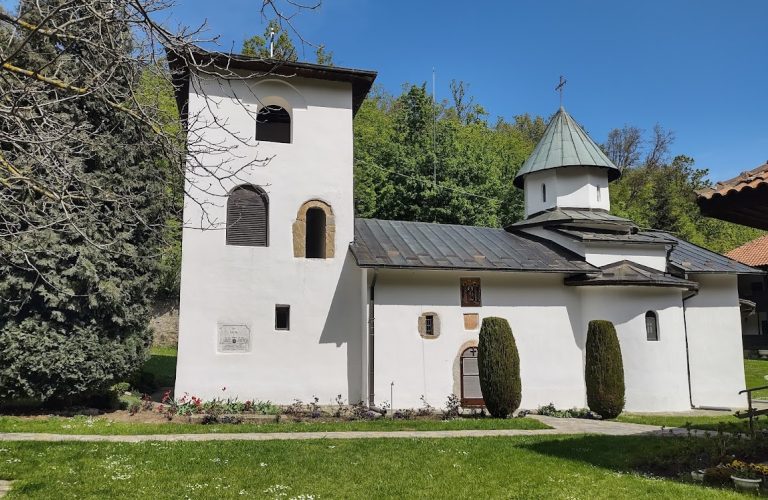
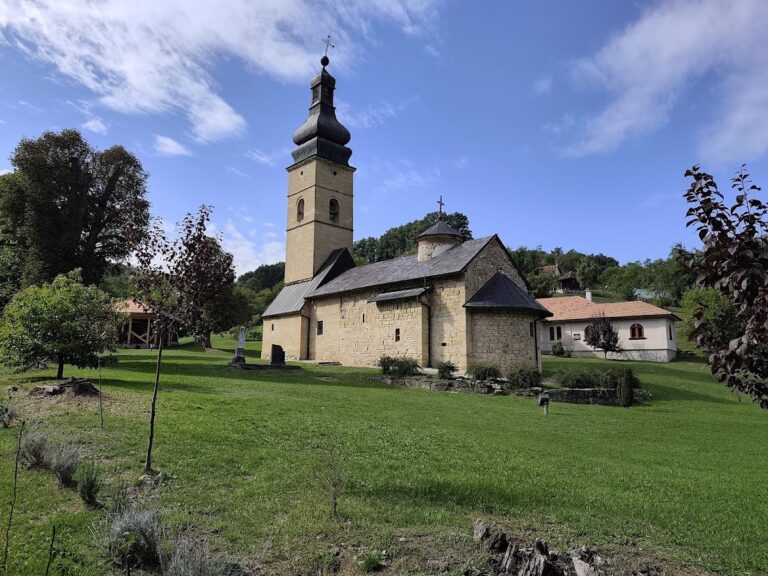
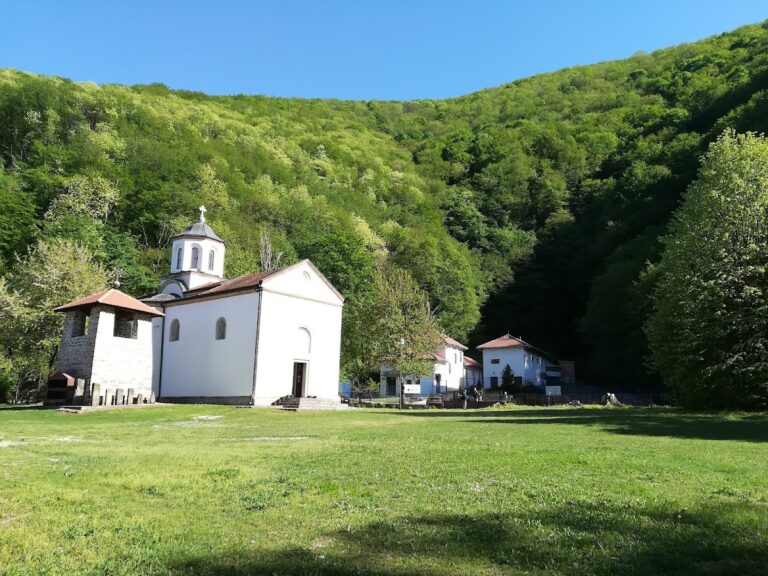
Vraćevšnica lies on the slopes of Mount Rudnik in the valley of the Vraćevšnička River, near the village of the same name. The complex consists of the Church of Saint George, monastery residences, an entrance tower, the later treasury and winter-chapel building, and the monument marking Višnja Obrenović’s burial place. The church follows the Raška architectural tradition, a medieval Serbian church-building style characterized by single-nave plans, vaulted interiors, and prominent altar apses.
Church of Saint George
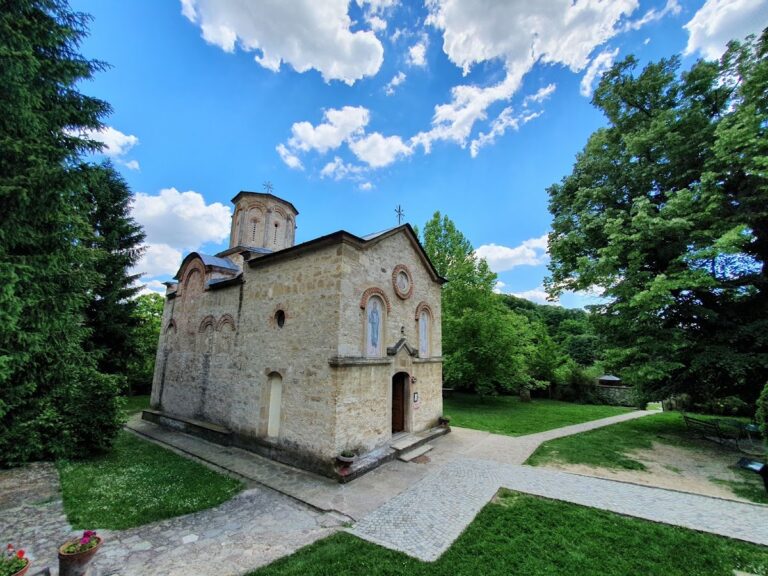
The church is a single-nave building with an almost regular rectangular plan. Its altar apse is semicircular inside and five-sided on the exterior, with a half-dome vault, while the nave is covered by a barrel vault. A narthex occupies the opposite end and is surmounted by a high octagonal structure. The church’s form and dimensions have been compared with the largely ruined church of Ješevac Monastery.
Yellowish sandstone faces the exterior. Blind semicircular arcades, decorative arches that do not open into the interior, and pilasters set on molded consoles divide the façades vertically. A dentil frieze, a band of small tooth-like blocks, runs horizontally beneath the roof eaves. The church’s 1737 frescoes were painted by artists working under Andrej Andrejević. They cover the interior, including the vaults, the half-dome over the apse, the choir area, and the narthex.
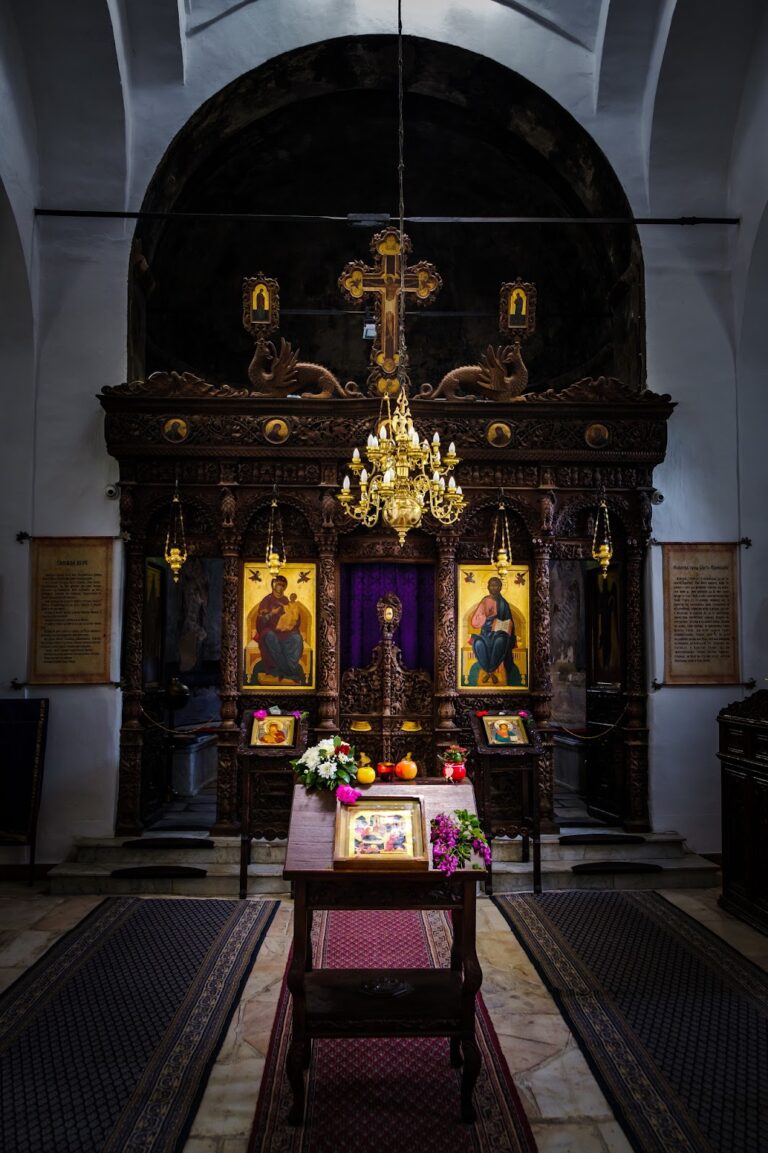
The iconostasis, the screen separating the sanctuary from the nave, dates from 1622. It contains thirty icons painted by artists from the eighteenth and nineteenth centuries. The identified painter Stavros worked in 1754 on the upper icon of the Mother of God.
Residences and monastery buildings
Monastery residences extend along the southern side of the church. The entrance gate is surmounted by a tower, forming a distinct vertical element of the complex. The residence rebuilt after the 1920 fire was constructed in 1921, and its original appearance was restored in 1966. On the western side, the 1978 treasury building includes a winter chapel on the upper floor. Its interior frescoes were painted by Žarko Vučković.
The courtyard also contains the monument marking Višnja Obrenović’s burial place. Together with the residences, entrance tower, church, and later treasury building, it forms part of the surviving arrangement of the monastery complex.
Treasury and surviving objects
The treasury contains icons and furnishings associated with the Obrenović family. Among them is a portrait of Prince Miloš painted by Đura Jakšić and a copper engraving plate showing the monastery as it appeared in the eighteenth century. These objects connect the monastery’s religious collection with the political and cultural history of nineteenth-century Serbia.
The former Old Palace curtain is made of burgundy wool with a linen drapery lining, burgundy edging, and tassel-like fringes fastened with metallic thread. Traces of blood remain visible on the fabric. The rectangular carpet measures 123 by 183 centimeters and bears geometric and floral ornament, with flowers in several shades as its dominant motif. Both objects are preserved in the permanent exhibition Gifts and Acquisitions: The Age of the Obrenović Dynasty at the Museum of the Rudnik-Takovo Region.
Nearby sites