Volkenroda Abbey: A Former Cistercian Monastery in Germany
Site at a Glance
- Rating
- 4.7
- Popularity
- Low
- Country
- Germany
- Primary era
- Medieval
- External website
- Open
- Eras represented
- Medieval, Early Modern, Modern
- Civilizations
- German, Holy Roman Empire
- Site type
- Religious
- Remains
- Fortified Monastery
On this page11 sections
History
Volkenroda Abbey is a former Cistercian abbey in Germany, founded in 1131 at Volkenroda, now part of the municipality of Körner in Thuringia. Cistercian monks from Altenkamp, a daughter house of Kamp, established it on the foundations of a former palatine castle, a fortified residence or administrative centre connected with a ruler or imperial court. The abbey was affiliated with Morimond, one of the order’s primary houses, and became an important centre of Cistercian expansion and settlement in Thuringia.
Foundation and expansion
A document traditionally dated to 1130 names Ulricus de Schunenburg as a witness and is associated with Countess Helinburg of Gleichen. The abbey church was consecrated during the twelfth or thirteenth century, although its precise date is uncertain. The new monastery received substantial land at its foundation and developed agricultural enterprises. Its income also came from privileges and indulgence grants. An indulgence was a remission of temporal punishment associated with sin in Catholic theology, and such grants could attract pilgrims and donations. These revenues enabled Volkenroda to buy additional land, including a free farm in Mühlhausen whose privileges exempted the abbey from tolls at the city’s boundaries and gates.
Volkenroda eventually became one of the richest and most prestigious monasteries in Thuringia. It helped extend the Cistercian network through the foundation of daughter houses at Waldsassen in 1133, Reifenstein in 1162, Loccum in 1163, and Dobrilugk in Lower Lusatia in 1165. The abbey’s agricultural resources and institutional connections supported both religious expansion and the colonization of surrounding areas.
Fortification and late medieval decline
During the Thuringian War of Succession, a conflict that lasted from 1247 to 1264 over the political future of the region, the abbot ordered a ring wall with towers and gates to be built around the complex. Mercenaries were hired to defend it. By the late fifteenth century, the community comprised approximately 60 monks and 100 lay brothers. Lay brothers were members of a monastic community who generally undertook agricultural, craft, and other practical work rather than following the full clerical routine of choir monks.
The abbey’s wealth and authority later contributed to its difficulties. Abuse of power, weak abbatial policies, and the commendatory system helped bring about spiritual and material decline. Under that system, an abbey could be placed under the nominal authority of a commendatory abbot who held its office and revenues without residing in or directly governing the community.
The Peasants’ War and destruction
Tensions became acute in the years before the German Peasants’ War, a series of uprisings in German-speaking lands during 1524 and 1525 driven by social, economic, religious, and political grievances. In 1517, the abbot used Saxon ducal riflemen to arrest rebellious peasants in nearby villages. He intended to make an example of them through a public trial, but local indignation led to an initial assault on the abbey. The small force of soldiers barely repelled the attack, and the prisoners were released without judgment.
On the morning of 27 April 1525, about one hundred insurgent peasants from Mühlhausen attacked Volkenroda and partly destroyed it by fire. Local tradition holds that they destroyed the valuable library, numerous religious artworks, and the collection of relics. They emptied chests, storerooms, stables, and cellars, and seized the abbey’s nearby farms at Körner and Mehlra. The abbot reported damage of about 20,000 gulden to the Saxon duke on 5 May, but later surviving evidence placed the loss at approximately 7,500 gulden. Before the attack, monks had moved some supplies and important records, including lists of dues and taxes, to the ducal estate at Schwerstedt.
The assault reflected resentment of Volkenroda’s economic and judicial power. Local people objected to increasing dues, strict demands for payment during crop failures and livestock epidemics, the abbey’s commercial acquisitions in Mühlhausen, and its influence over agricultural prices. Its control of the fish trade and the sale of its own beer without effective oversight by secular courts also caused hostility. Allegations about immoral conduct by monks angered the clergy of Mühlhausen. Thomas Müntzer, the radical preacher and reformer associated with the Reformation and the Peasants’ War around Mühlhausen, is unlikely to have taken part directly at Volkenroda because the abbot and other monastic representatives did not mention him in their reports.
Reformation and dissolution
After the suppression of the revolt, some monks returned to Volkenroda. Others adopted Protestantism and became preachers or schoolteachers, while a smaller number moved to monasteries that had survived the first stages of the Reformation. The abbey was dissolved around 1540 after Duke Moritz of Saxony converted to Protestantism. Much of its property was acquired by the imperial city of Mühlhausen and leased as separate estates to nobles and patricians. The abbey grounds and forest remained under the Saxon princes.
The remaining residential buildings suffered further destruction in 1641 during the Thirty Years’ War, the European conflict of 1618 to 1648 that caused widespread military disruption in central German territories. The complex gradually decayed during the seventeenth and eighteenth centuries, and parts of the church were rebuilt in 1802. Following the political reorganization of the Weimar Republic, the former monastic buildings were used as dwellings.
Preservation and renewed religious life
The abbey church continued to serve as the village’s Protestant church until 1968, when structural decay forced its closure. By the early 1990s, only ruins and a few houses remained. Mühlhausen monument conservators began efforts to save the complex in 1990. The association Wiederaufbau Kloster Volkenroda was founded in 1993 to revive its monastic tradition, and in 1994 the ecumenically oriented Jesus-Bruderschaft from Gnadenthal took over the buildings, established a community, and began restoring them. The Jesus-Bruderschaft is a Protestant-founded Christian community whose members from different churches share a communal religious life.
In 2005, the Stiftung Kloster Volkenroda assumed ownership. Its purpose is to promote Christian belief and intellectual, social, economic, cultural, and civic life at the abbey. The restoration created an ecumenical community, a European Youth Education Centre, a guesthouse, and a cultural and educational centre. The Jesus-Bruderschaft maintains communal religious life for celibate brothers and sisters and families from different churches and denominations. Daily worship, Eucharistic celebrations, and periods of prayer continue at Volkenroda.
The renewed abbey also participates in wider pilgrimage and educational networks. Since 2002, the Loccum-Volkenroda pilgrimage route has connected the site with its former daughter house at Loccum. The Via Porta pilgrimage route, opened at Volkenroda on 2 May 2010, connects it with Waldsassen. During the 1990s, the abbey was designated a protected cultural-heritage site of European importance. Since 1994, the former monastic agricultural estate has also served as a school farm, while the community has promoted organic agriculture and ecological education.
Remains
The medieval church
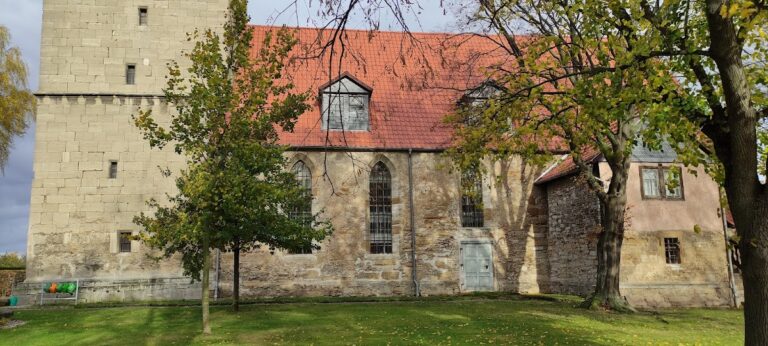
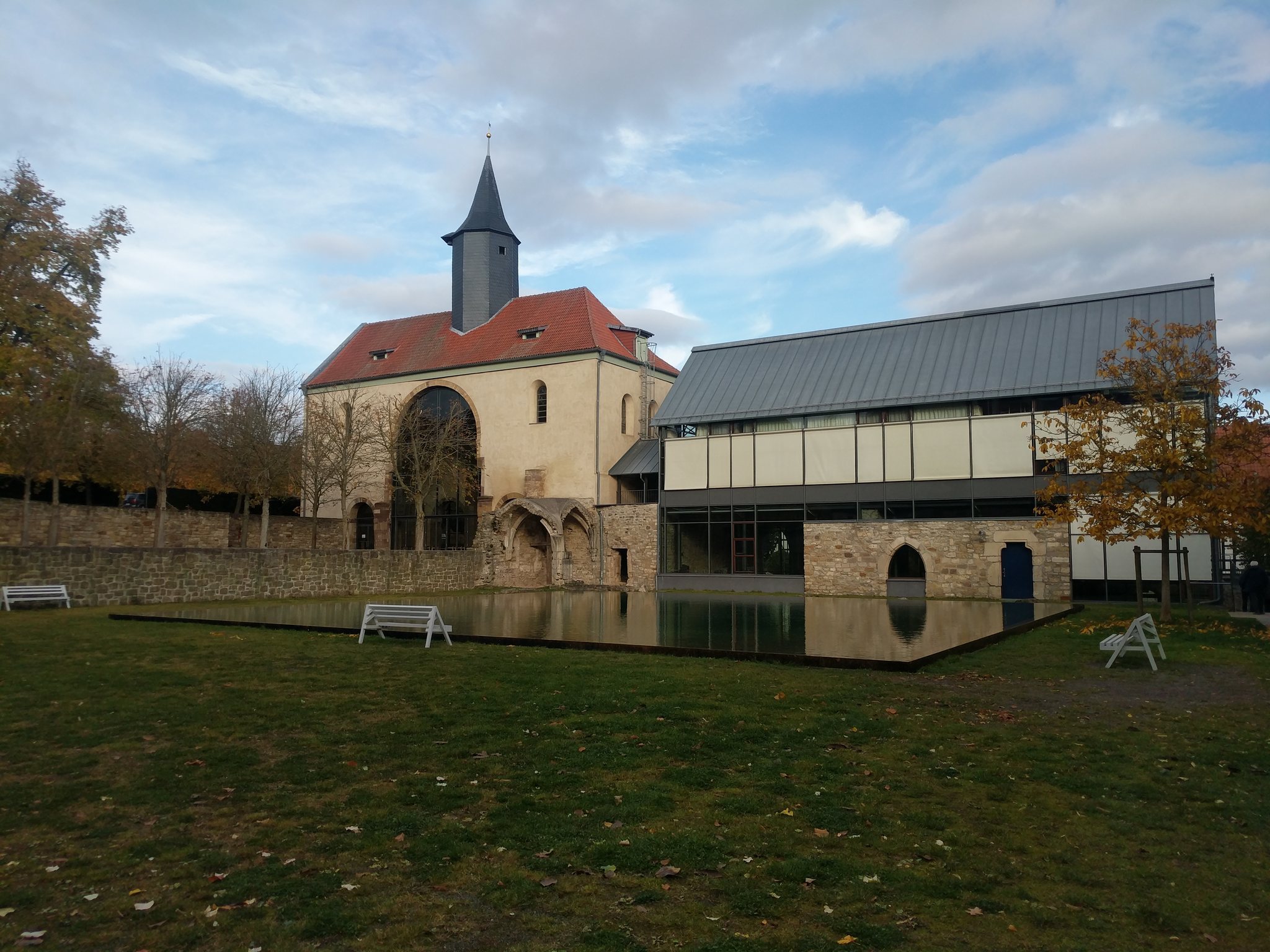
The historic complex includes the former abbey church, convent buildings, fortifications, a farmyard, and a granary. The church was a three-aisled basilica, but its surviving medieval fabric is concentrated in the choir and transept. Parts of the building were rebuilt in 1802, and its later closure reflected the severe deterioration of the structure. The choir and transept now form the principal surviving portions of the medieval church.
Fortifications
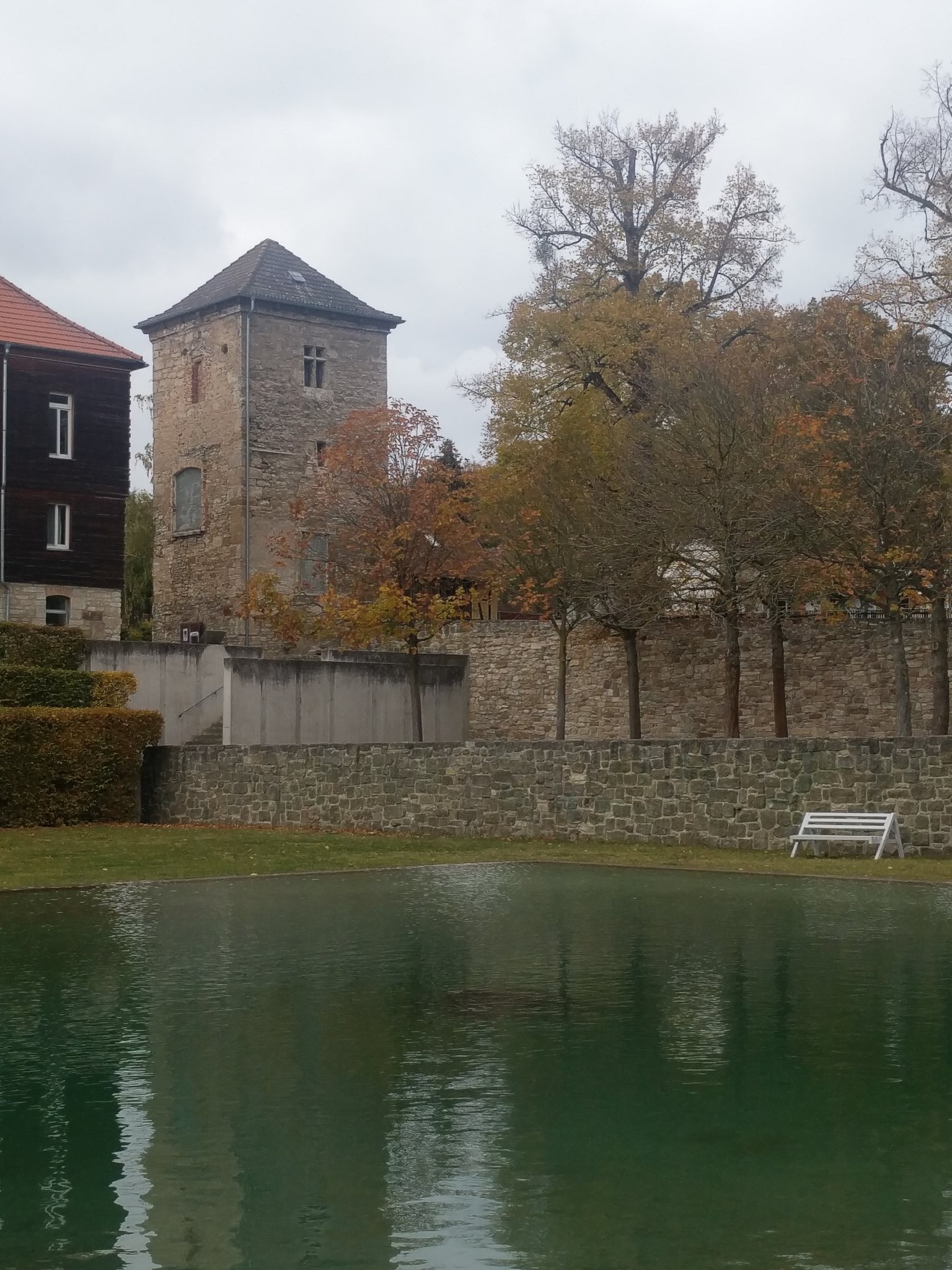
The monastic defenses formed a ring-shaped enclosure built of rubble stone, with towers and gates. They were constructed during the Thuringian War of Succession after the abbot ordered the complex fortified and arranged for mercenaries to defend it. A stone gate dated 1574 remains preserved. The surviving ring wall and gate tower were among the structures surveyed for visible damage in 1990 and included in a priority list for conservation. Emergency aid provided in 1991 was directed chiefly toward saving the church, the central focus of the restoration campaign.
Farmyard and granary
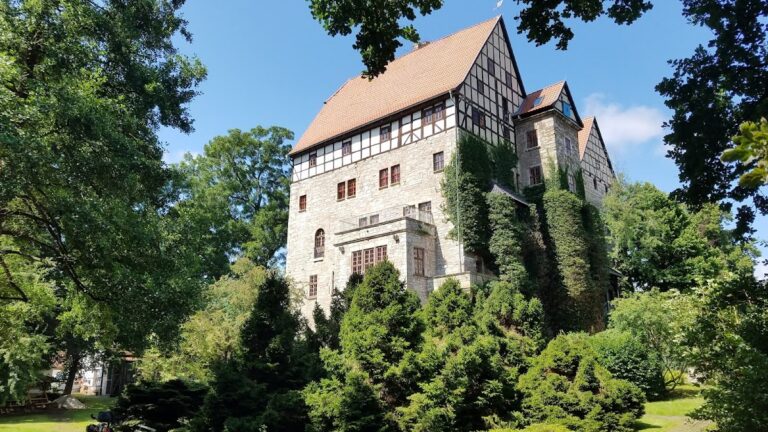
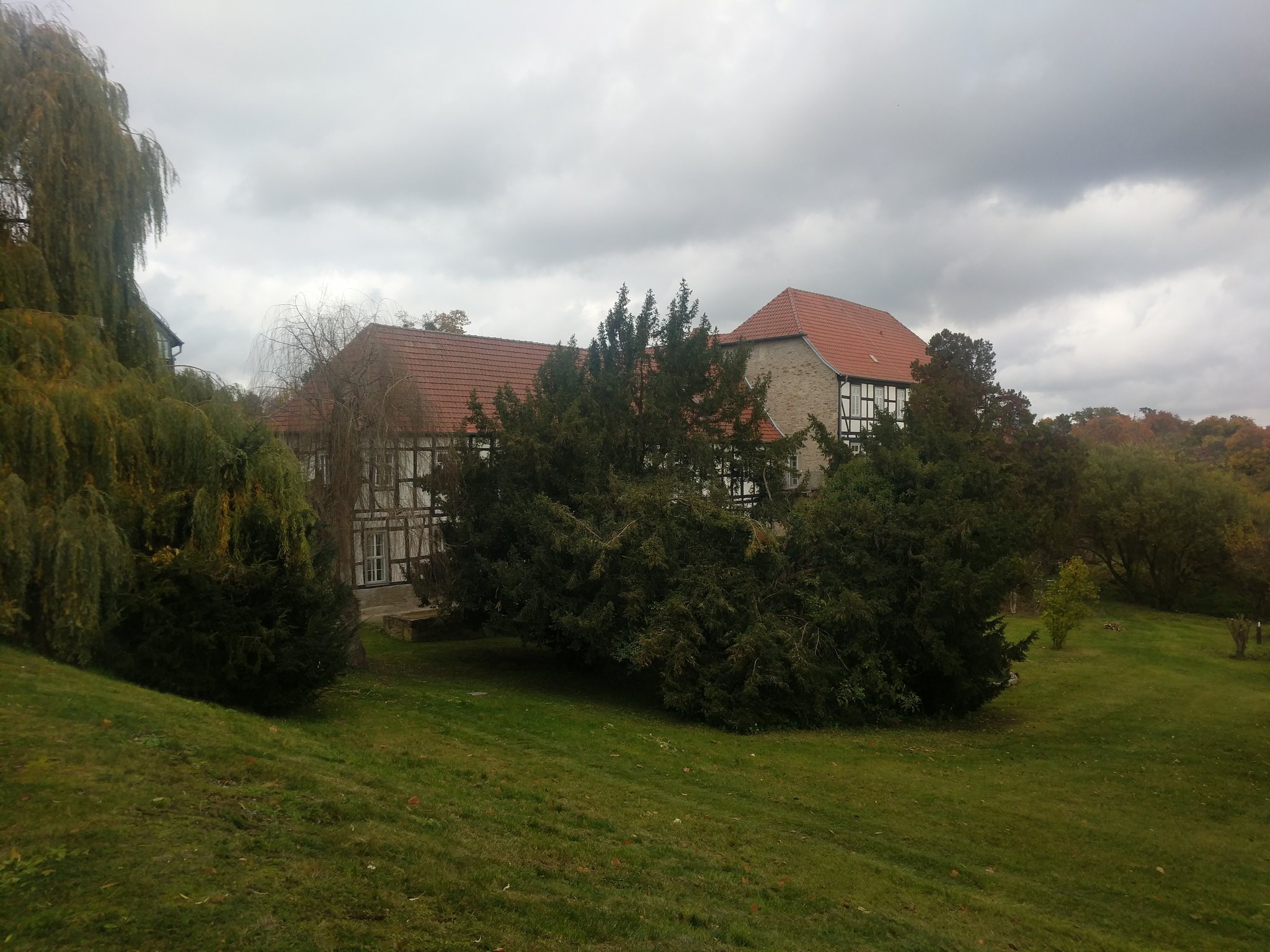
A half-timbered farmyard and a granary survive among the former monastic buildings. Their presence reflects the agricultural foundation of Volkenroda, whose medieval economy depended on extensive landholding and agricultural enterprises. The former monastic estate continues to be associated with farming through its later use as a school farm. Archaeological excavation and building research were initially deferred, even though clarification of the church’s construction history was intended. Restoration nevertheless secured and revived the surviving parts of the complex.
Christus-Pavilion
The vanished nave of the abbey church has been replaced functionally by the Christus-Pavilion. Built for Expo 2000 in Hanover, the ecumenical pavilion was dismantled after the exhibition and reconstructed at Volkenroda in 2001 on the former position of the nave. It now occupies the place once held by that part of the church and provides a setting for concerts, workshops, readings, open-air cinema, worship, and midday prayer. An annual summer concert weekend is also held there.