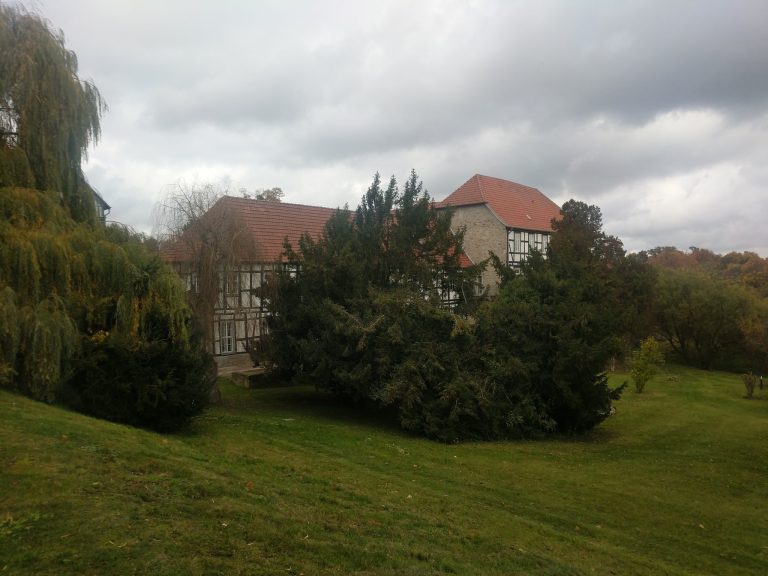
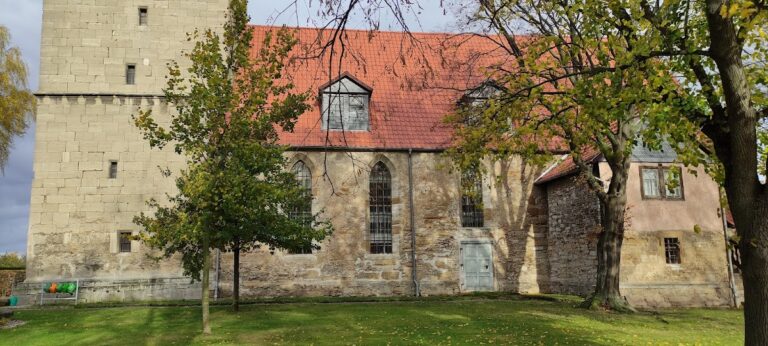
St. Petri, Mühlhausen/Thüringen: An Evangelical Parish Church in Germany


Site at a Glance
- Rating
- 4.5
- Popularity
- Very Low
- Country
- Germany
- Primary era
- Modern
- External website
- Open
- Eras represented
- Medieval, Early Modern, Modern
- Civilizations
- German, Holy Roman Empire, Teutonic Order
- Site type
- Religious
- Remains
- Church
On this page9 sections
History
St. Petri, Mühlhausen/Thüringen is an evangelical church in Germany whose origins traditionally date to 1250. It may have begun as a thanksgiving chapel beside an outer city wall after Mühlhausen’s victory over the Counts of Regenstein and Hohenstein. Evidence of a late Romanesque predecessor, an architectural tradition of thick walls and rounded arches, survives in parts of the building.
Medieval foundation and expansion
A plague cemetery was established around the church between 1348 and 1350. A wooden cemetery chapel beside St. Petri remained until the nineteenth century. At the request of residents of the Petriviertel, the German Order, a medieval Catholic religious and military order that administered churches and other properties, enlarged the church between 1352 and 1356. On 8 October 1356, Gerlach von Nassau, the Archbishop of Mainz, formally placed it back into service by document.
The German Order administered St. Petri as a filial church of St. Mary’s Church. After the Reformation, the sixteenth-century movement that led to the establishment of Protestant churches, St. Petri became an evangelical parish church.
Fire, rebuilding, and later alterations
A town fire in 1422 caused the church vault to collapse. The rebuilding used flat ceilings. In 1577, material from the demolished St. John’s Church was used for a two-storey extension on the west side, while the sacristy was heightened with a half-timbered tower.
Neo-Gothic redesign and modern history
Between 1893 and 1895, the entire church was redesigned in the Neo-Gothic style, the nineteenth-century revival of Gothic forms, to plans by the architect Gottfried Koethe. The double galleries were removed, the westwork, a substantial western entrance section often containing several levels or towers, was completely rebuilt, and the roof was repaired and finished with glazed coloured tiles. New choir windows followed in 1904.
St. Petri is a protected cultural monument in Thuringia. Its twentieth-century history also includes a First World War memorial in the north chapel. The work’s anti-war design was considered particularly courageous at the time, and the German artist and printmaker Käthe Kollwitz, known for socially engaged and anti-war works, praised it.
Remains
Plan and architectural fabric
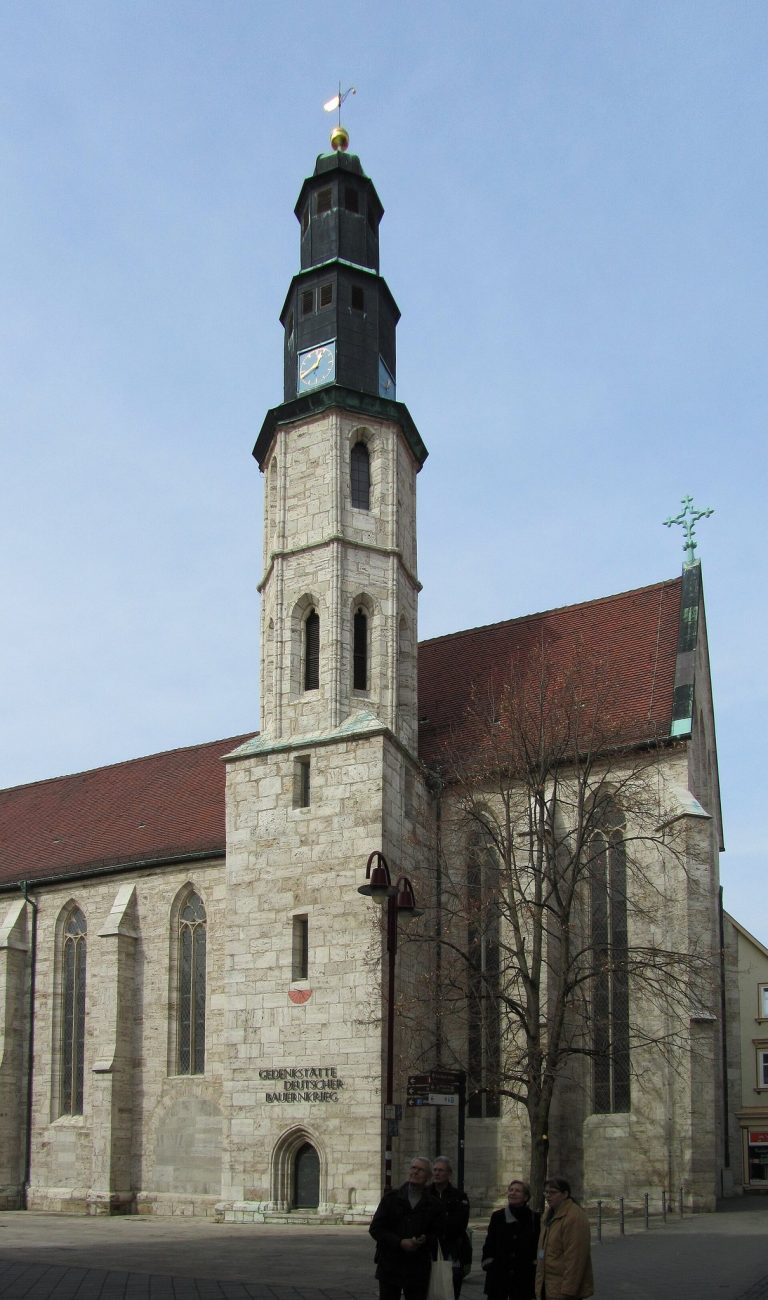
St. Petri is arranged as a three-aisled church. The north side preserves a Romanesque portal, an exterior wall that projects into the nave, and large windows in the north aisle, together indicating the earlier building phase. The west side contains the two-storey extension added in 1577. Above the sacristy rises a half-timbered tower with a distinctive needle-shaped spire.
The Neo-Gothic interior gives each aisle a different vaulted treatment. The central nave has a barrel vault with lunettes, transverse arches, and painted indications of ribs. The north aisle has groin vaults, formed by the intersection of two barrel vaults, while the south aisle has segmental transverse barrel vaults.
Altar, pulpit, and baptismal font
The Baroque altar and pulpit were made by the Ackermann carpentry workshop between 1746 and 1748. Figures of Peter and Paul flank the altar, which contains a representation of the Last Supper. Christ appears three times in the composition: as the Crucified on the altar table, as the institutor of the Last Supper at the centre, and as the Risen Christ in the crowning section. The altar was restored in 1980, when its side wings were removed to improve the interior’s overall appearance.
The baptismal font dates from 1352 to 1356 and is regarded as the oldest baptismal font in Mühlhausen.
Bells and organ
The oldest bell still in operation dates from 1482. After a 2.4-ton cast-iron bell fell in 2001, two new bronze bells were cast at the Lauchhammer bell foundry near Dresden. Examination led to the medieval bell frame being restored to its original operating form, and the tower now contains four bells.
The present Rühlmann organ dates from 1910 and replaced an instrument built for the church in 1713 by the Mühlhausen organ builder Christoph Wender. Its important Biedermeier case, an early nineteenth-century organ exterior associated with a restrained decorative style, dates from 1833 to 1834 and was made by the Schulze organ-building firm of Paulinzella, which temporarily maintained a branch in Mühlhausen. The organ includes couplers linking keyboards or a keyboard to the pedals, including II/I with a super-octave coupler, I/P, and II/P. It also has a swell pedal, register crescendo, piano pedal, and calcant, a device associated with operating an organ’s bellows. The instrument was extensively restored in 2009 and 2010.
First World War memorial
The north chapel contains a memorial created by the Mühlhausen sculptor Walter Krause. It depicts the “Outraged Christ” before a panel listing fallen soldiers, giving the chapel a specifically anti-war commemorative focus.