Vladimir Kremlin: The Fortified Medieval Core of Vladimir


Site at a Glance
- Rating
- 4.5
- Popularity
- Very Low
- Country
- Russia
- Primary era
- Medieval
- Eras represented
- Medieval
- Civilizations
- Golden Horde
- Site type
- Military
- Remains
- Citadel
On this page13 sections
History
Vladimir Kremlin is the former fortified central settlement of Vladimir, Russia, traditionally attributed to the Kievan prince Vladimir Monomakh in the early twelfth century. As a medieval East Slavic detinets, or fortified central enclosure, it formed the defensive, religious, administrative, and residential core of Vladimir-on-the-Klyazma. A Finno-Ugric settlement had occupied the site at the beginning of the Common Era.
Foundation and princely expansion
The most widely accepted interpretation places the foundation of the Kremlin in the early twelfth century, during the rule of Vladimir Monomakh, who was grand prince of Kiev. The settlement later expanded beyond the original fortress. The Vetshany Town to the east and the New Town to the west are attributed to Andrei Bogolyubsky, a major prince of Vladimir-Suzdal.
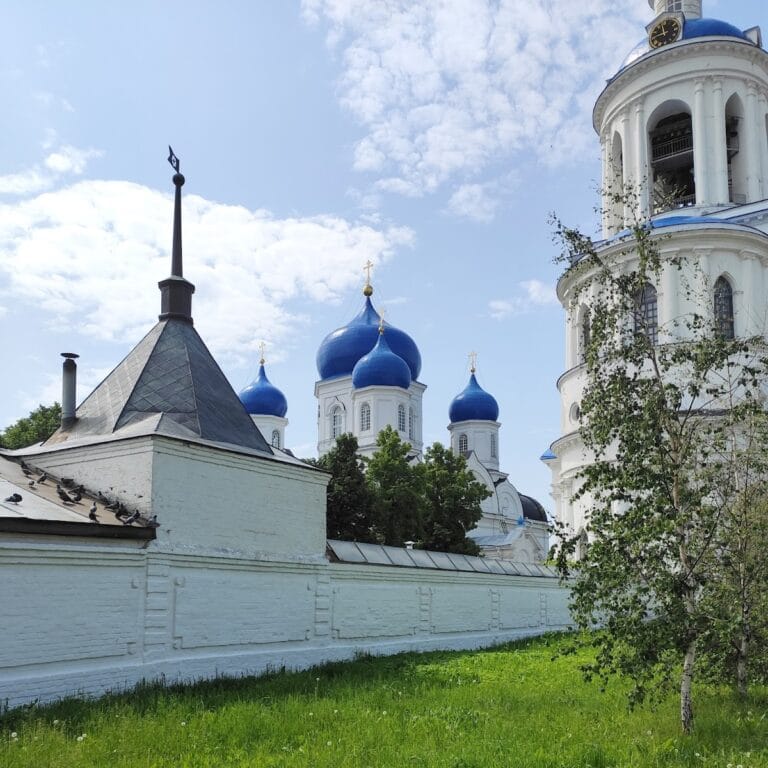
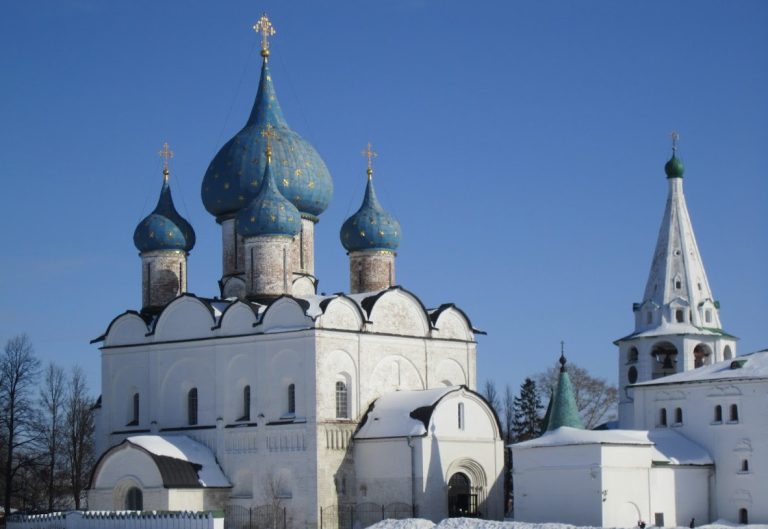
After Andrei Bogolyubsky’s death, Vladimir endured a seven-week siege by Yaropolk and Mstislav Rostislavich, both Rurikid princes. In 1185, an almost total fire damaged the city. Vsevolod Big Nest, Andrei’s successor and a prominent ruler of Vladimir, restored the capital and founded the Nativity of the Virgin Monastery in the southeastern part of the Kremlin.
Mongol conquest and later attacks
A Mongol army captured Vladimir in 1238 during Batu’s invasion of the Rus lands, a thirteenth-century campaign that devastated numerous principalities. After the conquest, the Kremlin was enlarged to correspond with the entire Pecherny Town, also known as the Monomakh or Middle Town. Its fortifications were renewed, while the defenses of the New Town and Vetshany Town were not rebuilt.
Vladimir was devastated again in 1281 and 1293 by Dyuden’s army. Further destruction followed in 1382 during the advance of Tokhtamysh, a ruler of the Golden Horde. In 1411, the city was unexpectedly raided by the Horde prince Talych, who served Edigei, a powerful Horde emir, and by the commander Karamyshev, who served the Nizhny Novgorod prince Daniil Borisovich.
Moscow rule and reconstruction
In 1486, Ivan III, grand prince of Moscow, ordered Vladimir’s walls to be rebuilt. A fire destroyed them again in 1491, and the defenses were reconstructed under the direction of Vasily Kuleshin, a senior administrative clerk. Another fire destroyed a substantial part of the fortifications in 1536. Istoma Kurchev, an architect and fortification builder sent by Elena Glinskaya, regent for the young Ivan IV, directed the restoration.
In 1609, during the Time of Troubles, a period of political and dynastic conflict in early seventeenth-century Russia, the Vladimir Kremlin withstood a siege by supporters of False Dmitry II, a claimant to the Russian throne. An inventory made in 1625 and 1626 described the fortress as dilapidated. It contained five stone churches, five wooden churches, a voivode’s court, administrative and judicial offices, and about 170 residential compounds. A voivode was a military and administrative governor. The compounds included those belonging to Patriarch Filaret, Prince Ivan Vorotynsky, and Dmitry Pozharsky, while several major monasteries from across Russia maintained affiliated compounds there.
Final rebuilding and dismantling
By decree of Tsar Alexei Mikhailovich, the dilapidated fortress was completely rebuilt between 1670 and 1674. The reconstruction produced a hewn-log wall and thirteen towers, replacing the earlier arrangement of nine towers.
Another fire swept through the Vladimir Kremlin in 1719, after which the fortifications were not rebuilt. Most of the ramparts were leveled during the late eighteenth and early nineteenth centuries. The Trinity and Ivanovo ramparts remained in the Pecherny Town. The site is now a Russian cultural-heritage monument of federal significance. In modern usage, “Vladimir Kremlin” is also applied to the walled Nativity of the Virgin Monastery, although identifying that monastery alone with the historic Kremlin is imprecise.
Remains
Ridge, ramparts, and gates
The Kremlin occupied the central part of a hilly triangular ridge at the confluence of the Lybed and Klyazma rivers, between the Vetshany Town and the New Town. From the second half of the thirteenth century, the area later called the Pecherny, Monomakh, or Middle Town covered 36.25 hectares. The original fortress occupied the middle section of the ridge on an irregular quadrilateral plan.
Natural slopes formed much of the defensive setting. The steep bank of the Klyazma protected the southern side, while the precipitous slopes of the Lybed valley protected the north. Deep ravines bordered the east and west, and their upper ends were extended by artificial ditches that separated the town from the surrounding plateau.
Earth ramparts and wooden defenses
The fortifications consisted of enormous earth ramparts with wooden walls along their crests. From the second half of the thirteenth century, their perimeter measured about 2.5 kilometers. A surviving section of the ramparts remains about 7 meters high and has a base approximately 20 meters wide. The later 1670 to 1674 rebuilding used hewn logs and included thirteen towers.
Pre-Mongol gates
Before the Mongol conquest, the detinets occupied only the southern part of the Pecherny Town and was separated from the rest by a white-stone wall. Its white-stone gates were probably reduced copies of Vladimir’s Golden Gate, the principal entrance to the New Town. The gates survived in the form of a bell tower until the nineteenth century and apparently supplied building material for the later bell tower of the Dormition Cathedral.
Post-Mongol entrances
After the enlargement of the Kremlin, four principal gates connected its fortified enclosure with the surrounding town areas. The Trade Gate led toward the former New Town, the Ivanovo Gate toward the Vetshany Town, the Frolovo Gate provided northern access, and the Tainitsky Gate provided southern access.
Religious and civic buildings
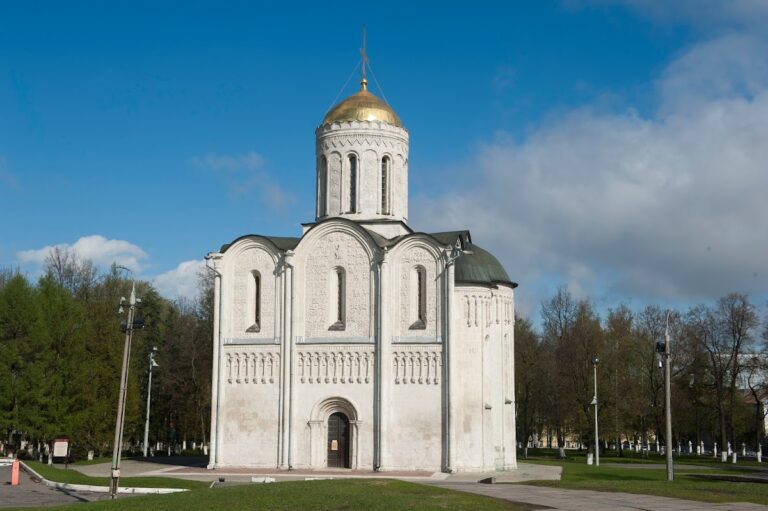
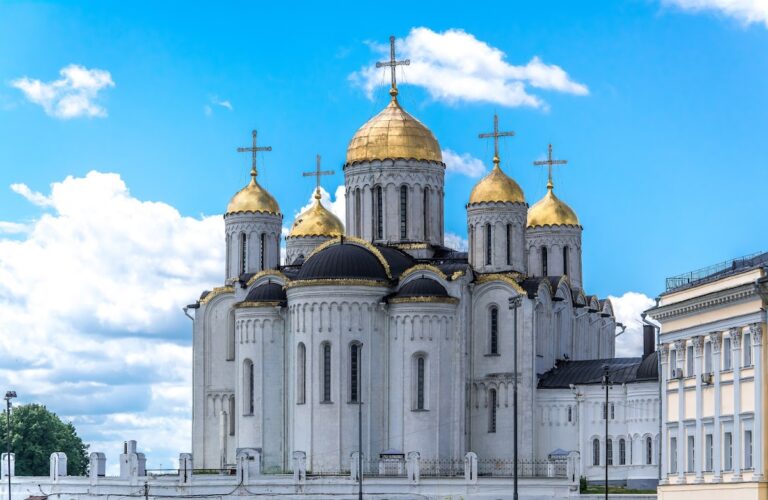
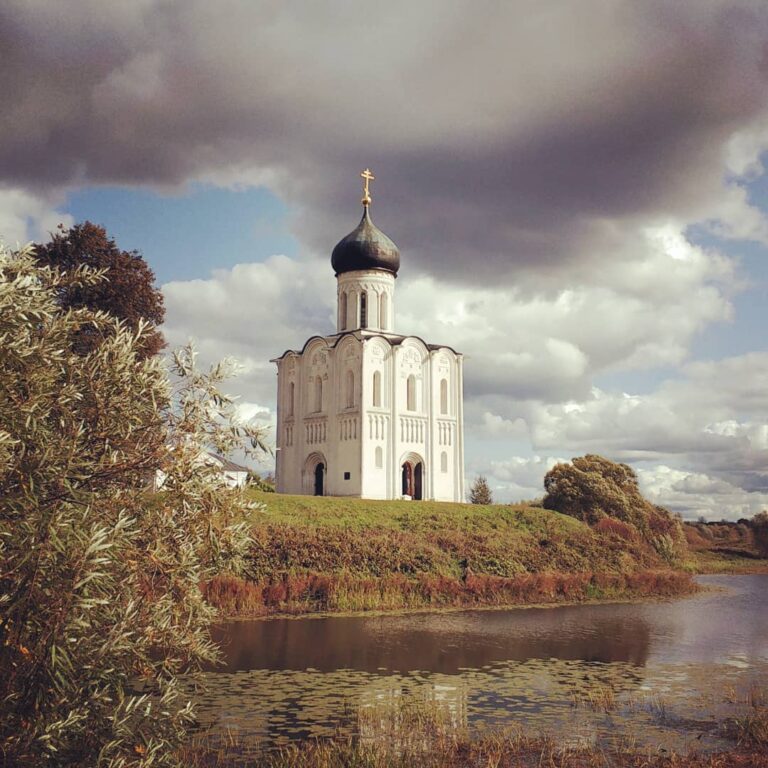
The pre-Mongol detinets contained the white-stone Dormition Cathedral and Saint Demetrius Cathedral. The later Nativity of the Virgin Monastery occupied the southeastern part of the Kremlin. Its walled enclosure is the only complex now commonly called the Vladimir Kremlin, although the historic Kremlin extended across a much larger fortified settlement.
Stone churches
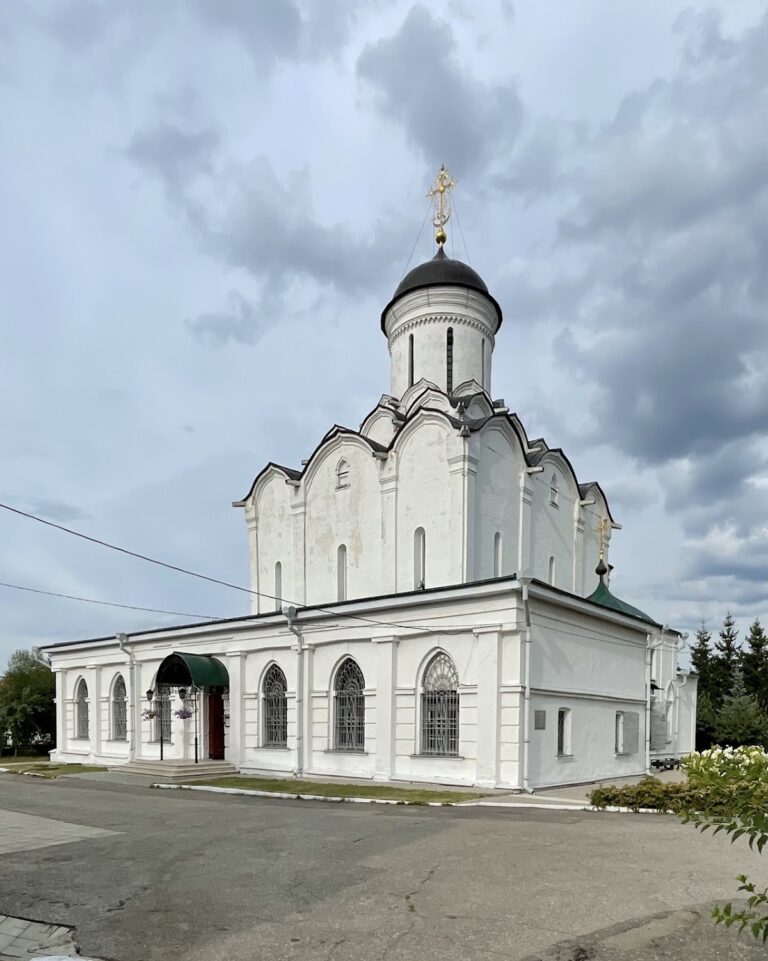
The inventory of 1625 and 1626 listed five stone churches within the Kremlin. They comprised the Dormition Cathedral, Saint Demetrius Cathedral, the Church of the Exaltation, and the cathedral and refectory church of the Nativity of the Virgin Monastery. The inventory places these religious buildings within a wider fortified settlement that also contained administrative offices and residential compounds.
Wooden churches and administration
Five wooden churches stood alongside the stone buildings. The Kremlin also contained a voivode’s court, administrative and judicial offices, and approximately 170 residential compounds. Among these were compounds associated with Patriarch Filaret, Prince Ivan Vorotynsky, and Dmitry Pozharsky, as well as affiliated compounds maintained by several monasteries from across Russia.
Nearby sites