Golden Gate of Vladimir: A Medieval City Gate
Site at a Glance
- Popularity
- Very High
- Country
- Russia
- Primary era
- Medieval
- Eras represented
- Medieval, Early Modern, Modern
- Civilizations
- Russian
- Site type
- Military
- Remains
- Gate
On this page16 sections
History
Construction and medieval role
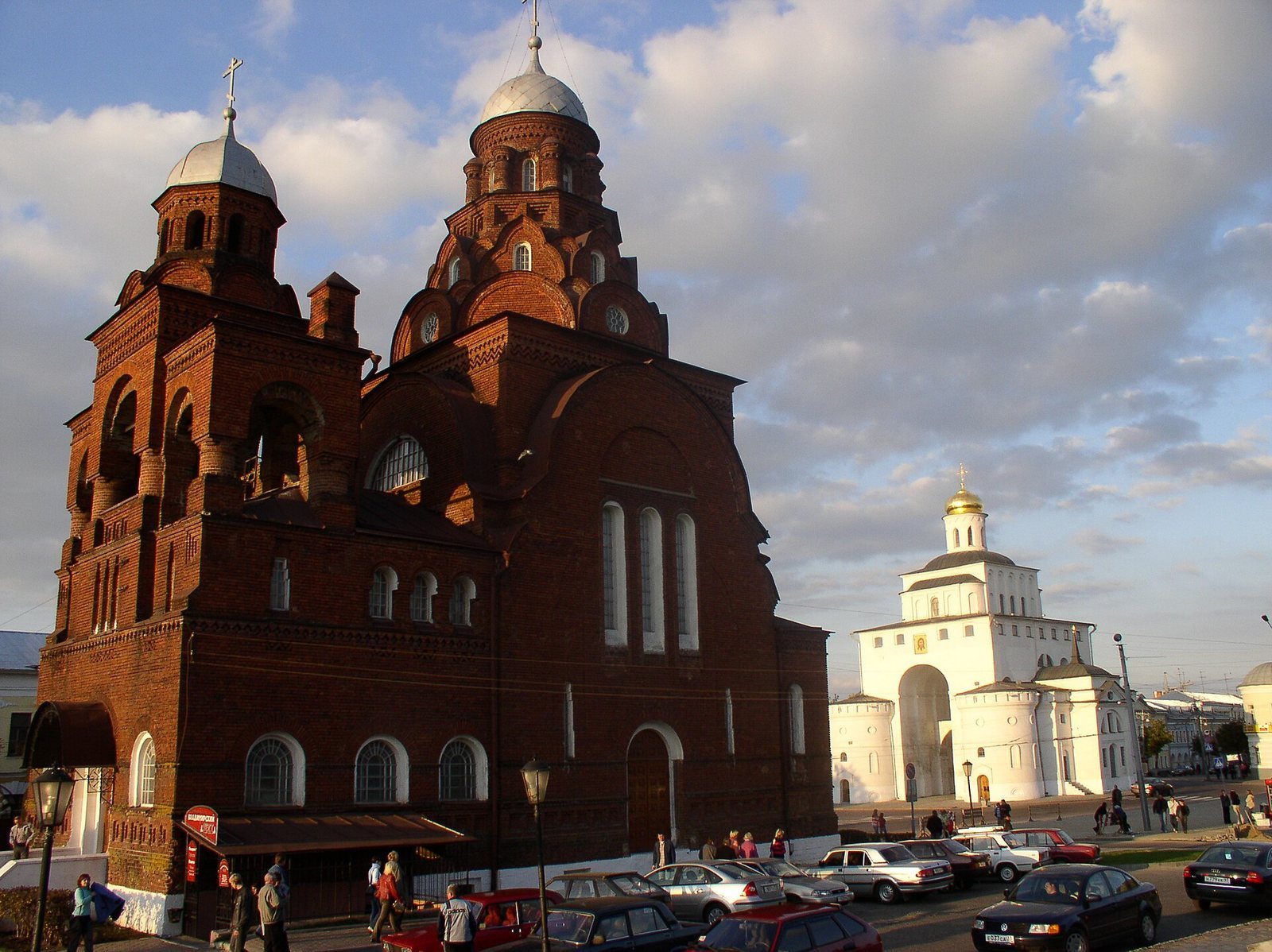
The Golden Gate is a medieval city entrance in Vladimir, Russia, begun in 1158 and completed in 1164 under Prince Andrei Bogolyubsky. Andrei, a prince of Vladimir-Suzdal, had transferred the principality’s capital from Suzdal to Vladimir. The gate marked the ceremonial approach to the New City, the district of the prince and the boyars, or high-ranking aristocrats. It served both defensive and triumphal purposes.
In the twelfth and thirteenth centuries, the Golden Gate was Vladimir’s principal and most ceremonial entrance. It belonged to a system of seven city gates and is the only one that survives. The Golden Gate on the west and the Silver Gate on the east were regarded as a pair evoking the New Jerusalem, a biblical image of a sacred, ideal city.
Construction is generally attributed to princely craftsmen, an interpretation associated with a princely mark on a white-stone block. A less certain tradition links the work to Italian craftsmen, possibly including an architect, said to have come from Holy Roman Emperor Frederick I Barbarossa, who ruled from 1155 to 1190.
The Mongol siege and subsequent repairs
In February 1238, Mongol forces led by Batu Khan besieged Vladimir but did not break through the Golden Gate. They entered the city through a breach in a nearby wooden section of its wall. After the city fell, the gate leaves were taken away and their gilded copper covering was stripped. Their later fate is uncertain. Traditions place them either in the Klyazma River after an attempted transport or in a hidden cache within the city.
Fires and enemy incursions damaged the gate, and by the fifteenth century it required major repairs. The chapel was repaired in 1469. In 1641, Tsar Michael Fyodorovich, the first ruler of the Romanov dynasty, ordered an estimate for further work, though repairs did not begin until the late seventeenth century.
Rebuilding and changing use
A major fire damaged the gate in 1778. During the subsequent regular replanning of Vladimir, the adjoining ramparts were removed to create a passage around the structure. This weakened its supports. A later legend connected the change with Empress Catherine II’s carriage becoming stuck in the narrow opening during a visit in 1767.
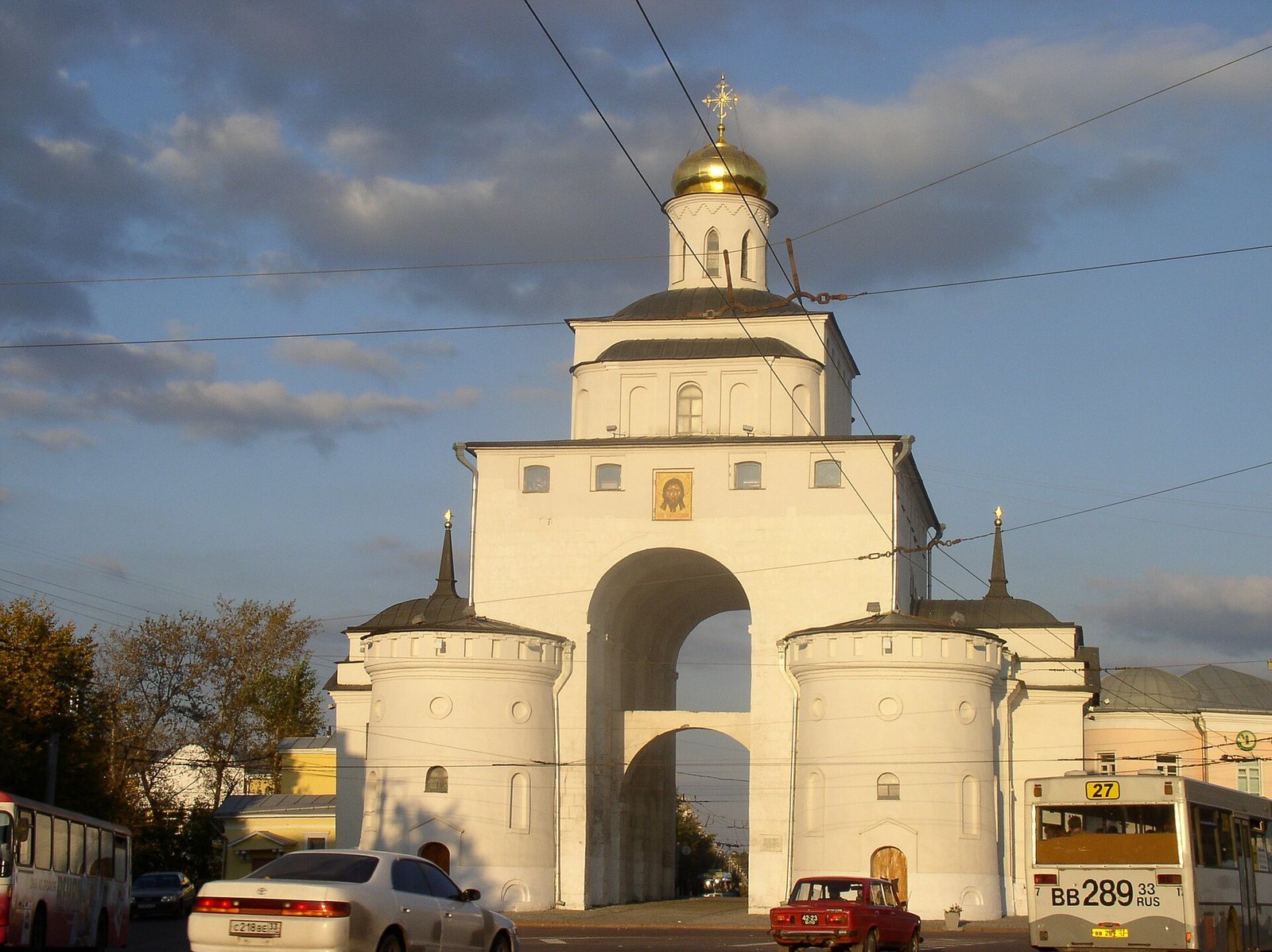
A rebuilding project in 1795 added corner supports enclosed in round towers and reconstructed the vaults with old stone. A new brick chapel above the gate was consecrated in 1810. From the early nineteenth century onward, proposals repeatedly called for a return to the gate’s earlier form. In the mid-nineteenth century, when it no longer had a practical gate function, its conversion into a water-collection and distribution facility was proposed but abandoned. A separate water tower was built nearby instead.
Modern commemoration and protection
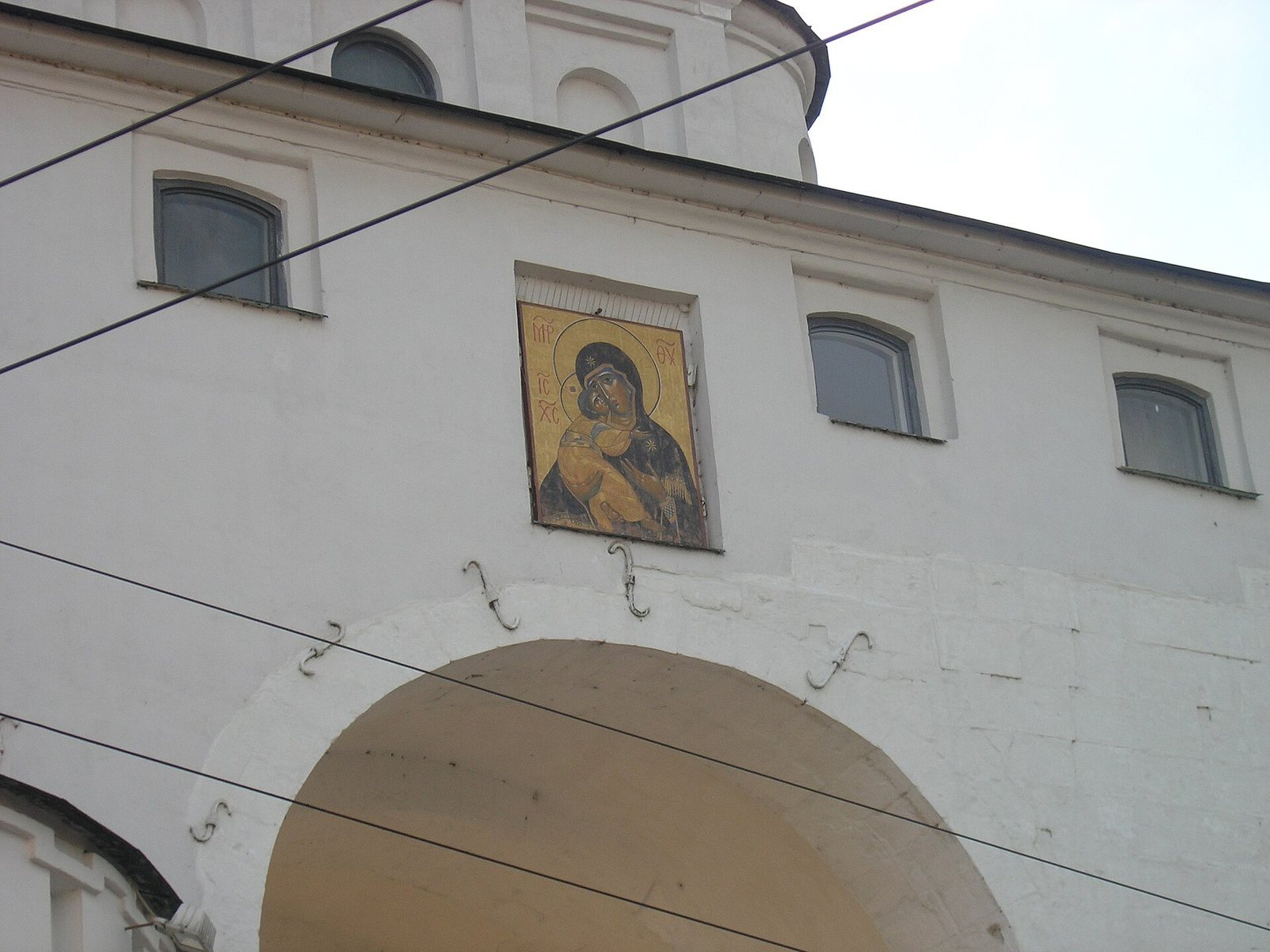
In 1983, a capsule carrying a message to Vladimir’s residents in the twenty-first century was placed in the gate. In 1991, residents gathered to venerate the relics of Saint Seraphim of Sarov, a Russian Orthodox monk revered as a saint, as they travelled from Saint Petersburg to Diveyevo. Icons were installed above the arch in the mid-1990s, continuing an earlier practice.
The Golden Gate became a federal-level cultural heritage monument in 1960 and was included in the UNESCO World Heritage property White Monuments of Vladimir and Suzdal in 1992. The Vladimir-Suzdal Museum-Reserve administers the site, and its chapel houses a military-history exhibition. Restoration began in July 2023.
Remains
The surviving gate is organized around a broad central passage with massive side supports and upper defensive levels. Its masonry uses a half-rubble technique, incorporating rubble stone into the walls. The passage is covered by a powerful semicircular vault, and its arch rises about 14 metres. These elements are among the oldest surviving parts of the structure.
Gate structure and defenses
Passage and fighting levels
Massive oak leaves once closed the entrance, hanging from forged iron hinges. Above the arch, a wooden floor formed an additional fighting platform; sockets for its beams remain in the masonry. A stone stairway inside the south wall led up beneath a sloping vault. At stair level, an exit connected with the southern rampart, while a passage through the north wall linked the platform to the northern rampart. The stair continued to an upper fighting level, whose walls had alternating raised sections and gaps, as well as narrow openings for observation or weapons.
Ramparts and approach
In the medieval layout, earthen ramparts met the gate on its north and south sides. Deep ditches lay beyond them, and a bridge crossed the ditch on the approach to the entrance. The nearby Kozlov rampart survives at about 6 metres high; it originally reached about 9 metres.
Chapels and later alterations
Medieval chapel
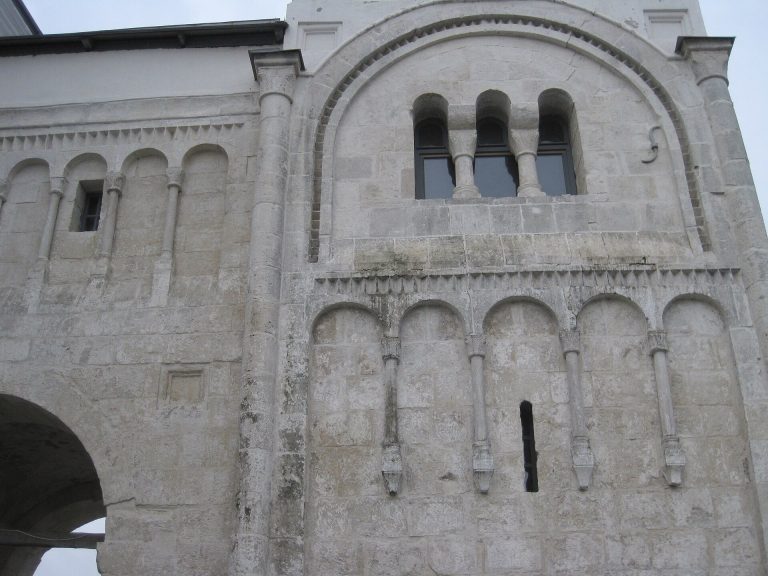
The original chapel stood at the centre of the upper platform. Dedicated to the Deposition of the Robe of the Virgin, a Christian devotion concerning a relic associated with Mary, it was built of white stone. Its form may have belonged to a type associated with buildings of Yuri Dolgoruky, a twelfth-century prince of Rostov-Suzdal. The square church had four interior pillars, three apses (projecting semicircular altar ends), and three arched entrances. A cylindrical drum supported its dome. Shallow wall projections resembling columns, known as pilasters, marked its interior and exterior. Decorative bands and shallow arches were once enhanced with sculpture, frescoes, and color.
Corner towers and later chapel
The gate’s later corner supports are enclosed within small round towers. Above the passage, a brick chapel stands apart from the earlier white-stone church in both material and date. The former fighting platform was converted into an enclosed gallery in the early nineteenth century.
Museum and commemorative features
Gallery of Soviet heroes
The upper gallery displays portraits, personal belongings, documents, and photographs relating to 160 Heroes of the Soviet Union, recipients of the country’s highest honorary title. They include participants in the Great Patriotic War, the Soviet name for the 1941–1945 conflict between the Soviet Union and Nazi Germany, as well as peacetime heroes. The display also includes small arms made by Kovrov designers Vasily Degtyaryov, Sergei Simonov, and Georgy Shpagin, and objects associated with cosmonaut Valery Kubasov.
Military-history exhibition
The chapel’s exhibition focuses on Vladimir’s defense during the February 1238 assault. Its central feature is a diorama, a three-dimensional scene depicting an event, created by Soviet artist Efim Deshalyt in 1972. The collection includes projectiles from a siege engine, thirteenth-century arrowheads and spearheads, chain mail, and a berdysh, a broad-bladed pole weapon.
Other objects include a Polish crossbow captured in the early seventeenth century; flintlock firearms from Catherine II’s era; a steel cuirass and musketoon from the period of the 1812 war; and a late-nineteenth-century rifle, uniform, banners, and awards. Captured Turkish weapons are also displayed.
Icons and capsule
Two icons are positioned above the arch: an image of the Mother of God on the eastern side and Christ the Saviour on the western side. A niche in one of the corner towers contains the message capsule.