Château de Marcillé-Robert: A Fortified Castle in France


Site at a Glance
- Rating
- 4.3
- Popularity
- Very Low
- Country
- France
- Primary era
- Medieval
- Eras represented
- Medieval
- Civilizations
- Duchy of Brittany
- Site type
- Military
- Remains
- Castle
On this page8 sections
History
Château de Marcillé-Robert is a ruined fortified castle in France, at Marcillé-Robert on the Marches of Brittany. Its strategic and economic importance was recognized during the Gallo-Roman period, while the present stone castle probably took shape in the second half of the twelfth century as the medieval lordship regained importance.
The early castle mound
A raised fortified earthwork, or castle mound, stood at Marcillé from the beginning of the eleventh century. Riwallon the Viaire, a powerful Breton lord and an early known ancestor of the Vitré family, was active there. His grandson, Robert I of Vitré, abandoned the site after his conflict with Briant I of Châteaubriant in 1049 and 1050. Robert then moved the centre of his possessions to Vitré.
The earlier mound was situated approximately 300 metres from the later stone castle. It is now covered by a pond, while the stone fortress occupied a separate rocky position above the Seiche River.
Renewed importance in the twelfth century
Marcillé regained importance during the second half of the twelfth century. Robert III of Vitré probably built the present stone castle and restored the lord’s presence in the settlement. The southward extension of his lands contributed to this renewed role. The addition of “Robert” to the settlement’s name is also attributed to this period, although that explanation remains uncertain.
The castle became a castle lordship administered from its fortress, with associated judicial and administrative authority. It held high-justice rights, meaning that its lord could hear serious criminal cases and impose the most severe penalties. Later lords gave preference to Château de Vitré and left Marcillé, although the castle and its lordship remained part of the wider Vitré inheritance.
From the Vitré family to La Trémoille
After the death of Philippa of Vitré, the domain passed by marriage to the House of Laval. Guy IX of Laval reached an arrangement with his mother-in-law, Jeanne of Brienne. She assigned her dower to the Barony of Vitré and its dependencies, including Marcillé Castle, and selected the castle as her residence.
The lordship subsequently passed by inheritance from the Vitré family to the Laval family and then to the dukes of La Trémoille, who retained it until the French Revolution. In the records of Château de Vitré, Jean Meschinot appears among the retinue of Guy XIV of Laval during journeys between Vitré, Châteaubriant, and Nantes. In 1471, Meschinot received the captaincy of Marcillé Castle for his son Jean.
The Laval household used Marcillé regularly in 1470 and 1471, making at least eight or ten substantial dining and overnight stays there. The castle was fortified during the fifteenth century, but its defences were soon tested by the changing character of warfare. In 1488, the army of Louis II de La Trémoille, a French military commander, occupied the castle without difficulty or combat.
Destruction and protection
Royal orders brought the castle’s destruction in 1595. At the request of Madame de Laval and by order of Fay d’Aumont, Marshal of France, Count of Châteaubourg, and governor of the king’s army in Brittany, the castle was demolished on 8 March and during the fortnight of April that year.
In 1799, the towers and the masonry ruins described in the sale record as the remains of the keep were sold as national property. The Château de Marcillé-Robert has been entered on France’s national register of protected historic monuments since 15 September 2017. The Communauté de communes de la Roche-aux-Fées has owned the site since 2012.
Remains
Promontory and castle layout
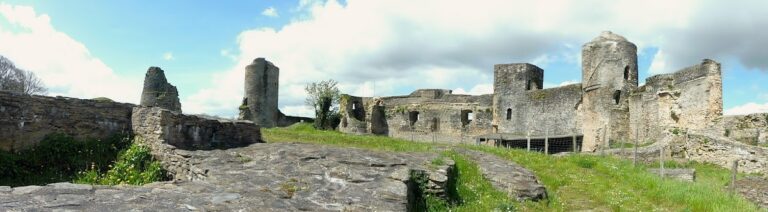
The ruined castle stands on a rocky promontory overlooking the Seiche River, within the frontier lands known as the Marches of Brittany. These lands derived military and political importance from their position between Brittany and neighbouring territories. The stone fortress was built about 300 metres from the earlier castle mound, whose position is now occupied by a pond. The castle had no keep and was instead organized around five tall towers. The tallest surviving tower measures 11 metres.
Gates and defensive design
Three gates gave access to the fortress, including one known as the Morel Gate. The surviving ruins retain the evidence of a towered and gated enclosure rather than a central keep. The absence of artillery embrasures indicates that the castle was not adapted to advances in weaponry, a limitation that helps explain the character of its fifteenth-century fortifications and its easy occupation in 1488.
Nearby sites