Museum van het Heilig Bloed: Relics and the Basilica of the Holy Blood in Bruges


Site at a Glance
- Rating
- 4.6
- Popularity
- Medium
- Country
- Belgium
- Primary era
- Medieval
- External website
- Open
- Eras represented
- Medieval, Early Modern, Modern
- Civilizations
- Belgian, County of Flanders
- Site type
- Religious
- Remains
- Basilica
On this page17 sections
History
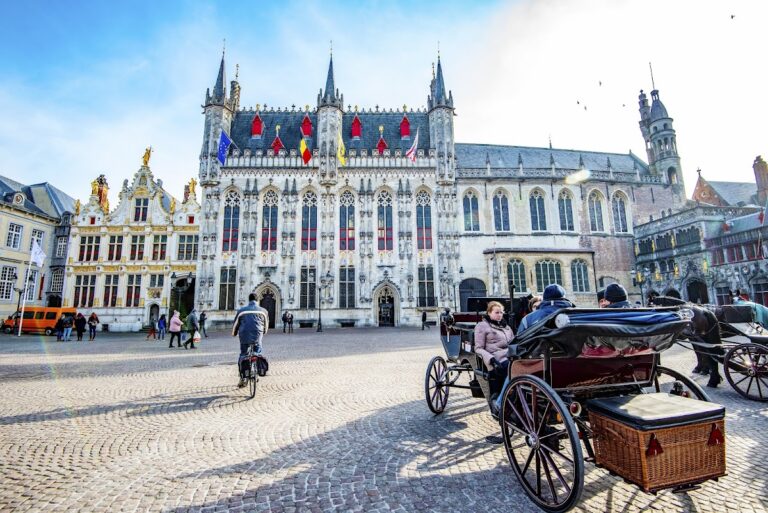
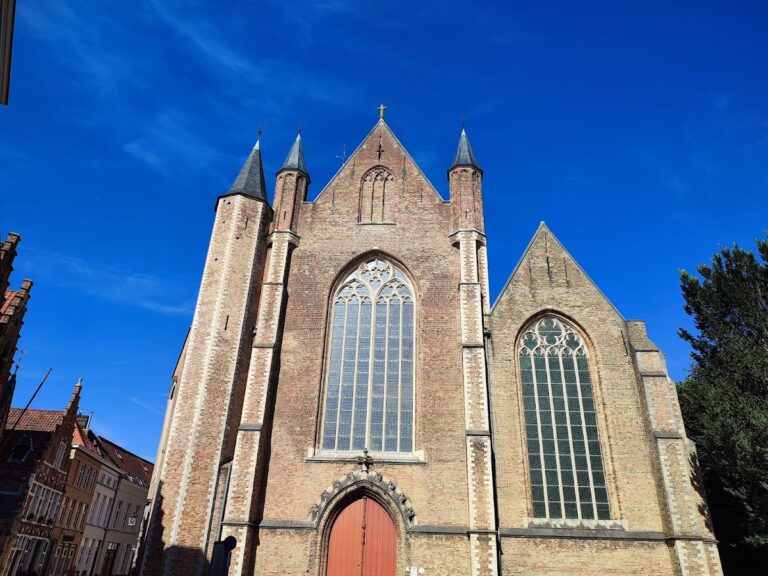
The Museum van het Heilig Bloed is associated with the Roman Catholic Basilica of the Holy Blood in Bruges, Belgium, a double chapel founded in the twelfth century and combining Romanesque, Gothic, and Gothic Revival architecture. The building stands beside the former Oud Steen, the first residence of the Counts of Flanders, whose former home is now used as Bruges Town Hall.
Foundation and the Lower Chapel
Thierry of Alsace, Count of Flanders, decided to establish the chapel in 1134. The lower Chapel of Saint Basil was constructed between 1134 and 1149 as part of the private chapel complex beside the Oud Steen. A relic of Saint Basil the Great, a fourth-century Christian bishop and theologian, had been brought from Caesarea Mazaca in Cappadocia by Robert II, Count of Flanders. The chapel was dedicated to Saint Basil and became the foundation of the religious complex.
The upper chapel was built between 1134 and 1157. It originally formed the second level of the private double chapel and was constructed in the Romanesque period, when churches commonly used massive masonry and rounded arches. During the first half of the thirteenth century, it acquired the name Chapel of the Holy Blood, reflecting the growing importance of the relic traditionally associated with Jesus Christ.
The Precious Blood and Its Traditions
Christian tradition says that Joseph of Arimathea, the Gospel figure associated with arranging Jesus’s burial, collected the Precious Blood. Another tradition holds that Thierry of Alsace brought the relic from the Holy Land after joining the Second Crusade in 1147 and returning to Bruges in 1150. Popular accounts connect its arrival with Baldwin III of Jerusalem, but the relic has not been shown to have been in Bruges before the 1250s.
A different interpretation links its arrival to the sack of Constantinople in 1204 during the Fourth Crusade, when the army of Baldwin IX, Count of Flanders, took part in the capture of the Byzantine capital. The authenticity of the relic remains unresolved, but it has played an important role in Bruges’s religious life since its arrival. In 1310, Pope Clement V issued a papal bull granting indulgences to pilgrims who visited the chapel to see it.
A weekly liquefaction miracle was associated with the relic. The alleged phenomenon apparently ceased in 1310, although a recurrence was claimed in 1388. The relic continues to be shown publicly every Friday and each day during the two weeks before Ascension Day.
Procession and Civic Memory
The Procession of the Holy Blood appears to have begun as a civic ceremony in the late thirteenth century and was formally instituted in 1303. Held on Ascension Day, it commemorates Bruges’s liberation from French tyranny in the preceding year, an event associated with Jan Breydel and Pieter de Coninck. The ceremony combines a historical recreation of the relic’s arrival with dramatizations of biblical episodes, linking the relic’s religious meaning with the city’s civic memory.
The wider tradition also includes the Belgian Passion play Jeu du Saint Sang, or “Play of the Holy Blood,” first published in 1938. It is performed in Bruges every five years as part of the continuing cultural and religious tradition associated with the procession.
Transformation and Modern Status
The upper chapel was transformed from its original Romanesque form into a Gothic chapel at the end of the fifteenth century. It was renovated again in 1823, followed by successive nineteenth-century campaigns that gave the interior and exterior their present Gothic Revival character. The work involved Jean-Baptiste Bethune, Louis Delacenserie, Thomas Harper King, William Curtis Brangwyn, and Charles De Wulf.
The monumental staircase to the upper chapel suffered serious damage during the French Revolution. After the ruins of the Oud Steen were removed, a decision was made in 1832 to move the staircase four metres backward and rebuild it. The basilica became a minor basilica in 1923, an honorary status granted by the Roman Catholic Church, and remains an active church within the Diocese of Bruges.
Remains
The basilica occupies Burg Square and is arranged vertically around two chapels. The lower Chapel of Saint Basil is a dark Romanesque structure, while the upper Chapel of the Holy Blood preserves later Gothic and Gothic Revival forms. The surviving complex includes chapels, a monumental staircase, stained glass, sculpture, murals, altars, and objects connected with the basilica’s liturgy and relic traditions.
Lower Chapel and Saint Yves Chapel
Chapel of Saint Basil
The Chapel of Saint Basil is among the best-preserved Romanesque churches in West Flanders. Its plan has two side aisles and a central nave that continues into a choir ending in a semicircular apse. Massive masonry and rounded arches give the interior its characteristic Romanesque form. Above the entrance connecting the chapel with its annex, a twelfth-century tympanum, the decorated surface within an arched doorway, represents the baptism of Saint Basil.
The right aisle contains a seated Madonna and Child known as Sedes Sapientiae, or “Seat of Wisdom.” This polychrome wooden sculpture dates from the early fourteenth century. The aisle also holds two venerated wooden statues made around 1900, one showing Jesus on the Cold Stone and the other the Pieta. Both statues are carried annually in the Procession of the Holy Blood.
Chapel of Saint Yves
Added to the left of the choir in 1504, the Chapel of Saint Yves contains relics associated with Saint Basil and Blessed Charles the Good, Count of Flanders. Its black-marble retable, an ornamental structure behind an altar, is attributed to designs by Lancelot Blondeel, the Flemish painter and architect whose work is also associated with the monumental staircase.
Staircase and Upper Chapel
De Steegheere
The monumental staircase known as De Steegheere leads to the upper chapel. Built between 1529 and 1533 in Late Gothic and Renaissance styles, it was based on drawings by Lancelot Blondeel. Sculpted statues decorate its exterior, including gilded bronze figures of Isabelle of Burgundy, Mary of Burgundy, Thierry of Alsace, and Philip of Alsace.
Medallions on the staircase depict the Austrian archdukes Albert VII and Maximilian III, Margaret of York, and Sibylla of Anjou. Sibylla was Thierry of Alsace’s wife and the daughter of Fulk, King of Jerusalem. The staircase was rebuilt and repositioned in the nineteenth century after damage during the French Revolution and the removal of the Oud Steen ruins.
Upper Chapel
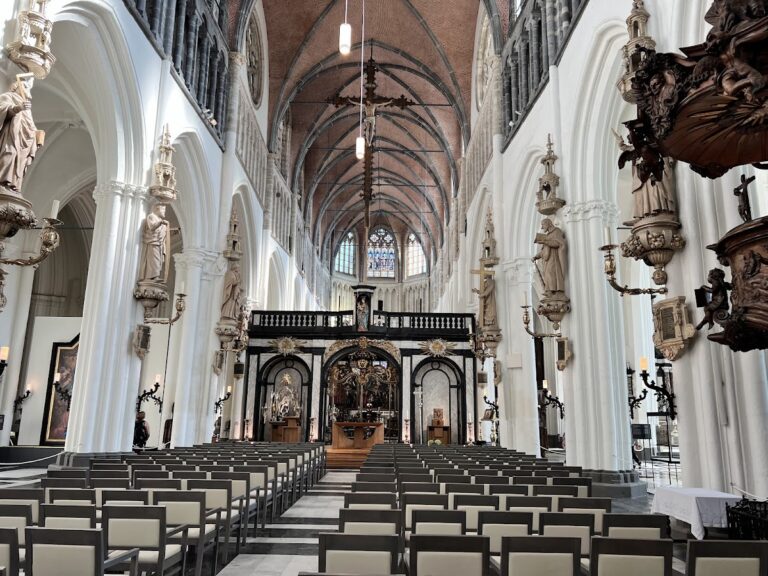
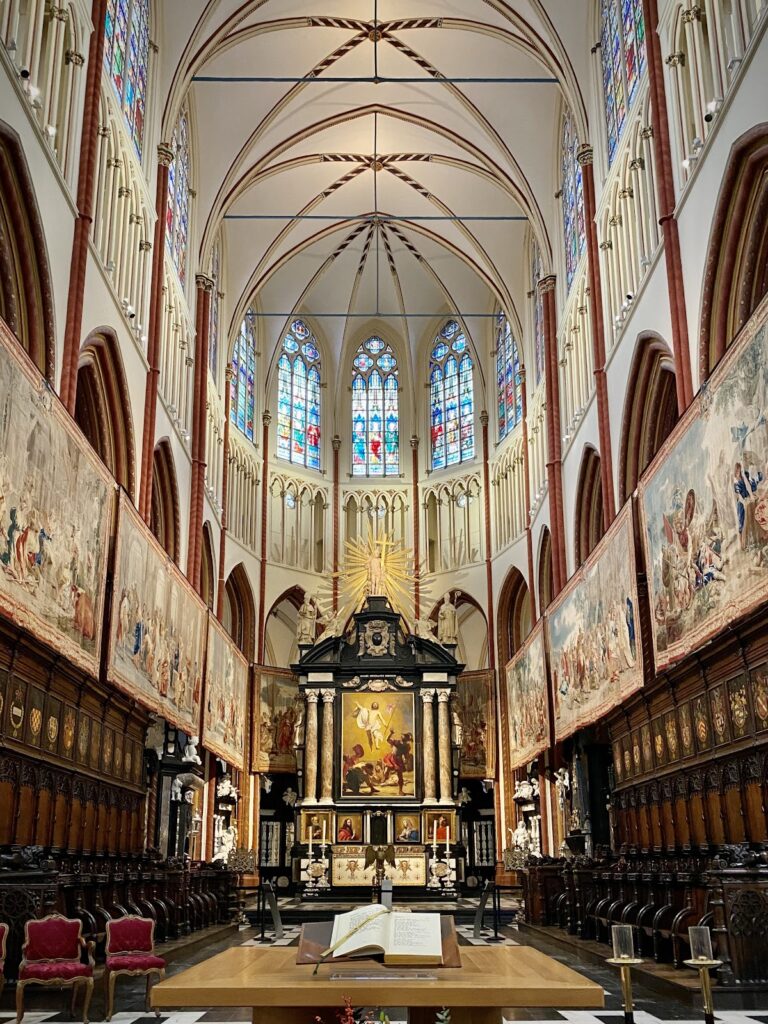
Only the curved arches leading into the side Chapel of the Holy Cross survive from the original Romanesque upper chapel. Most of the upper chapel’s present appearance reflects its later Gothic and Gothic Revival transformations. Its nineteenth-century decoration includes characteristic mural ornament, while choir stained-glass windows dated 1845 show rulers of the County of Flanders from Philip the Bold, Duke of Burgundy, to Archduchess Maria Theresa of Austria, Holy Roman Empress.
The original stained glass was removed after the French Revolution, and some panels later entered the Victoria and Albert Museum in London. A globe-shaped pulpit made by Henry Pulinckx dates from 1728. Its form was conceived to express the universal evangelical mission of preaching.
Altars and Painted Decoration
A large mural behind the high altar was completed in 1905. Its upper section depicts the Mystery of the Cross, with Christ shedding his blood against backgrounds representing Bethlehem and Jerusalem. The lower section shows Thierry of Alsace receiving the relic from Baldwin III of Jerusalem and handing it to a chaplain while kneeling beside Sibylla of Anjou.
The high altar used for the Eucharist includes an early seventeenth-century alabaster relief of the Last Supper. Beside it are a tintinnabulum, a small processional bell, and an umbraculum, a yellow-and-red silk processional parasol. These are ceremonial objects traditionally associated with basilicas.
Relic Side Chapel
The relic side chapel contains a white-marble Baroque altar completed in 1751 by Laurent Delvaux. Two adoring angels flanking the altar were made by Peter Pepers. To the right hangs Jacob van Oost the Elder’s painting of the Descent from the Cross.
Relic and Museum Objects
Phial of the Precious Blood
The venerated relic is kept in a phial, a small bottle or vial, said to contain a piece of cloth bearing the blood of Jesus Christ. Modern examination identifies the vessel as a Byzantine perfume bottle made near Constantinople from rock crystal and dating from the eleventh or twelfth century. Its neck is wound with gold thread, its stopper is sealed with red wax, and it has reportedly never been opened since it arrived in Bruges.
The phial is enclosed in a glass-fronted gold cylinder. Coronets decorated with angels close the cylinder at both ends, and the frame bears the engraved date “MCCCLXXXVIII die III maii,” corresponding to 3 May 1388.
Processional Reliquary
The reliquary used in the Procession of the Holy Blood is displayed in the basilica museum. Made in Bruges in 1617 by the goldsmith Jan Crabbe, it contains approximately 30 kilograms of gold and silver and more than 100 precious stones. The gem-encrusted case is hexagonal and topped by golden statues of Jesus Christ, the Virgin Mary, Saint Donatian, the patron saint of Bruges, and Saint Basil the Great.