Burg Zbiroh: A Medieval Castle in Czechia
Site at a Glance
- Rating
- 4.6
- Popularity
- Low
- Country
- Czechia
- Primary era
- Medieval
- External website
- Open
- Eras represented
- Medieval
- Civilizations
- Holy Roman Empire, Kingdom of Bohemia
- Site type
- Military
- Remains
- Castle
On this page8 sections
History
Burg Zbiroh, also called Zbirohy, is a fourteenth-century medieval castle in Czechia, founded at an unknown date by an unidentified builder. Its position on a narrow rocky spur above the Jizera River gave it a naturally restricted setting and shaped its defensive layout.
Markvartid ownership and royal seizure
During the middle of the fourteenth century, the surrounding region belonged to branches of the Markvartid family, a medieval Bohemian noble lineage that included the Lemberk and Vartenberg lines. By the end of the century, Markvart of Vartenberg held Burg Zbiroh.
Markvart rebelled against King Wenceslaus IV, who ruled Bohemia and was also Holy Roman Emperor in the late fourteenth century. Markvart was also associated with attacks on travelers. Royal forces besieged Burg Zbiroh and the nearby castle of Hrubý Rohozec, capturing both around 1390. Their properties were then confiscated.
Rebuilding and the Hussite Wars
Wenceslaus IV later sold Burg Zbiroh to Otto of Bergow, a Bohemian nobleman who rebuilt the castle. Otto retained it during the Hussite Wars, the religious and political conflicts in Bohemia that followed the reform movement associated with Jan Hus. During these wars, Burg Zbiroh was among the strongholds supporting King Sigismund, Wenceslaus’s younger half-brother and a later king of Bohemia whose authority was contested during the conflict.
Destruction and later history
The castle later again became associated with robbers. In 1442, the provincial levy captured and razed Burg Zbiroh. It was not repaired afterward and began to decay. By the middle of the fifteenth century, the castle was described as deserted, including during the settlement of the inheritance of Otto of Bergow’s son Jan in 1458.
When the estate was divided in 1613, the abandoned castle passed to Jan Jiří of Vartenberg, a later member of the Vartenberg noble family. The ruins are protected as a cultural monument, although increasing tourist traffic has progressively damaged the monument.
Remains
Rocky spur and outer defenses
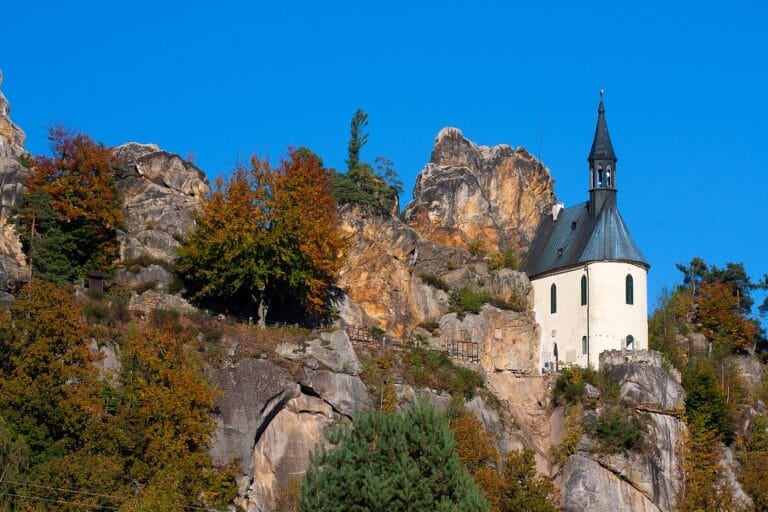
The four-part castle occupies a narrow, steep rocky spur in a bend of the Jizera River, at approximately 450 to 452 metres above sea level. Rock formations strongly determined the arrangement of the site. An eastern outer bailey, a subsidiary enclosed area outside the main fortified core, was lightly fortified and separated from the core by a neck ditch, a ditch cut across the narrow connection of a rocky spur. The southern side of the core was protected by a zwinger, an outer defensive passage between the main fortification and an additional enclosing barrier. The access route probably passed through this area.
Castle core
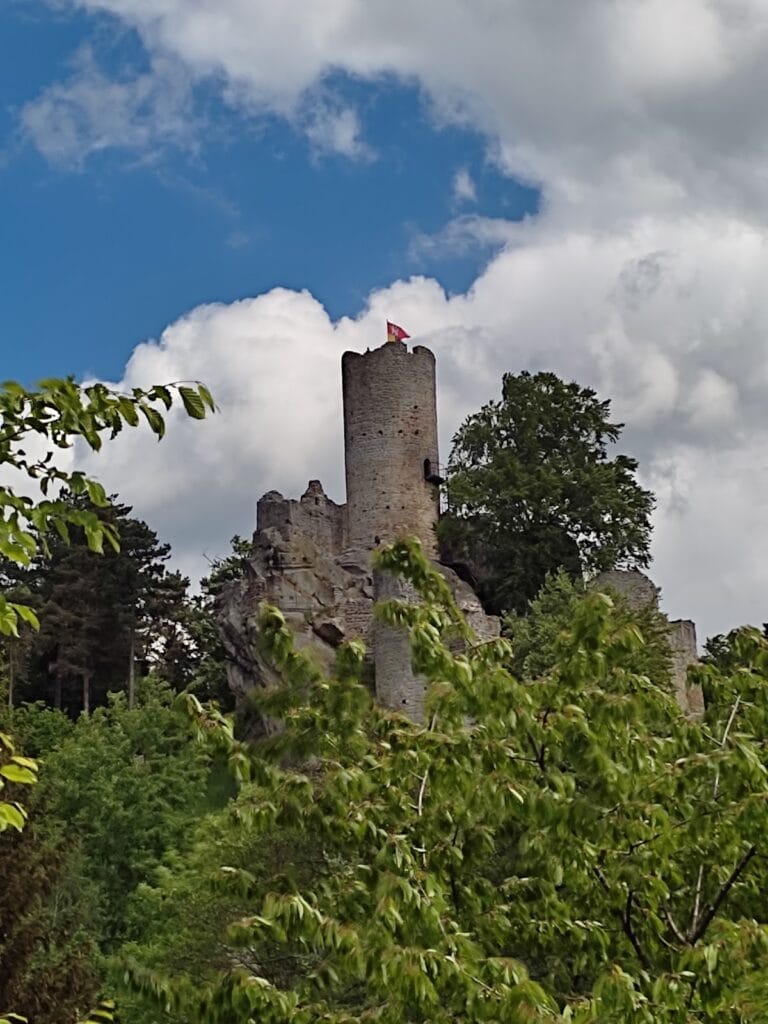
A probably residential square tower known as Kazatelnice stood at the front of the castle core above the ditch. Behind it were a cistern, a reservoir for storing water, and an L-shaped palace with two wings. The northern wing contained cellars that used the natural shape of the terrain. A perimeter wall was built against the rock blocks, while a rounded, bastion-like projection extended northward from the western wing of the palace.
Western area and surviving fabric
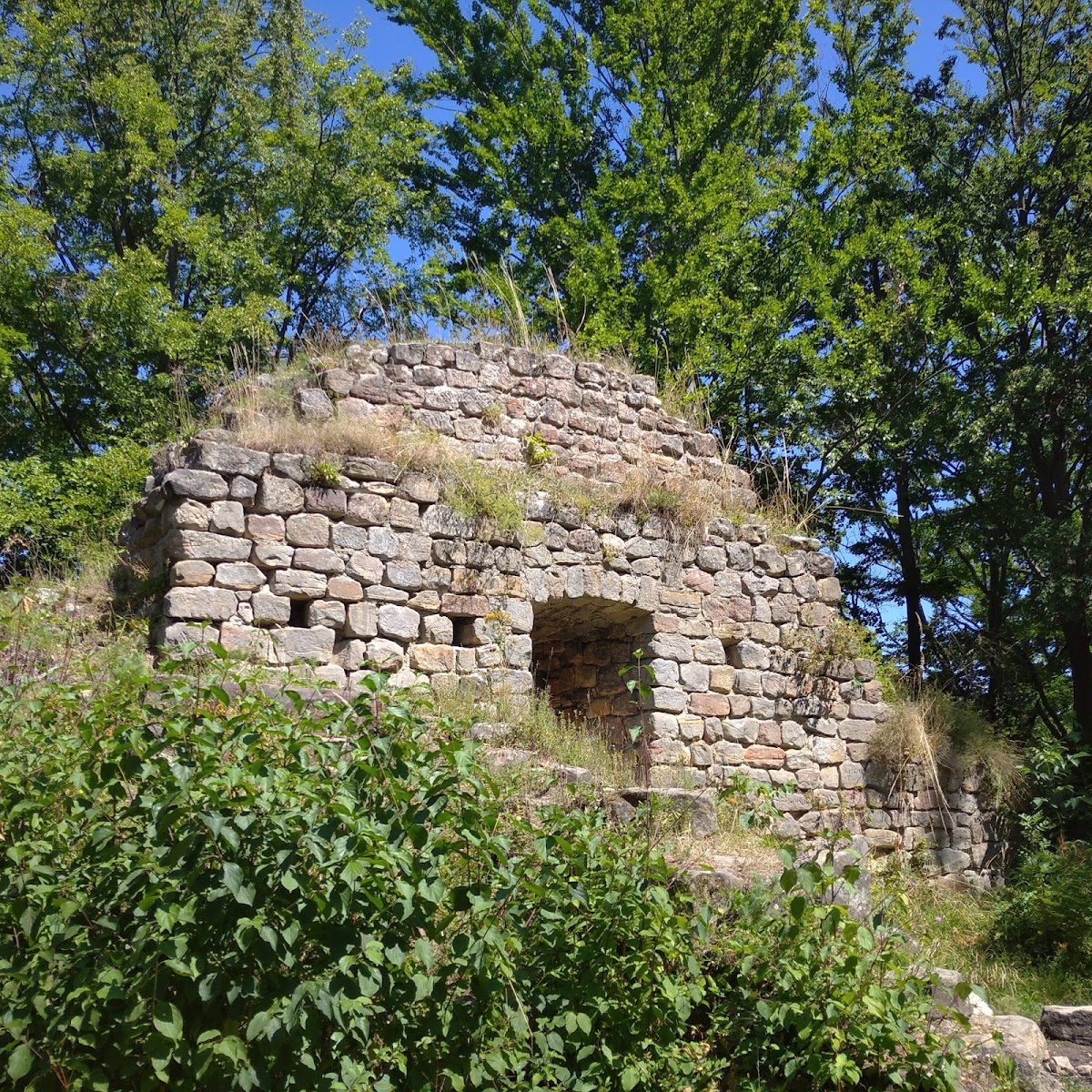
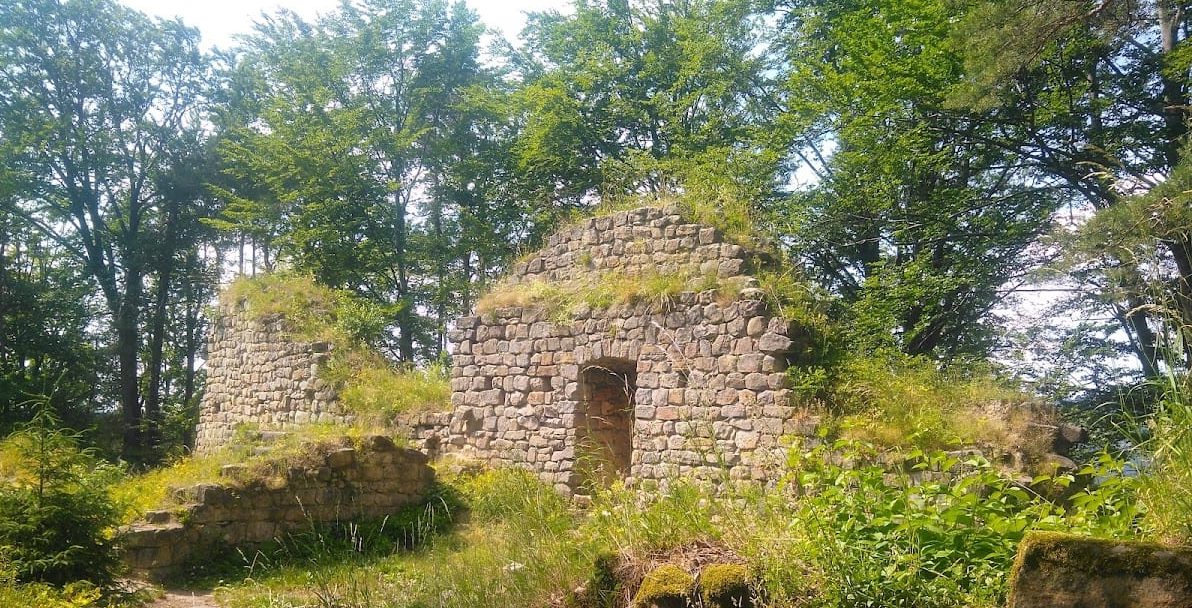
The arrangement of the area west of the castle core remains uncertain. Its surviving remains consist chiefly of sections of the outer fortifications. Elsewhere, the ruin retains portions of retaining and perimeter walls, the tower, rooms cut into the rock, cellars, and the cistern. Together, these elements preserve the castle’s adaptation to the steep spur and its irregular rocky foundations.
Nearby sites