Rotštejn Castle: A Gothic Rock Castle in Czechia


Site at a Glance
- Rating
- 4.7
- Popularity
- Medium
- Country
- Czechia
- Primary era
- Medieval
- External website
- Open
- Eras represented
- Medieval
- Civilizations
- Holy Roman Empire, Kingdom of Bohemia
- Site type
- Military
- Remains
- Castle
On this page8 sections
History
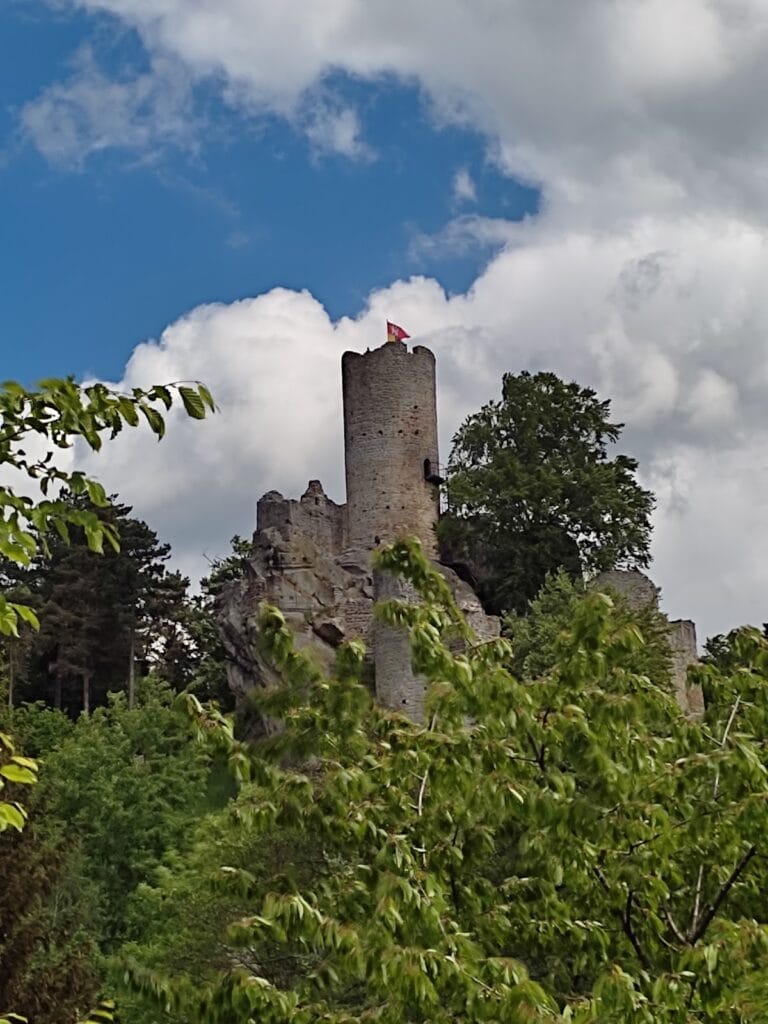
Rotštejn Castle is a ruined Gothic rock castle in Czechia, founded in the mid-thirteenth century by nobles of the Markvartic family. Built partly in masonry and partly into sandstone formations, it occupied a naturally defensible position and became the seat of the Rotštejn family.
Foundation and Markvartic ownership
Jaroslav of Hrutwice, associated with present-day Hruštice, is identified as the castle’s first owner and builder. He established Rotštejn for his son Vok of Rotštejn. For another son, Zdeněk, Jaroslav built Valdštejn Castle. Zdeněk later became the founder of the Waldstein family, one of the branches descended from the medieval Markvartics.
Conflict and reconstruction of ownership
From 1312 onward, nobles from the surrounding area damaged the Rotštejn estate and its property. In 1318, a large force devastated the estate and castle. A legal record names 152 nobles among those involved, revealing the scale of the conflict and the number of local landholders connected with the attack.
In 1360, Ješek of Rotštejn held the castle and received permission from Charles IV, the fourteenth-century King of Bohemia and Holy Roman Emperor, to organize weekly markets in the nearby village of Klokočí. The privilege linked the castle’s lord to the economic administration of the surrounding settlement.
The Hussite Wars and abandonment
The Rotštejn family became extinct in 1415, after which the estate, including the castle, passed to Ondřej or Vaněk Paldra of Vařiny. He held it during the Hussite Wars, the fifteenth-century religious and political conflicts in Bohemia associated with the followers of Jan Hus.
The castle’s fate during those wars remains uncertain. It may have escaped Hussite burning, since Vaněk reportedly returned after 1430 and found it usable. Another account places its conquest in 1426 and says that its lord lived at a farm in nearby Klokočí. Hussite presence at Rotštejn is not confirmed by archaeological finds or written evidence.
A sale document from 1514 described Rotštejn as abandoned, with walls and rock formations collapsed into the courtyard. A later reference from 1540 likewise treated it as abandoned and ruined. Weathering of the sandstone contributed to the ruin’s continuing deterioration.
Later refuge and conservation
During the Thirty Years’ War, in the early seventeenth century, soldiers made the rock cavities below the collapsed castle a place from which villagers sought refuge. The villagers later adapted these cavities, and the area gradually developed into a distinctive rural settlement complex.
Since 1988, the Protection of the Klokočské Rocks association has cared for the ruin. Its civic work is led by chatelaine H. T. Hlubučková, a person responsible for the administration and care of a castle or historic estate. Rotštejn also serves as a small center for environmental and ecological education. The ruin is listed as a cultural monument of the Czech Republic.
Remains
Rotštejn occupies sandstone rock blocks, using the natural formations as part of its defensive system. The castle combined built masonry with spaces carved directly into the rock. Its surviving fabric consists of a small number of walls, rock-cut windows, niches, and other carved features, while wooden walkways and paths now lead to the summit of the ruin.
Rock-cut castle layout
The adjacent rocks shaped the castle’s arrangement and helped form its defenses. A rock opposite the accessible part of the ruin originally carried the castle tower. Another carved rock window belonged to a half-timbered guardhouse, linking a natural rock feature with a lighter timber structure. Written descriptions preserve information about the former appearance of the castle, while the surviving carved elements indicate how its buildings were integrated with the sandstone.
Defensive features
Rotštejn’s conventional defenses included gates, bridges, and bastions, or projecting defensive platforms. These elements were connected with the surrounding rock formations, but their former presence is now represented by carved niches. The remaining walls and rock-cut openings provide the principal physical evidence of the castle’s masonry and carved construction.