Tsukawara Kofun Cluster: An Ancient Burial-Mound Complex in Japan


Site at a Glance
- Rating
- 4.1
- Popularity
- Very Low
- Country
- Japan
- Primary era
- Medieval
- External website
- Open
- Eras represented
- Classical, Medieval
- Civilizations
- Yamato
- Site type
- Burial
- Remains
- Necropolis
On this page8 sections
History
The Tsukawara Kofun Cluster is a group of ancient burial mounds in Kumamoto, Japan, constructed between the fourth and sixth centuries. Built during the era when kofun, monumental burial mounds of ancient Japan, were used for important burials, the cluster is the largest of its kind in Kumamoto Prefecture and one of the largest in Japan.
Early references and archaeological investigation
The cluster is said to have been described in the Edo-period works Higo Kokushi and Kokon Higo Kenmon Zakki. Modern archaeological investigation began in 1972 during construction of the Kyushu Expressway. The work revealed a varied burial complex that included square moated tombs, circular mounds, keyhole-shaped tombs, stone sarcophagi, and an earthen grave covered by a stone lid.
A wider survey of the Tsukahara Plateau in 1975 showed that the burial complex extended beyond the expressway property and identified an associated settlement. Including the surrounding area, 203 burial mounds have been investigated, while the entire cluster may once have contained nearly 500 mounds. The investigated and developed area, however, lies above the expressway route.
Preservation and public development
The discovery led to a prefecture-wide campaign to preserve the mounds. Rather than cutting a V-shaped route through the hill, engineers carried the expressway through a tunnel beneath the burial ground. This approach was described as the first in Japan to reconcile a major public-works project with the preservation of cultural property.
The Tsukahara Tunnel delayed the opening of the Kyushu Expressway between Mifune and Matsubashi Interchanges by two years, until 1978, and increased construction costs by 2.6 billion yen. The site was designated a National Historic Site of Japan in 1976, a national category protecting archaeological, historical, and cultural places considered important to the country’s heritage. It was subsequently developed as Tsukahara Kofun Park.
Plans for the Kumamoto City Tsukahara History and Folklore Museum began in 1974 through an agreement involving the Agency for Cultural Affairs, Kumamoto Prefecture, Jonan Town, and the Japan Highway Public Corporation. The museum opened in 1983 as the Jonan Town History and Folklore Museum and took its present name after Jonan Town merged with Kumamoto City in 2010. The 2016 Kumamoto Earthquake led to its closure, and it reopened on 22 July 2017.
Remains
Mound layout and burial forms
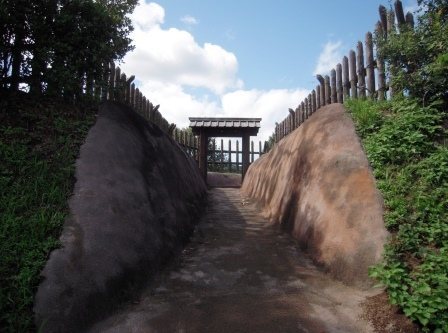
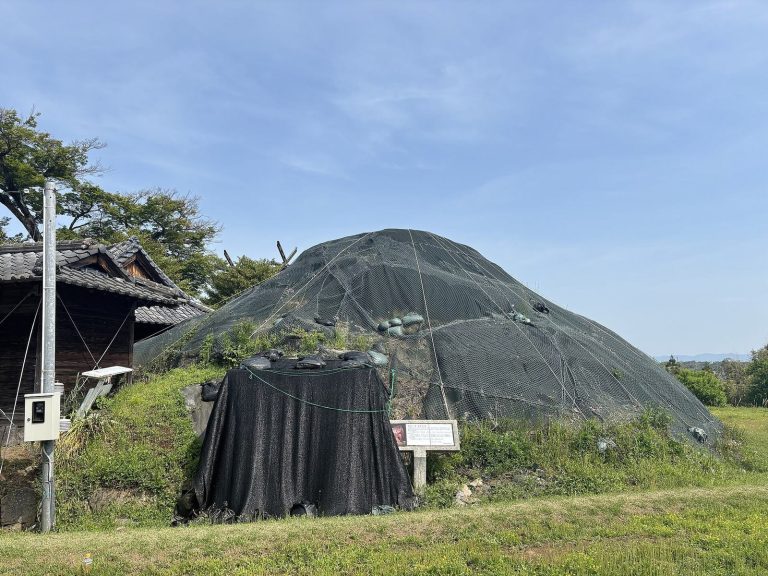
Tsukahara Kofun Park covers an area roughly equivalent to five baseball fields and is arranged around two hills, a northern hill and a southern hill. The landscaped park contains 77 reconstructed burial mounds. Large square moated tumuli are concentrated mainly south of the northern hill, while large circular tumuli cluster around the northern hill and south of the southern hill. The wider burial complex continues across the plateau beyond the park and the expressway property, where the associated settlement forms part of the archaeological setting.
The investigated area contains 39 square moated tumuli, 34 circular tumuli, one keyhole-shaped tomb, 18 stone sarcophagi, and one stone-lidded earthen grave. A square moated tumulus has a square plan enclosed by a ditch, while a circular tumulus has a round plan. A keyhole-shaped tomb combines a rectangular or square end with a circular end when viewed from above. Three keyhole-shaped tombs are believed to have existed in the wider cluster, and two are located within the park.
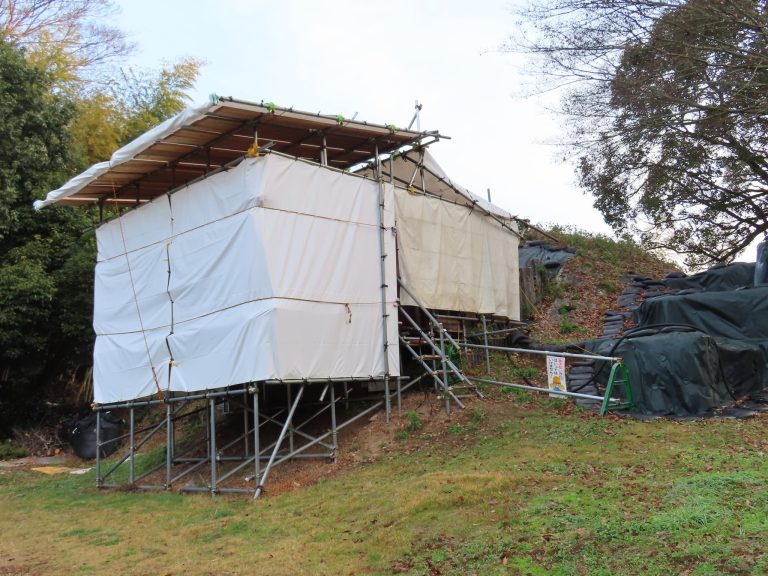
The burial complex also includes stone sarcophagi, which are stone burial containers. One house-shaped sarcophagus, designed externally to resemble a small house, was damaged during the 2016 Kumamoto Earthquake. The earthquake also caused information boards in the park to fall.
Park structures and archaeological displays
Tsukahara Tunnel
The Tsukahara Tunnel passes immediately beneath the burial mounds and is 340 metres long. Its position close to the ground surface protects the mounds above. For this reason, the tunnel has a rectangular cross-section without a ceiling slab, reflecting the engineering solution adopted to preserve the archaeological complex while carrying the expressway through the area.
History and Folklore Museum
The Kumamoto City Tsukahara History and Folklore Museum serves as a guidance facility for the kofun cluster. Its three exhibition rooms address archaeology, history, and materials. The museum preserves and displays pottery excavated from the burial mounds alongside other historical and folklore materials from the former Jonan Town area.
The park was created by landscaping the area around the burial complex. In addition to the museum, it contains the Hino-kimi amusement area and the Kumamoto Prefectural Astronomical Observatory. Planted cherry trees, hydrangeas, and cosmos, together with playground equipment, form part of the developed park landscape surrounding the reconstructed mounds.