Hitaka Shrine: A Shinto Shrine in Oshu, Japan


Site at a Glance
- Rating
- 4.3
- Popularity
- Low
- Country
- Japan
- Primary era
- Early Modern
- Eras represented
- Early Modern, Modern
- Civilizations
- Tokugawa
- Site type
- Religious
- Remains
- Sanctuary
On this page13 sections
History
Hitaka Shrine is a Shinto shrine in Japan, located in Mizusawa, Oshu, Iwate Prefecture. Its traditional foundation dates to 810, when it was established by imperial order under Emperor Saga. The shrine is associated with the incorporation of regional religious traditions into the central government’s military base at Isawa, following the submission of Aterui and the construction of Isawa Castle by Sakanoue no Tamuramaro in 802. This connection presents a historical interpretation of the shrine’s origins rather than a confirmed account.
Foundation and religious identity
The region was formerly known as Hitakami Province, and the shrine is also called Hitaka Myoken or Hitaka Myoken-gu. These names reflect its association with Myoken Bodhisattva, a Buddhist astral deity linked especially with the Pole Star and the Big Dipper. In Japanese religious history, Myoken was often identified with Amenominakanushi, here understood as the Heavenly Central Lord. That deity is the shrine’s principal object of worship, accompanied by seven others: the Fire-Producing Spirit, the Great Year Spirit, the Year Spirit, the Young Year Spirit, the Water Goddess, Okuninushi, and the Spirit of Inari.
Tradition connects Hitaka Shrine with the eleventh-century Former Nine Years’ War and Later Three Years’ War, conflicts in northeastern Japan involving the Abe family and regional military powers. Minamoto no Yoriyoshi and his son Minamoto no Yoshiie are said to have visited the shrine to pray for victory. Later, the Isawa family, subsequently known as the Rusu family, maintained its veneration. These regional governors were responsible for protecting northeastern Japan, and devotion to the shrine also came from the Oshu Fujiwara and Date families.
Medieval and early modern patronage
Fujiwara no Hidehira is traditionally credited with rebuilding the shrine in 1170. Hidehira was a leading ruler of the Oshu Fujiwara, the powerful family that governed northern Honshu. During the Keicho era, which lasted from 1596 to 1615, Date Masamune revived the shrine, donated estate land, undertook construction, and left a record of his visit.
In 1632, Rusu Munetoshi, also known as Date Munetoshi and the first lord of Mizusawa Castle, remodeled the present main hall. His family’s connection with the shrine remains visible in the precinct, where Munetoshi and his son Rusu Munenao, the second lord, are buried. A bronze statue of Rusu Munetoshi was erected in September 1974.
Festivals and modern recognition
Hitaka Shrine’s spring annual festival takes place on April 22, while its summer annual festival is held on August 22. The fire-prevention festival was formerly combined with the spring festival on the twenty-second day of the first lunar month. Its principal observance now takes place on the last Saturday of April.
The fire-prevention festival is traditionally linked to Date Munekage, lord of Mizusawa Castle, who experienced the Great Fire of Meireki in Edo during the Meireki era, from 1655 to 1658. After returning, he organized a firefighting unit and prayed for protection from fire at Hitaka Shrine and the associated Mizuyama Shrine. The tradition connects Hitaka’s solar element with fire and Mizuyama’s water association with protection from it. Festival floats pass through the former castle town as performers play the Hitaka-bayashi musical accompaniment.
When Isawa Prefecture was established in 1869, Hitaka Shrine became the prefecture’s general shrine. In 1871 it was classified as a village shrine, a category in Japan’s state-regulated system for ranking Shinto shrines. That classification ended when the shrine-ranking system was abolished in 1946. The main hall received designation as a national Important Cultural Property in 1990. Mizuyama Shrine became a prefectural tangible cultural property in 1972, and Hitaka-bayashi became a prefectural intangible folk cultural property in 1963. Six stone lanterns, the Rusu family cemetery, and the two Ubasugi trees received municipal cultural-property designations between 1957 and 1974.
The connected worship hall and offering hall were rebuilt in 1949. A kagura hall, used for ritual music and dance dedicated to the kami, was completed in 1964. Since 1959, it has hosted the Tanko District Kagura Festival. The shrine’s historical identity also appears in the work of the poet Miyazawa Kenji, whose manuscript supplement to Spring and Ashura refers to its former shrine administrator.
Remains
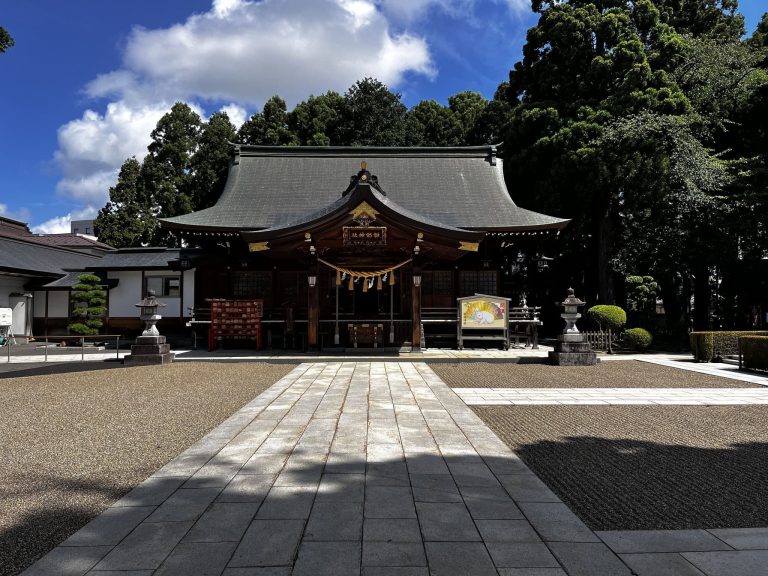
Hitaka Shrine occupies a precinct of approximately 1,518 tsubo, or about 5,000 square metres. Its principal building is an early Edo-period main hall, accompanied by the later connected worship and offering halls. The precinct also includes Mizuyama Shrine, the kagura hall, six stone lanterns, the Rusu family cemetery, the traditional Victory River site, and two Japanese cedars known as the Ubasugi.
Main shrine buildings
Main hall
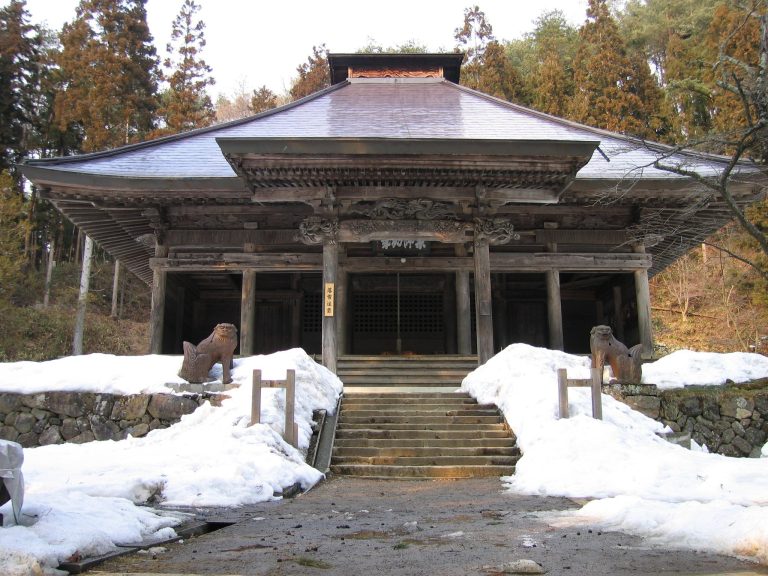
The main hall is a three-bay nagare-zukuri building, a Shinto style in which the roof extends forward to create a projecting worship porch. A bay is the structural interval between two columns, so the hall has three such intervals across its front. Its roof is covered with copper sheets and was formerly thatched. Bracketed frog-leg struts, supporting ring beams, and the tie beam beneath the projecting porch give the building distinctive structural details. Its unusual rainbow beams and frog-leg struts preserve techniques associated with the Muromachi period, the era from approximately 1336 to 1573, although the building itself dates from the early Edo period, which lasted from 1603 to 1868. It is one of the few surviving Shinto main halls in Iwate from that period and is important for understanding the prefecture’s Shinto architectural history.
Worship and offering halls
The worship hall and offering hall are attached to the main hall, creating a connected group of shrine buildings. Their present form comes from the rebuilding of 1949, and they therefore belong to a later phase than the early Edo-period main hall.
Associated buildings and historic features
Mizuyama Shrine and kagura hall
Mizuyama Shrine stands within the precinct as an ancestral-spirit shrine. Its association with water forms part of the traditional explanation for the fire-prevention festival held with Hitaka Shrine. Nearby, the kagura hall completed in 1964 provides the setting for ritual performances, including the Tanko District Kagura Festival, which has been held there since 1959.
Stone lanterns and Rusu cemetery
Six stone lanterns stand within the shrine grounds. One carries an inscription dated May 3, 1668. The precinct also contains the cemetery of Rusu Munetoshi, the first lord of Mizusawa Castle, and his son Rusu Munenao, the second lord. Together, these features preserve material links with the warrior house that shaped the shrine’s early modern history.
Victory River monument
A monument marks the place traditionally identified as the spot where Minamoto no Yoshiie washed the sword used to kill Abe no Sadato during the Former Nine Years’ War. The place is also known as Victory River, preserving a martial association within the shrine precinct.
Ubasugi cedars
Two Japanese cedars known as the Ubasugi stand in the grounds. One is traditionally said to have grown from a cedar chopstick planted by Minamoto no Yoshiie during a celebratory feast after the defeat of the Abe family, and it is consequently also called Yoshiie’s Cedar. When it received designation, this tree was approximately 24 metres high, had a trunk circumference of about 5.8 metres at breast height, and was estimated to be more than 550 years old. The second cedar also holds municipal natural-monument status.