Tomb of the Etruscan Prince: An Etruscan Funerary Monument near Pisa
Site at a Glance
- Rating
- 4.2
- Popularity
- Medium
- Country
- Italy
- Primary era
- Iron Age
- Eras represented
- Iron Age
- Civilizations
- Etruscan
- Site type
- Burial
- Remains
- Burial Mound
On this page15 sections
History
The Tomb of the Etruscan Prince is an Etruscan burial complex at Gagno, on the northwestern outskirts of Pisa, Italy, dating broadly to the seventh century BC. The Etruscans were an ancient people of central Italy whose communities flourished before Roman rule. Finds from the central pit place an early phase of the monument in the first quarter of that century.
Early development
The mound stood at the centre of a group of smaller tombs. This arrangement has been interpreted as evidence of a socially ranked society organized around kin groups, extended families or clans that claimed common descent. The necropolis appears to have served an important Pisan kin group, whose successive burials expressed its standing.
During the third quarter of the seventh century BC, the complex received further burials, extending its use. In the sixth century BC, additional graves were placed south of the mound, reinforcing its role as a monument to the group and a way to project its identity.
Sixth-century use
Ritual activity also took place around the mound. The iron trident associated with the monument has been linked with kingship and Neptune, the Roman god of the sea, but tridents were also used for fishing. A connection between the commemorated man’s status, wealth, or prestige and maritime activity remains possible, but is not established.
Together with other Etruscan finds north of the Arno, including discoveries in the Piazza del Duomo and stadium areas, the tomb supports the presence of people in the Pisa region in antiquity. Its evidence has also helped clarify broad patterns in Etruscan funerary practice.
Rediscovery and investigation
In 1853, work to enlarge the suburban cemetery on Via San Jacopo uncovered about twenty tombs in the burial complex. On 5 April 1967, digging a well brought further materials to the surface. Professor Antonio Fascetti identified them as Etruscan and publicized the discovery, which was initially described as an Etruscan-Ligurian tomb. The finds were transferred to the heritage authority.
More extensive investigations began in December 1994, prompted by a photograph and article about the 1967 discovery. The first excavations exposed slabs later identified as parts of the mound’s stone ring. Further work in September 1995 uncovered early burials, stone markers, and additional slabs associated with the complex.
Remains
Mound and central installations
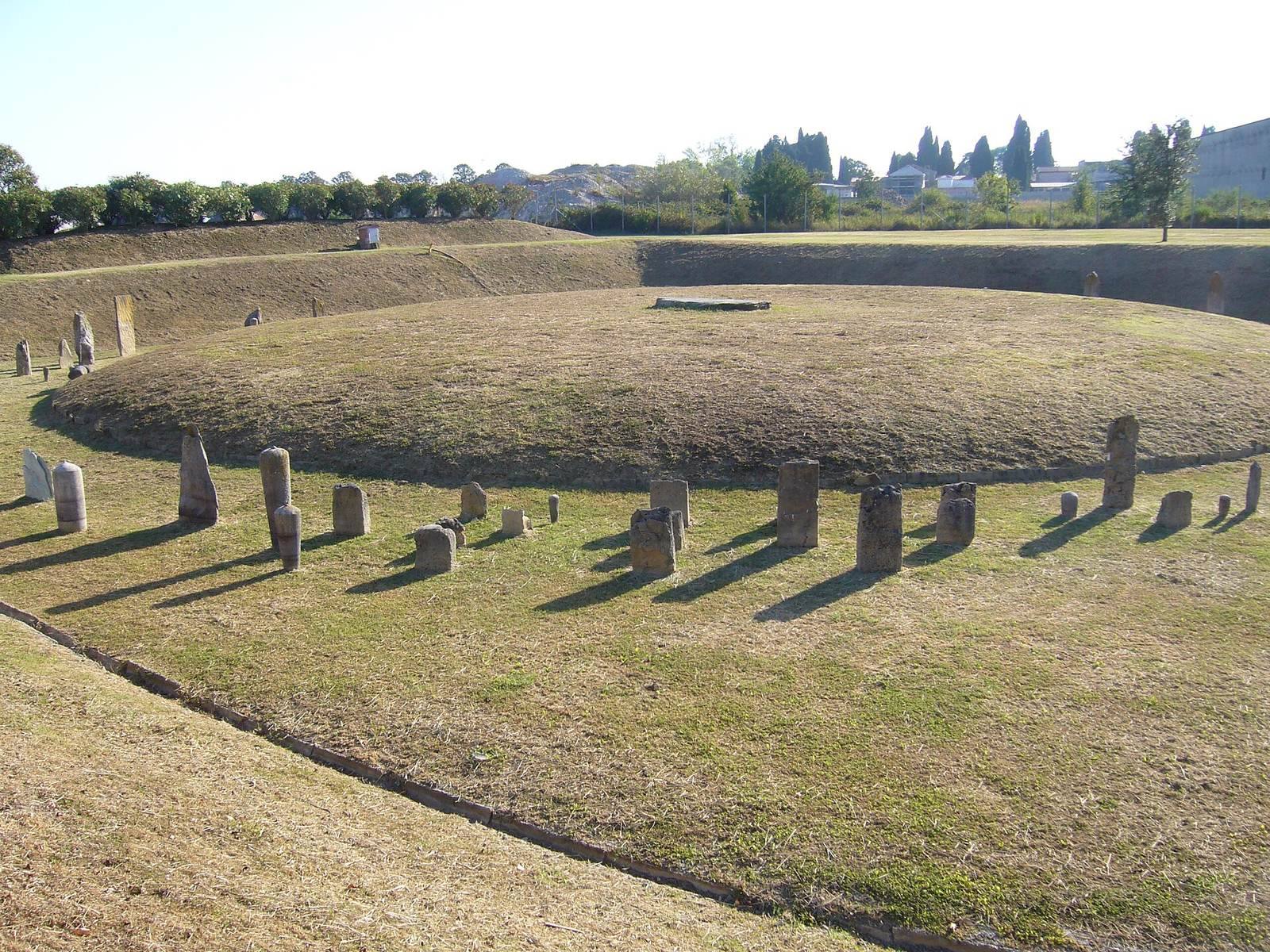
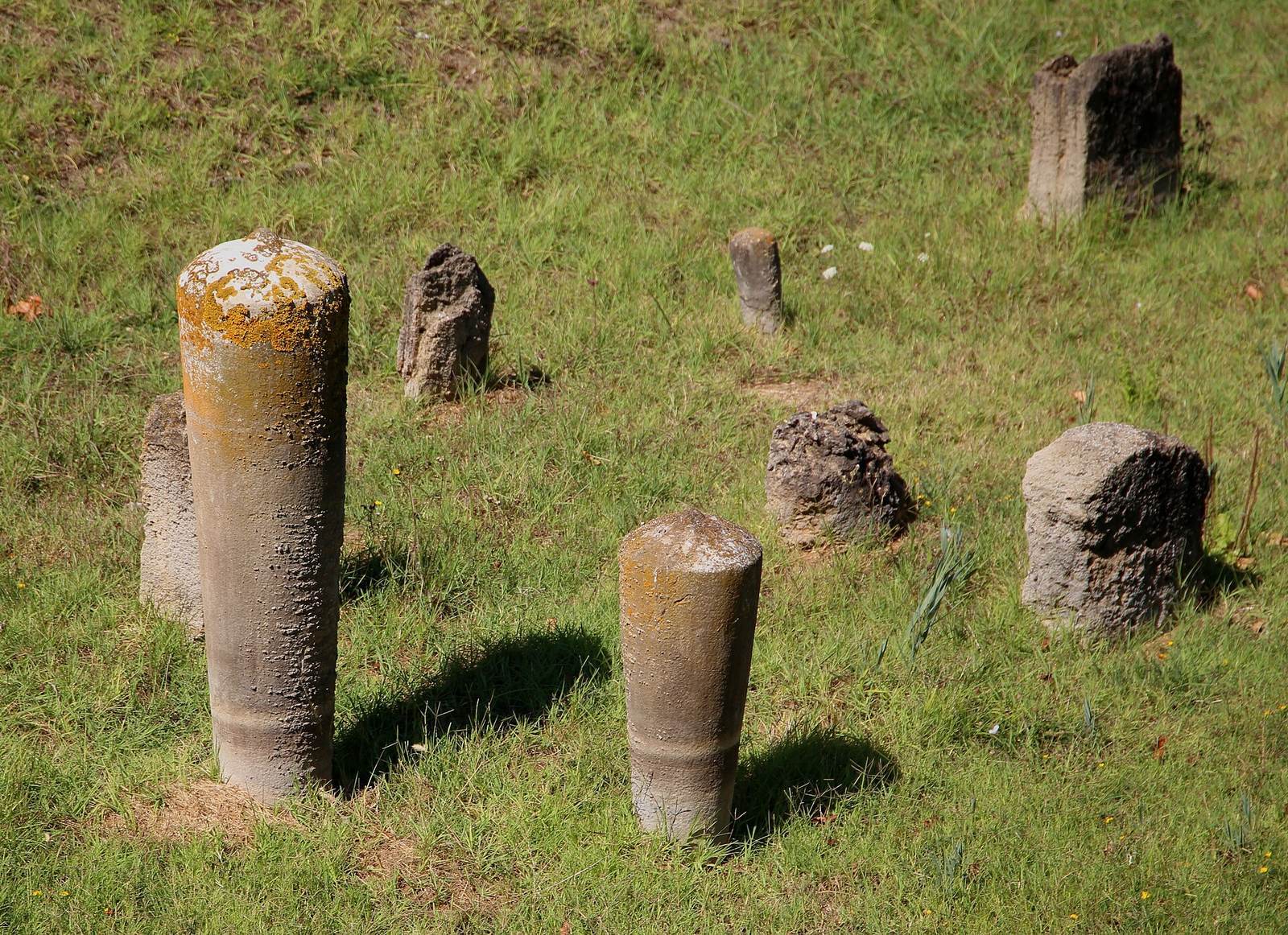
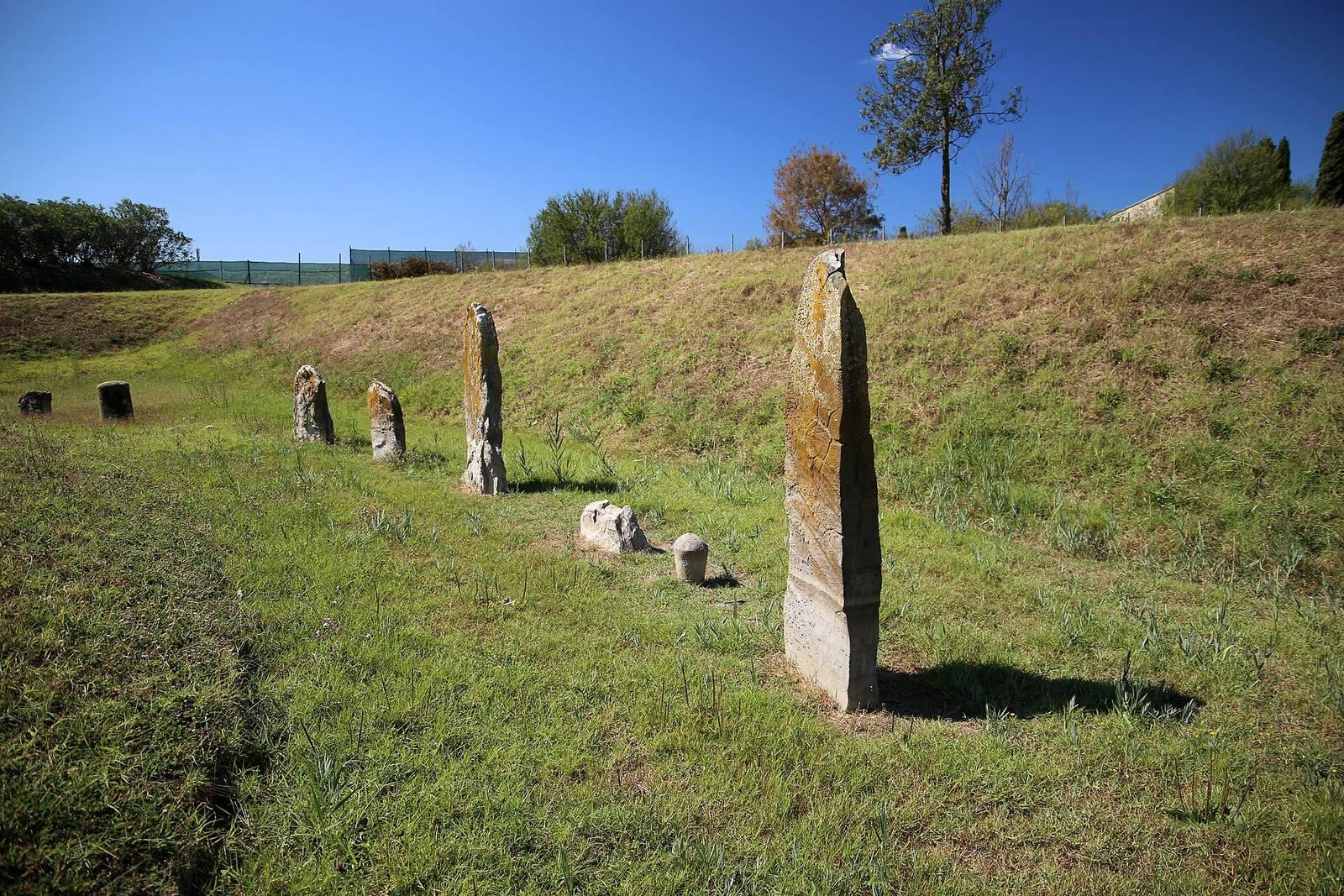
The site is arranged around an earthen mound about 30 metres in diameter. A regular ring of thin stone slabs set upright bounded it, while paired monolithic stones formed a second line about seven metres beyond the ring, with roughly two metres between pairs. In the northeastern part of the ring, two small upright slabs set at right angles may have supported a wooden step giving access to the area around the mound.
Central pit
A square pit at the monument’s centre measured four metres on each side and one metre deep. It held a wooden chest measuring 2.50 by 1.50 by 0.70 metres, with vessel fragments, a bronze cup, and sheep bones probably left from a funerary meal. Small stones filled the pit, and earth covered it to the level of the ring slabs. A triangular cavity in the fill contained sterile clay and an iron trident whose shaft had been ritually broken. The mound has been interpreted as a cenotaph, a funerary memorial to the deceased.
Central altar and deposits
An altar stood above the cavity. A knife, four iron spits, and a horse’s jaw were found on its surface. The altar was later dismantled, and some of its pieces were placed in a square pit five metres from its original position. Northeast of the altar, a decorated jar with a lid occupied another square pit. It contained abundant ash, small bronze nails, fragments of bronze sheet, and a fine gold wire. The metal fragments may have formed part of a kolossós, a substitute representation of the deceased. Burned sheep bones suggest that a fire may also have been prepared in the deceased’s honor.
Burials around the mound
Early burials to the south
Burials belonging to the early phase south of the mound used small jars set at ground level and covered with earth. Their modest grave goods consisted mainly of bronze pins and ornaments associated with women.
Later burials on the mound
Four later burials on the mound included two female and two male individuals. In one female burial, an urn and grave goods were placed inside a large jar set on a stone surface in a circular pit, which a single large stone closed. The other, less well-preserved female burial had its urn in a stone box. In the male burials, a small urn and grave goods, mostly weapons, rested on a stone slab; an inverted large jar enclosed them and was covered with earth.
Young girl’s burial
A young girl’s burial lay between the mound’s stone ring and the paired stones. Her ashes were placed in a large jar in a pit with a small perfume vessel, a necklace bearing gold pendants, and a hair fastener.
Sixth-century entrance and exterior altars
Entrance offerings
Stones marked the access area in the sixth-century entrance arrangement. A pit between the two innermost blocks held a column-handled vessel for mixing wine and water and an amphora, or large storage jar. Both were decorated in the black-figure technique, with dark figures painted against lighter clay.
Altars outside the mound
Two rudimentary altars stood outside the mound and were associated with sacrificial activity. An Attic cup, a drinking vessel associated with the region around Athens, formed part of the evidence for these rites.