Camposanto Monumentale: Pisa’s Medieval Cemetery and Museum
Site at a Glance
- Popularity
- Very High
- Country
- Italy
- Primary era
- Medieval
- Eras represented
- Medieval, Early Modern, Modern
- Civilizations
- Grand Duchy of Tuscany, Republic of Florence, Republic of Pisa
- Site type
- Burial
- Remains
- Necropolis
On this page27 sections
History
Origins and foundation
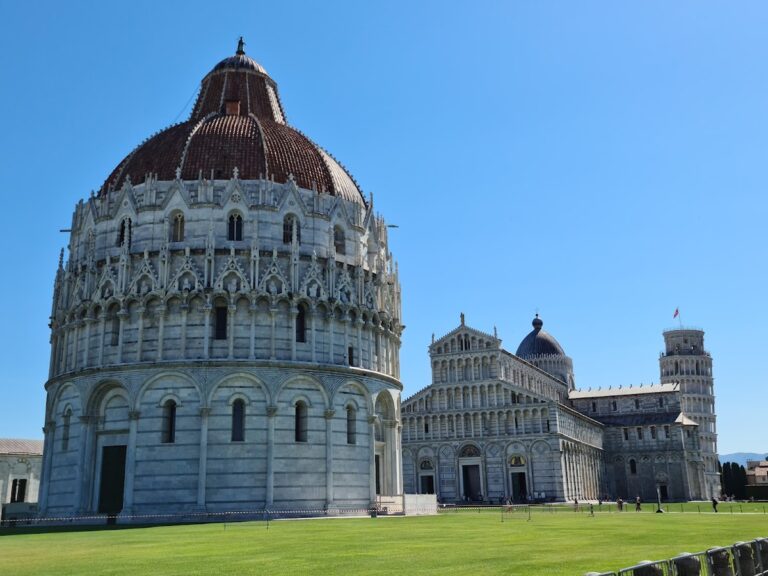
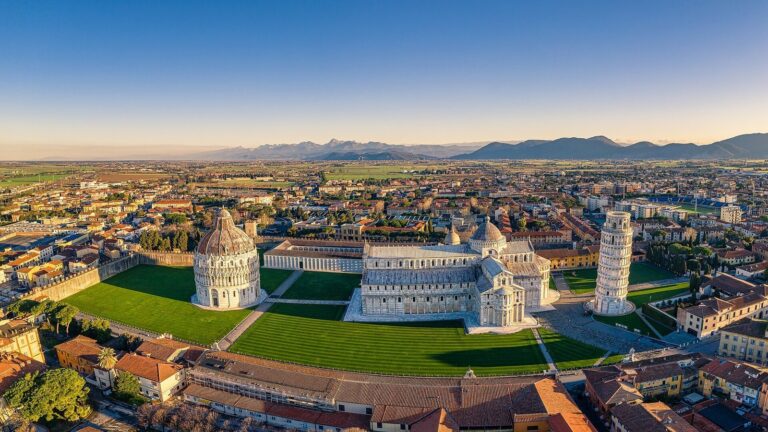
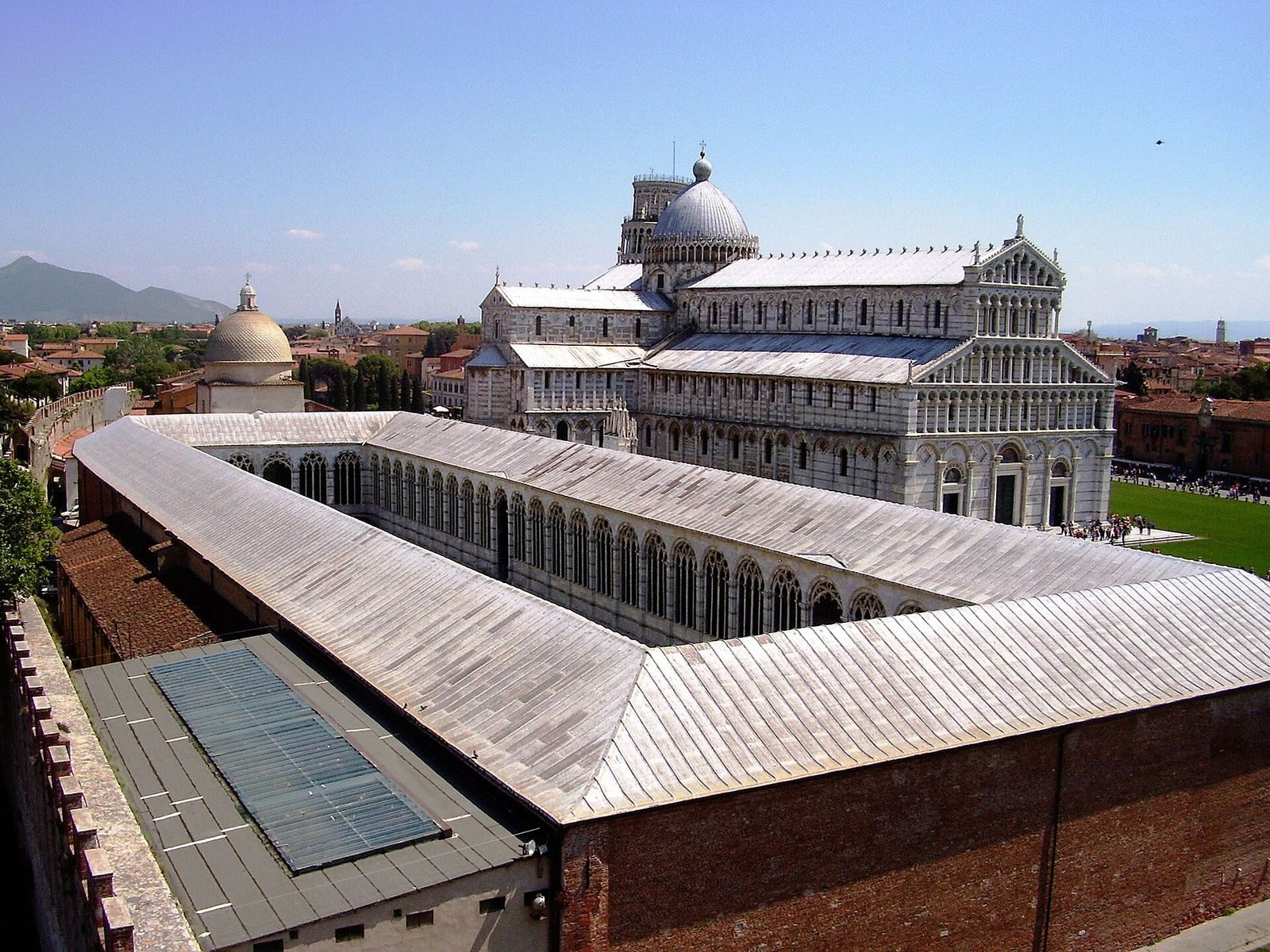
The Camposanto Monumentale is a Gothic cemetery complex on the north side of Piazza del Duomo in Pisa, Italy. Construction began in 1277 under the medieval builder Giovanni di Simone, as the city sought to bring burials around the cathedral into one enclosed cemetery. The site had already served as a burial ground and included the remains of a baptistery belonging to the church of Santa Reparata, which stood where Pisa’s cathedral now rises.
Documents from before 1287 refer to a burial place intended beside the cathedral; the name Campo Santo appears in records from that year. A tradition links the name to earth from Golgotha, the place near Jerusalem associated in Christian tradition with Jesus’s crucifixion. Archbishop Ubaldo Lanfranchi was said to have brought this sacred earth to Pisa, though the date of its arrival is uncertain. Legend held that bodies buried in it became skeletons within a day.
The cemetery project had been contemplated well before work began. From 1260, cathedral officials reportedly swore upon taking office to undertake its construction, while the city pressed for the crowded burials near the cathedral to be moved. On 19 June 1277, Archbishop Federico Visconti gave land for an enclosed cemetery. The project may initially have been conceived as a church dedicated to the Most Holy Trinity. The western part was begun for that purpose, but the design changed as the cemetery enclosure took shape. The eastern side was added to complete it.
Construction and medieval use
Work slowed after Pisa’s defeat by Genoa at the Battle of Meloria in 1284, a major naval loss for the city. Building resumed in the fourteenth century, when the design was substantially revised. Later work is associated with Lupo di Francesco, and the complex was completed in 1464. Fresco painting began during construction in the 1330s and continued over roughly three centuries, with the latest images dating to the early seventeenth century.
The Camposanto became a burial place for prominent Pisans, including civic leaders, University of Pisa rectors and professors, and members of notable families. Roman sarcophagi had already been reused for the burials of influential political and military figures between the eleventh and thirteenth centuries. From the fourteenth century, sarcophagi formerly placed around the cathedral were brought inside. Their collection and arrangement helped preserve them and also expressed Pisa’s maritime power and its claimed inheritance of ancient Rome.
From cemetery to museum
From the sixteenth century, Roman inscriptions and other historical material were gathered at the Camposanto, beginning its development as a museum. During the eighteenth and nineteenth centuries, most Roman sarcophagi around the cathedral were moved into its galleries. The transfer was considered complete after the cathedral square was refurbished in 1865, apart from the burial monument of Busketo, which remained on the cathedral façade. In the early nineteenth century, curator Carlo Lasinio also brought in sarcophagi from city churches and organized the collection as an archaeological museum.
In the nineteenth century the Camposanto became a city museum, incorporating artworks from religious institutions suppressed during the Napoleonic reforms as well as art and archaeological objects acquired for the collection. At the same time, cemetery use intensified, and new tombs filled the galleries. The complex drew Romantic-era visitors, while drawings and prints circulated images of its frescoes. Concern over flaking paint and detached plaster led to material study and early restoration efforts.
War damage and conservation
On 27 July 1944, an Allied air raid ignited the lead roof. The fire burned for three days before the roof collapsed, severely damaging the frescoes and destroying or breaking many sculptures and sarcophagi. Molten lead also harmed the stonework of the portico. Postwar rescue work included detaching frescoes from the walls; this exposed their preparatory drawings, known as sinopie, or underdrawings made before a fresco.
A conservation campaign launched in the late 1980s aimed to recover the monument’s layered historical appearance. Further deterioration led to renewed study of earlier treatments and additional restoration. The Camposanto forms part of the Piazza del Duomo, Pisa, UNESCO World Heritage Site, inscribed in 1987 and extended in 2007. It remains in Roman Catholic religious use.
Remains
Enclosure and interior
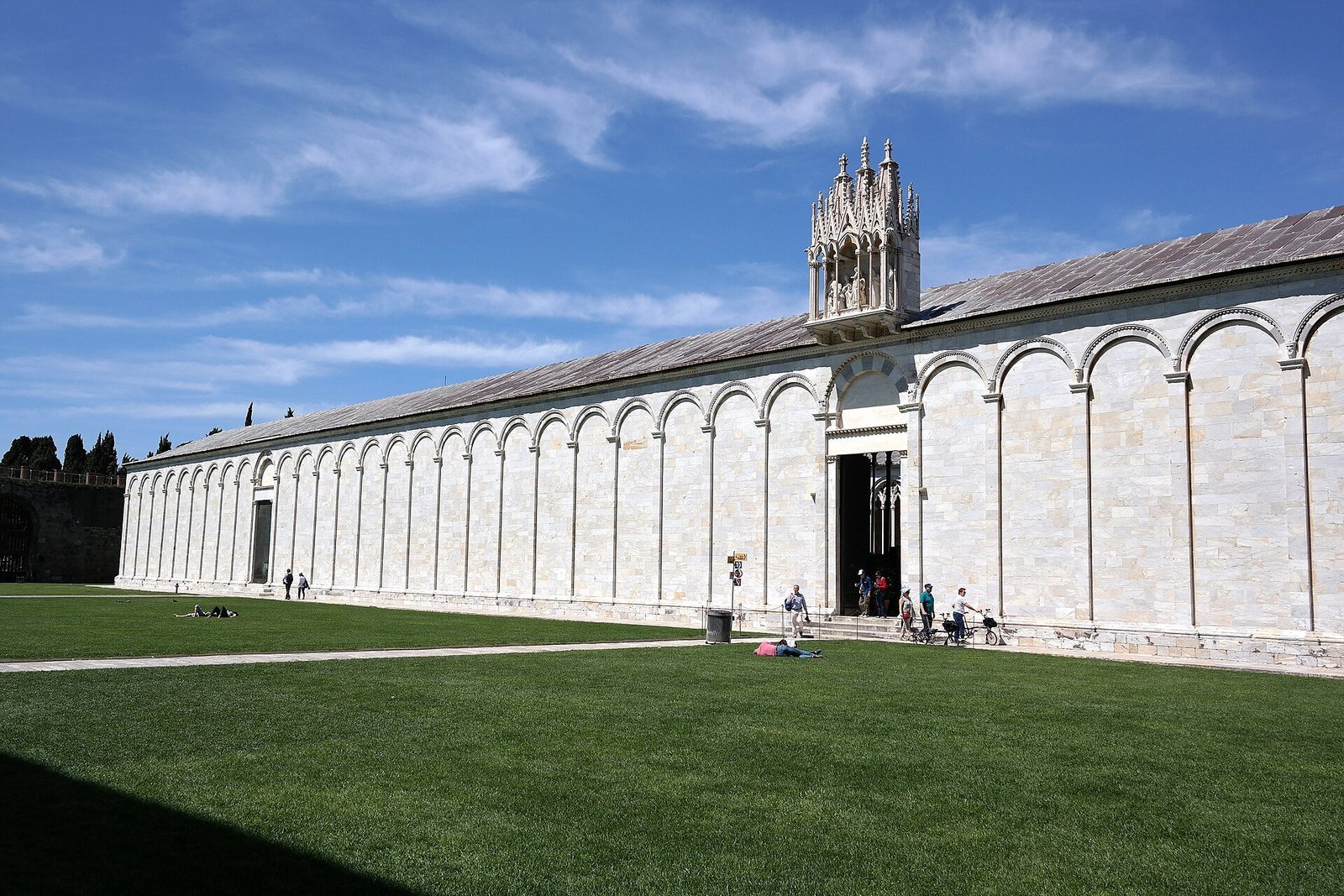
The site is an elongated rectangular enclosure, set at an angle to the axis shared by the cathedral and baptistery. Its plain white-marble exterior wall has 43 recessed, or blind, arches, with sculpted human heads at the points where the arches begin. Two entrances are on the south side, while the principal portal faces the square. A Gothic shrine above that portal, made in the second half of the fourteenth century, holds a Virgin and Child with four saints, attributed to a follower of Giovanni Pisano. The angels are attributed to Tino di Camaino. The wall’s alignment creates a perspective effect that makes the square appear larger when viewed from its ends.
Galleries and central space
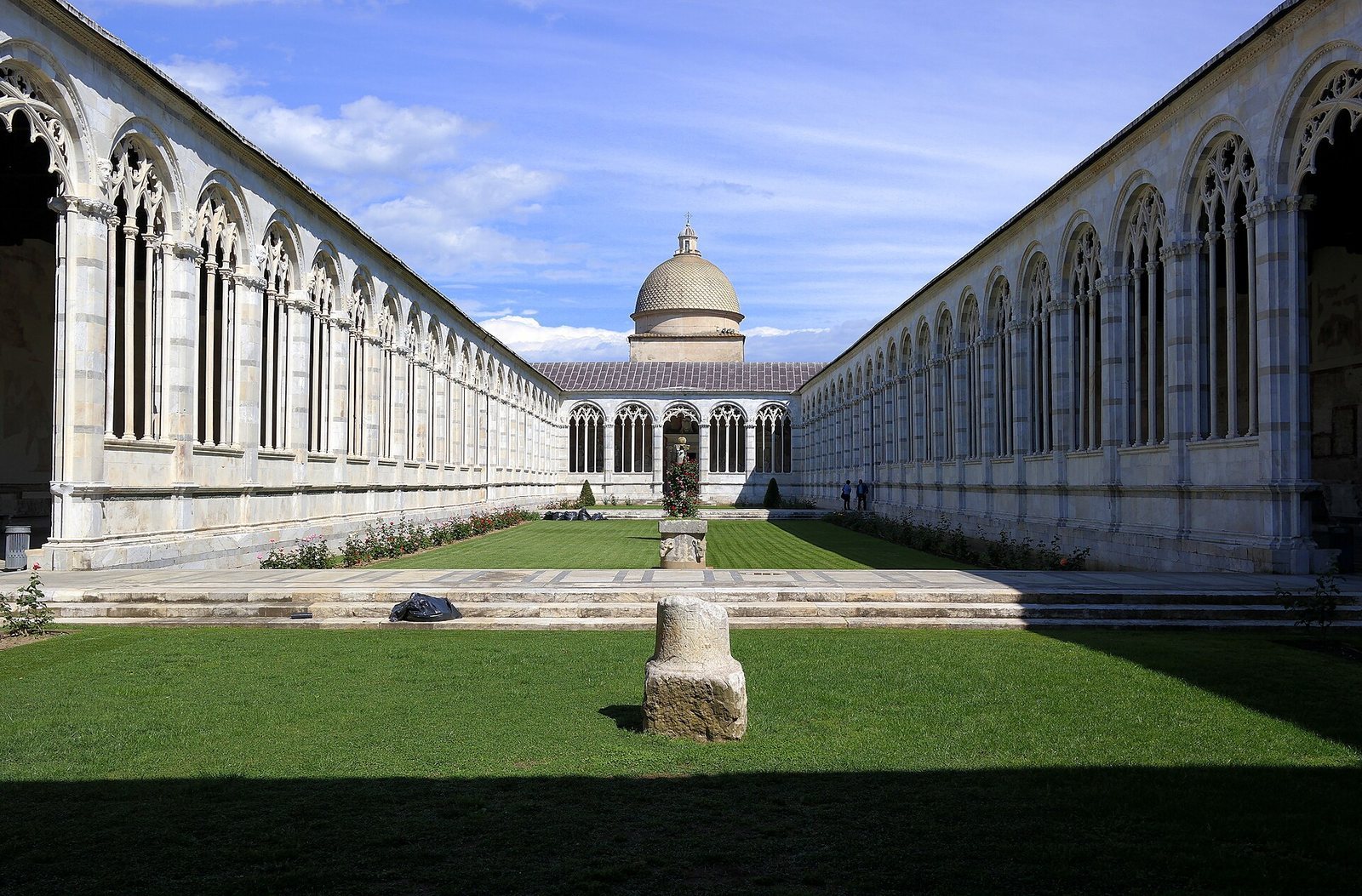
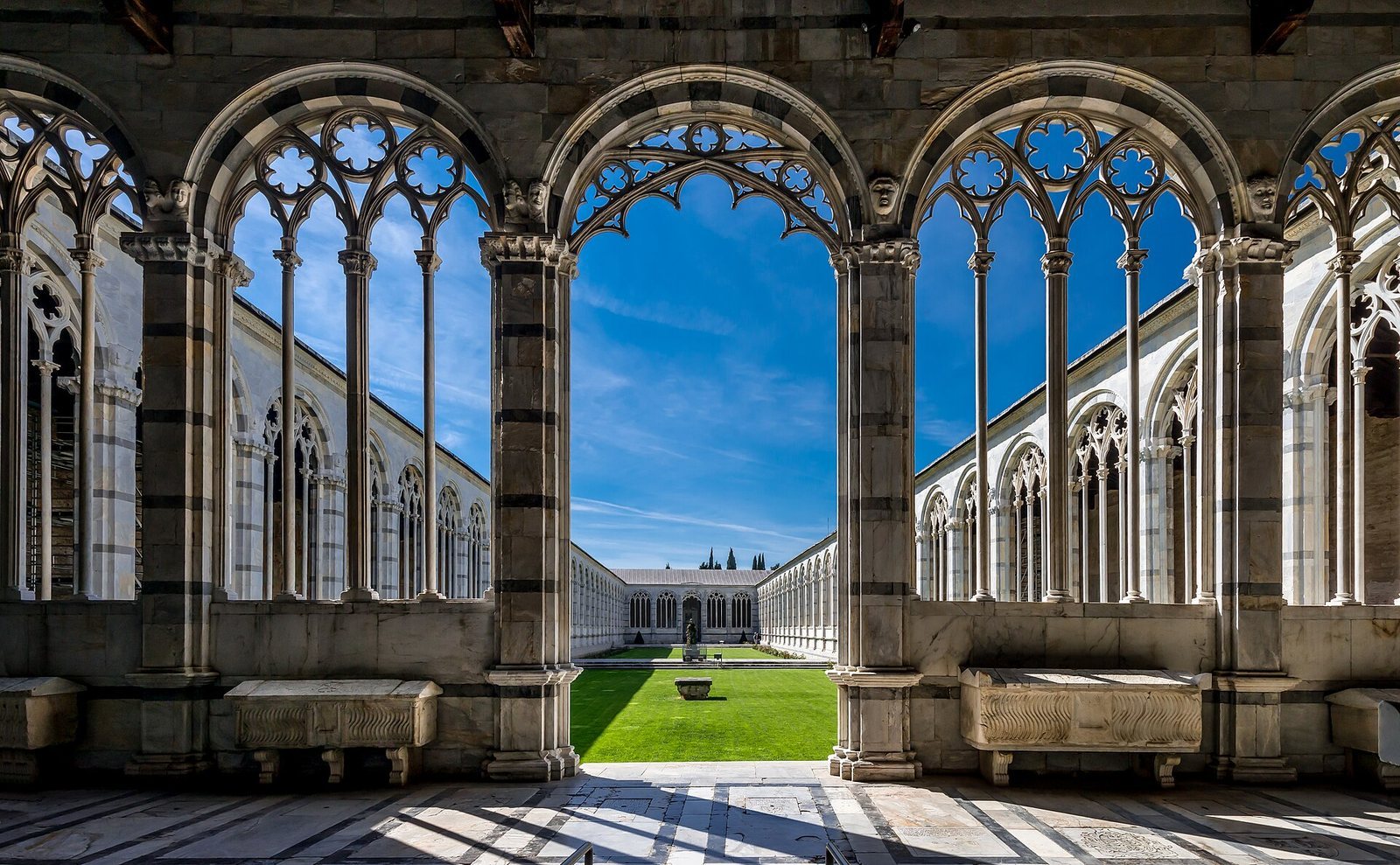
Inside, the arcades form a cloister-like arrangement. Slender columns support decorated arches with multi-lobed stone tracery. The eastern arm rises by two steps and was designed as a sacred area for altars; it and the adjoining ends of the north and south arms form the oldest and most carefully ornamented part of the complex.
Important burials were once placed in the central lawn, regarded as sacred earth, or in reused Roman stone coffins known as sarcophagi. Simpler burials lay beneath floor slabs in the arcades. Nineteenth-century rearrangement moved the sarcophagi out of the central area, and burials now lie beneath the arcades. Medieval composite capitals and two thirteenth-century wellheads, decorated with human and animal heads, stand in the central space.
Chapels
Ammannati Chapel
The oldest chapel, in the north arm, dates to about 1360 and takes its name from the tomb of Ligo Ammannati, a University of Pisa teacher who died in 1359. The tomb, from the school of Giovanni Pisano and formerly attributed to Cellino di Nese, combines a sarcophagus decorated with a Pietà, a sculpture of the deceased lying beneath a Gothic shrine, and a relief of a teacher instructing students. A Pietà depicts Mary mourning Christ’s dead body.
Nearby are stone fragments dating from the twelfth to fifteenth centuries, assembled by Lasinio in the early nineteenth century, and a Roman-period Neo-Attic krater, an ancient vessel for mixing wine and water, decorated with a procession associated with Dionysus. Nicola Pisano drew on the vessel’s motifs for the pulpit in Pisa’s baptistery.
Aulla Chapel
The Aulla Chapel, also in the north arm, contains a glazed, polychrome terracotta altarpiece by Giovanni della Robbia, dated 1518–1520. Its central image depicts the Assumption with four saints; the lower panel, or predella, shows episodes from saints’ lives. The chapel also holds the original hanging lamp that Galileo Galilei saw swinging in the cathedral.
Dal Pozzo Chapel
Archbishop Carlo Antonio Dal Pozzo built this chapel in 1594 over an older structure, at the center of the eastern arm. It has a small dome and an altar dedicated to Saint Jerome. Relics transferred from the cathedral in 2009 include remains attributed to eleven apostles, two fragments of the True Cross, a thorn from Christ’s Crown of Thorns, and a small piece of the Virgin Mary’s garment. Mass is sometimes celebrated there.
Walled openings and burial ground
Between the Ammannati and Aulla chapels, openings intended for further chapels were built already blocked. The space behind them, toward the outer wall, served as a cemetery for about forty years before the larger cemetery on Via Pietrasantina was established.
Roman sarcophagi and other ancient objects
The galleries contain 84 Roman sarcophagi, of which between 28 and 31 were reused for later burials. They are arranged near the walls; examples decorated on their backs are set apart so that both sides can be seen. Roman and Etruscan urns and sculptures are now in the sacristy museum.
West arm
Among the west-arm works is a mid-third-century sarcophagus reused by the Falconi family. Its central shrine contains two figures, with a woman and soldier on either side; a lion’s head decorates the back. Another third-century example places a couple’s busts in a central medallion held by winged spirits called genii. The sarcophagus of Bellicus Natalis, consul in AD 87, has female figures and genii holding garlands; it may be among the earliest datable evidence for the revival of sarcophagus production in the second century AD.
Other objects include a marble krater from the first century BC; a sarcophagus from the first half of the third century showing Mars and Venus in a central shrine and the twin gods Castor and Pollux at the sides; and the Bonaguida Vase. This bulb-shaped stone funerary marker dates to the late Archaic period and was reused as a funerary urn in the twelfth or thirteenth century.
North arm
At the opening of the north arm is an Attic grave marker carved from Pentelic marble, showing a seated woman before a servant and a swaddled child. Nearby, a mid-second-century sarcophagus of Lucius Sabinus, a tribune of the plebs, is decorated with pairs of centaurs and winged Victories. Four further sarcophagi beneath the large windows date to the second or third century.
Beyond the Ammannati Chapel are a fragment of Roman mosaic flooring and a large late-second-century sarcophagus depicting the Greek tragedy of Phaedra and Hippolytus. It was reused in 1076 for the burial of Beatrice, mother of Matilda of Canossa, and supplied motifs later used by Nicola Pisano for the baptistery pulpit. Nearby examples depict a Good Shepherd with a flock, a deceased woman’s bust among winged genii, and a door to the afterlife.
Beyond the Aulla Chapel, sarcophagi show a wedding ceremony, winged Victories, a procession of sea deities, and scenes involving satyrs and maenads, among other subjects. They date from the mid-third to late third century, while a large late-second-century example depicts battles between Romans and peoples described in the ancient scene as barbarians. A fragment of marble flooring with colored inlay interrupts this group. Further works include a mid-third-century sarcophagus of the Muses, whose lid shows a reclining couple, and child-burial sarcophagi with winged figures at play, racing in a circus, or in Bacchic scenes. Early-fourth-century examples depict the Good Shepherd and, on a Christian sarcophagus, Old Testament scenes arranged around the deceased couple’s busts.
Eastern arm
The eastern arm contains a Roman sarcophagus with curved, fluted decoration known as strigilation, and an early-second-century sarcophagus for Annio Proculus, a local official of the colony of Ostia, and his mother Annia. It is decorated with a headdress and bundled rods that served as a sign of office.
South arm
The south arm includes a second-century sarcophagus front showing the Good Shepherd and the Muses, an early-fourth-century work with boar-hunting scenes, and a third-century front showing a Victory writing on a shield. Ancient inscriptions mounted on the wall include decrees issued by the colony of Iulia Pisana in AD 2 and 4 in honor of Augustus’s adopted sons Gaius and Lucius Caesar.
Among the reused medieval burials is the twelfth-century sarcophagus of Giratto, an oval, fluted work by Biduino and his workshop, decorated with lions attacking prey. Its inscription is among the earliest stone inscriptions in vernacular Italian. The oval sarcophagus of Abbot Benedetto has garlands held by winged figures and lion masks; its lid inscription gives the date 1443, and the work is attributed to the workshop of Andrea di Francesco Guardi. Other Roman examples in the arm depict marine processions, Bacchus and Mercury, Nereids and Tritons, Selene and Endymion, and the hunt for Meleager. These works date from the second to late third century; the Selene and Endymion sarcophagus has a lid reworked in the Middle Ages.
Later funerary monuments
Medieval and early modern tombs
The Gherardesca monument, dated 1315–1320, was made by a follower of Giovanni Pisano known as the Master of the Gherardesca Monument. It stood in the church of San Francesco until the nineteenth century. Above its sarcophagus are a statue of Count Gherardo di Bonifacio, an Annunciation group with an angel and the Virgin, and figures of Saints Nicholas and Francis. Other notable tombs include that of Bartolomeo Medici, who died in 1555, sculpted by Tribolo, and the tombs of jurists Filippo Decio, who died in 1535, and Giovanni Boncompagni, who died in 1544. The latter has statues by Bartolomeo Ammannati dated 1574.
Eighteenth- and nineteenth-century monuments
Monuments to later Pisans include the tomb of Count Francesco Algarotti, who died in 1764, made by Carlo Bianconi, Mauro Tesi, and Giovanni Antonio Cybei, and the tomb of physician Andrea Vaccà Berlinghieri by Bertel Thorvaldsen, from about 1826. The west side also holds the tombs of painter Giovan Battista Tempesti and physician and writer Lorenzo Pignotti, who died in 1804 and 1812 respectively. On the east side are monuments to architect Alessandro Della Gherardesca, who died in 1852, and mathematician and physicist Ottaviano Fabrizio Mossotti. Lorenzo Bartolini’s sculpture The Inconsolable, dated 1840–1841, forms part of the monument to Count Giovan Francesco Mastianì-Brunacci.
Frescoes and painted cycles
The frescoes once covered the perimeter walls, with 26 compositions spread across more than 300 metres of painted surface and covering over 2,600 square metres. The earliest paintings date to the 1330s or early 1340s; the latest were made in the early seventeenth century.
Early fourteenth-century paintings
Francesco Traini is associated with a Crucifixion in the south-western area. The eastern arm has works attributed to him, dated 1330–1335, depicting the Crucifixion, Ascension, Doubting Thomas, and Resurrection. In the south gallery, Taddeo Gaddi’s Stories of Job, from about 1342, shows Job’s feast, Satan’s pact with God, Job’s misfortunes, and his patience.
Works usually attributed to Buonamico Buffalmacco include the Triumph of Death, Last Judgment, Hell, and Thebaid, painted around the first half of the fourteenth century. The Triumph of Death brings together three living people and three dead, hermits, young people struck down by Death, and angels and demons disputing over the souls of the dead, shown as children. It also depicts nobles pursuing courtly pastimes in a garden. The Last Judgment places the Redeemer between the blessed and the damned; Hell includes scenes associated with Dante and a central Lucifer. The Thebaid presents about thirty episodes from the lives of desert hermits and was retouched in its upper-right area by Zaccaria Rondinosi in the seventeenth century.
North gallery
Piero di Puccio’s Theological Cosmography (1389–1391) arranges circles representing the earth, celestial spheres, elements, and planets, with Saints Augustine and Thomas Aquinas in the lower corners. The same painter’s scenes from Genesis show Adam and Eve, Cain and Abel, Noah, and the building of the Ark.
Benozzo Gozzoli painted Old Testament scenes on the north side between 1468 and 1483. They include Noah’s harvest and drunkenness, the Tower of Babel, the destruction of Sodom, stories of Isaac and Jacob, and Moses with the tablets of the Law. The cycle also includes the crossing of the Red Sea, which survives as a fragment, as well as scenes of the Annunciation, the Adoration of the Magi, apostles, and saints.
South gallery
Frescoes of Pisan saints were painted between 1377 and 1391 by Andrea di Bonaiuto, Antonio Veneziano, and Spinello Aretino. The cycle of Saint Ranieri follows his conversion, journey to the Holy Land, temptations and miracles, return to Pisa, death and funeral, and posthumous miracles. Bonaiuto painted the first scenes in 1376–1377, while Veneziano’s scenes date to 1384–1386.
Spinello Aretino’s six scenes of Saints Efisio and Potito date to 1390–1391. They depict the saints’ presentation to the Roman emperor Diocletian, Efisio’s conversion and battle, his martyrdom, Potito’s miracles and martyrdom, and the transfer of their bodies from Sardinia to Pisa around 1380–1389.
Later paintings
Stories of Esther and Ahasuerus by Agostino Ghirlanda and Aurelio Lomi date to the second half of the sixteenth century. Zaccaria Rondinosi painted stories of King Uzziah and The Feast of Belshazzar in 1666.
Detached paintings and preparatory drawings
Following the 1944 fire, the frescoes were removed from the walls and mounted on fiber-cement panels attached to wooden frames. The revealed preparatory drawings are displayed in the Museum of the Sinopie, in buildings on the opposite, south side of the square; the museum opened in 1976 and was renovated by 2007. Later conservation replaced panels after an adhesive used in an earlier treatment failed, and sensors between the panels and walls monitor temperature and condensation. The Buffalmacco cycle returned in stages between 2005 and 2018, including the Thebaid in 2014, Hell in 2015, the Last Judgment in 2017, and the Triumph of Death in 2018. Other frescoes have also been gradually returned to their original positions.