Nagoya Shrine: Guardian Shrine of Nagoya Castle


Site at a Glance
- Rating
- 4
- Popularity
- Low
- Country
- Japan
- Primary era
- Early Modern
- External website
- Open
- Eras represented
- Early Modern
- Civilizations
- Oda regime
- Site type
- Religious
- Remains
- Sanctuary
On this page8 sections
History
Nagoya Shrine is a Shinto shrine in Nagoya, Japan, traditionally founded on March 16, 911, by imperial command beside Hachioji Shrine and Wakamiya Hachimansha. Originally affiliated with Tsushima Shrine as one of the Tenno shrines, it enshrined Gozu Tennō and later became the guardian shrine of Nagoya Castle and the tutelary shrine of Nagoya.
Foundation and destruction
Emperor Daigo, who reigned from 897 to 930, is associated with the shrine’s traditional foundation. In 1532, its buildings burned during the battle in which Oda Nobuhide seized Nagono Castle from Imagawa Ujichika. Nobuhide rebuilt the shrine in 1540. A temple called Kiozan Anyoji, also known as Tenno-bo, was later established beside it as the shrine’s affiliated temple.
A passage in the opening section of the Shinchō Kōki states that Oda Nobunaga studied at a temple called Tenno-bo. This is considered to refer to Anyoji, linking the former affiliated temple with Nobunaga’s early education.
Tokugawa Nagoya
In 1595, Toyotomi Hideyoshi granted the shrine lands yielding 348 koku. In 1610, Tokugawa Ieyasu began constructing Nagoya Castle on the site of the former Nagono Castle. The shrine and its two neighboring shrines would have stood within the planned castle grounds, but a divination ordered by Ieyasu indicated that Nagoya Shrine should remain in place. It therefore stayed in the Sannomaru area, directly opposite the Ninomaru Ote Nimon Gate, and assumed its role as the castle’s guardian shrine.
Hachioji Shrine was moved to present-day Shimizu in Nagoya’s Kita Ward, while Wakamiya Hachimansha was moved to present-day Sakae in Naka Ward. Nagoya Tōshō-gū was established immediately west of Nagoya Shrine in 1619. In 1620, Tokugawa Yoshinao, Ieyasu’s son and the first lord of the Owari branch of the Tokugawa family, reconfirmed the shrine’s 348-koku estate and repaired its buildings. In 1629, he established the subsidiary Hyōzu Shrine.
Festivals and religious change
During the Edo period, the shrine’s Tenno Festival was regarded as one of Nagoya’s three major festivals, alongside those of Nagoya Tōshō-gū and Wakamiya Hachimansha. Since the Tenno and Wakamiya festivals took place on the same day, they were collectively known as the Gion Festival. The procession included two dashi, or festival floats, together with more than ten other vehicles.
During the Meiji period, the government’s separation of Shinto and Buddhism required the two traditions, which had long been institutionally connected, to be distinguished. Gozu Tennō was replaced as the principal deity by Susanoo, a Shinto kami associated with storms, the sea, and the slaying of the eight-headed serpent in Japanese mythology. The shrine was renamed Susanoo Shrine, its estate was confiscated in 1871, and Anyoji was demolished.
In 1876, the shrine and Nagoya Tōshō-gū were moved to their present locations, the former site of the Meirindo domain school, because the Nagoya Garrison was to occupy the castle. Hyōzu Shrine was then combined with the main sanctuary. The shrine took the name Nagoya Shrine in 1899. In 1900, a kagura hall for sacred music and dance was built, and the building also served as a Noh stage. Monthly Noh performances were held there. In 1907, the shrine became eligible to receive offerings of food and cloth.
Wartime destruction and later history
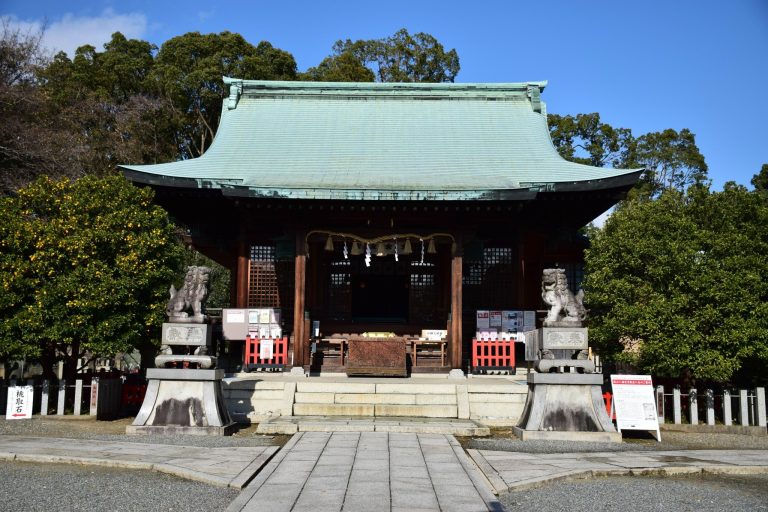
The main sanctuary was destroyed during the Nagoya air raid of March 19, 1945, in the Pacific War. It was largely rebuilt by 1959. The kagura hall survived the bombing but was destroyed by fire in 1992. Nagoya Shrine is now associated with Susanoo, Kushinada-hime, the Eight Pillar Deities, and the Hyōzu Deity, and it was formerly classified as a prefectural shrine.
Remains
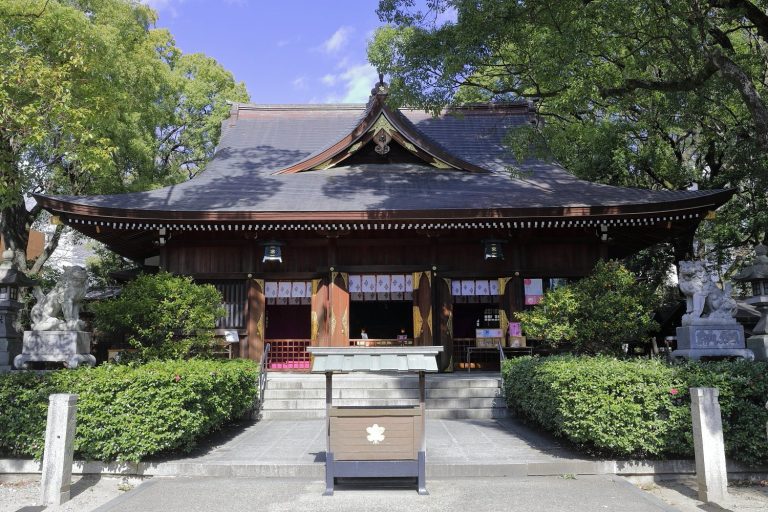
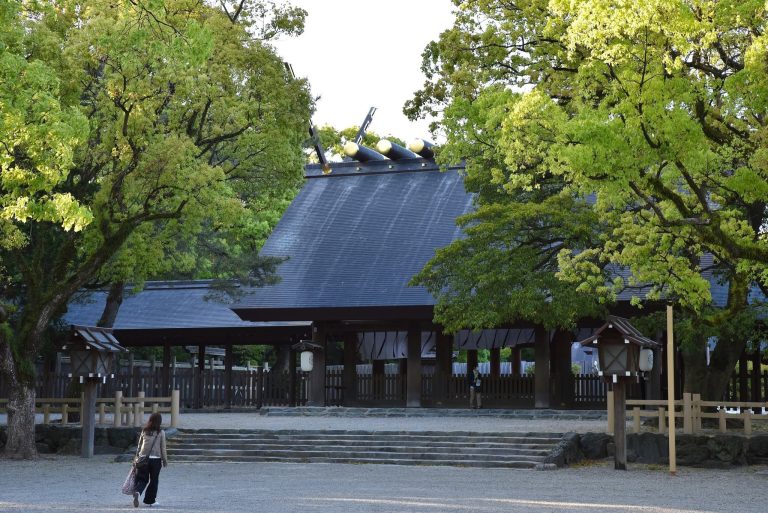
The present precinct occupies the former site of the Meirindo domain school, with Nagoya Tōshō-gū immediately to the west. Its arrangement includes the main sanctuary, a worship hall, and subsidiary shrine elements. The former Hyōzu Shrine is incorporated with the main sanctuary rather than standing as a separate building, reflecting the reorganization of the precinct in 1876.
Sanctuary and performance buildings
The main sanctuary was largely reconstructed by 1959 after its destruction in the 1945 air raid. The precinct also had a kagura hall, a building for sacred music and dance that served as a Noh stage. Although it survived the wartime bombing, the hall was later destroyed by fire in 1992.
Festival remains
The historic Tenno Festival procession used two dashi floats and more than ten additional vehicles. Most of these procession vehicles were lost in the 1945 air raid. One dashi remains associated with Nagoya Shrine and is displayed within the precinct. The festival also continues through a mikoshi, a portable shrine carried in ritual procession, that travels to Wakamiya Hachimansha. During the Wakamiya Festival on May 16, one float and a mikoshi from the formerly neighboring shrine travel between the two shrines.