Tsuboi Hachimangū: The Tutelary Shrine of the Kawachi Genji


Site at a Glance
- Rating
- 4.3
- Popularity
- Low
- Country
- Japan
- Primary era
- Early Modern
- External website
- Open
- Eras represented
- Early Modern
- Civilizations
- Tokugawa
- Site type
- Religious
- Remains
- Sanctuary
On this page9 sections
History
Tsuboi Hachimangū is a Shinto shrine in Japan, located in Habikino, Osaka, and was founded in 1064 during the Heian period by Minamoto no Yoriyoshi. Dedicated to Hachiman, Empress Jingū, and Emperor Chūai, it became the principal tutelary shrine of the Kawachi Genji, the Minamoto lineage based in Kawachi Province.
The Kawachi Genji Foundation
The surrounding area became the home of the Kawachi Genji after Minamoto no Yorinobu became governor of Kawachi Province in 1020. Yorinobu, his son Yoriyoshi, and his grandson Yoshiie lived there for three generations, giving the branch its name. The lineage belonged to the Seiwa Genji, the Minamoto branch traditionally traced to Emperor Seiwa.
On 15 May 1064, after Minamoto no Yoriyoshi returned victorious from the Earlier Nine Years’ War, an eleventh-century conflict in northeastern Japan that ended with the defeat of the Abe clan, he established the shrine at Mount Kōromine. It stood north of the Kawachi Genji family temple Tsūhōji and east of Yoriyoshi’s private residence. He invited the worship of Iwashimizu Hachimangū, and the place-name changed from Kōromine to Tsuboi. Hachiman, traditionally associated with warfare, protection, and the imperial tradition, became the shrine’s central religious figure.
After taking Buddhist vows, Yoriyoshi founded Kerinji, also called Hanawa-ji, west of the shrine. An image of Amida Buddha attributed to Jikaku Daishi was installed there. The Takagi family became the hereditary priestly family of Tsuboi Hachimangū and is said to descend from Minamoto no Yoshitoki, a descendant of Yoshiie. Traditions differ over whether Yoshitoki was Yoshiie’s fifth or sixth son.
Expansion and Ancestral Worship
Yoriyoshi later established another shrine of Iwashimizu Hachimangū in Kamakura as a base for the Kawachi Genji’s expansion into eastern Japan. That foundation was first called Tsurugaoka Wakamiya and later became Tsurugaoka Hachimangū. In 1109, Minamoto no Yoshitoki founded Tsuboi Gongen Shrine within the Tsuboi precinct as an ancestral shrine and object of veneration for the Kawachi Genji.
When Minamoto no Yoritomo, Yoriyoshi’s fifth-generation descendant, founded the Kamakura shogunate in the late twelfth century, the principal tutelary shrine of the Kawachi Genji shifted from Tsuboi Hachimangū to Tsurugaoka Hachimangū. Tsuboi thereafter served as the ancestral and tutelary shrine of the Ishikawa Genji, the branch of the Kawachi Genji that settled locally.
War, Rebuilding, and Later Changes
War fires from the Nanboku-chō period through the Warring States period repeatedly damaged the shrine, and it fell into decline. Its present shrine buildings were rebuilt in 1701 on the orders of Tokugawa Tsunayoshi, the Tokugawa shogun, by Yanagisawa Yoshiyasu, his senior administrator and adviser.
During the Meiji period, the shrine was known as Hachiman Shrine. Ishimaru Shrine, Shimmei Shrine, Hachiman Shrine at Hirose, Ōkiokami Shrine, and Asukato Shrine were merged into it. Ōkiokami Shrine and Asukato Shrine later became independent again, in 1955 and 1952 respectively. After the Second World War, the institution took the name Tsuboi Hachimangū.
Tsuboi Hachimangū is regarded as one of the Three Genji Shrines, together with Rokusonō Shrine in Kyoto and Tada Shrine in Kawanishi. The precinct’s Tsuboi Gongen Shrine, also called Tsuboi Shrine, preserves the association with the Minamoto lineage through its dedication to Yorinobu, Yoriyoshi, Yoshiie, Yoshitsuna, and Yoshimitsu. The shrine is associated with nationally designated cultural properties, while its camphor tree has natural-monument status in Osaka Prefecture and is included among the Osaka Green Hundred selections.
Remains
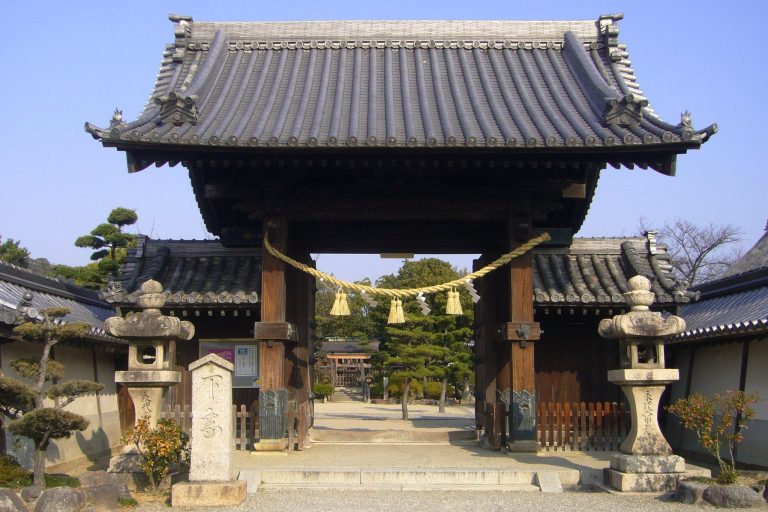
The surviving precinct combines the principal shrine, its middle gate, the subsidiary Tsuboi Gongen Shrine, a shrine office, the Tsuboi Water Well, and a camphor tree. The principal buildings and the buildings of Tsuboi Gongen belong to the rebuilding of 1701, while the well, tree, and transmitted objects preserve further links with the shrine’s Minamoto traditions.
Principal Shrine Buildings
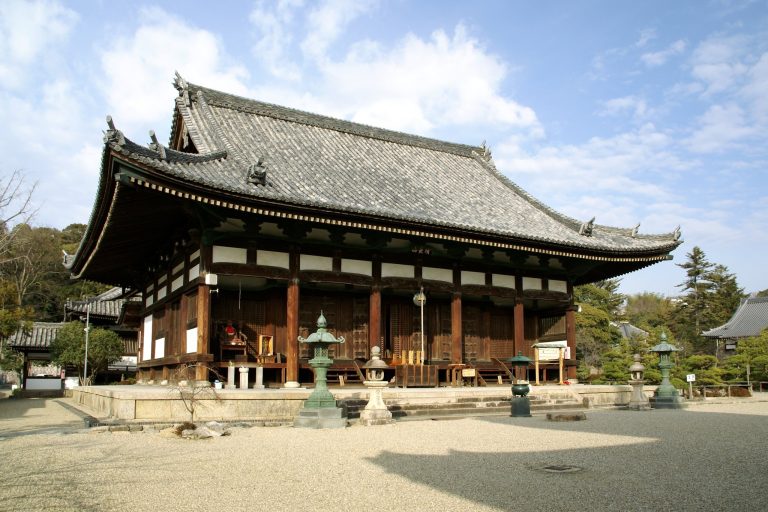
The principal shrine building and middle gate were rebuilt in 1701 by Yanagisawa Yoshiyasu under the orders of Tokugawa Tsunayoshi. These structures form the principal architectural remains of the early eighteenth-century reconstruction that followed the shrine’s repeated destruction by war fires.
Tsuboi Gongen Shrine
Tsuboi Gongen Shrine, the subsidiary shrine within the precinct, has a main sanctuary and a worship hall, both rebuilt in 1701. The sanctuary is dedicated to the five Minamoto figures associated with the Kawachi Genji: Minamoto no Yorinobu, Minamoto no Yoriyoshi, Minamoto no Yoshiie, Minamoto no Yoshitsuna, and Minamoto no Yoshimitsu.
Well and Camphor Tree
The Tsuboi Water Well is associated with Minamoto no Yoriyoshi. A camphor tree also stands within the grounds. It is designated a natural monument of Osaka Prefecture and forms part of the Osaka Green Hundred selections.
Transmitted Arms and Armor
The shrine transmits a black leather-laced dōmaru cuirass, a form of Japanese body armor, traditionally said to have been used by Minamoto no Yoshiie. The armor is designated an Important Cultural Property. Another transmitted object is the sword inscribed “Yasutsuna,” whose blade bears the name “Tenkomaru.” It is traditionally known as the Tenkomaru Sword and is designated an Important Art Object. The Kawachi Meisho Zue describes it as one of a paired male and female set made from the same iron as the Onikiri sword, transmitted from Minamoto no Mitsunaka and worn by Yoshiie.