Treasury of the Basilica of Saint Servatius: A Historic Church Collection in Maastricht
Site at a Glance
- Popularity
- Medium
- Country
- Netherlands
- Primary era
- Medieval
- Eras represented
- Medieval, Modern
- Civilizations
- Dutch, Holy Roman Empire
- Site type
- Religious
On this page28 sections
History
The Treasury of the Basilica of Saint Servatius is the historic church collection in Maastricht, Netherlands. Its relics, meaning objects associated with saints, and reliquaries, containers made to hold relics, accumulated through donations over many centuries. By about 1070, the holdings were extensive enough to require a custodian dedicated to their care.
Among the early gifts, Einhard, a Carolingian scholar and abbot, gave the church a reliquary shaped like a triumphal arch, now lost, and probably also presented the Key of Saint Servatius. In the tenth century, Henry the Fowler, an East Frankish king, transferred relics of the saint, including his original crozier, a hooked pastoral staff, to the newly established church at Quedlinburg. In 1039, Holy Roman Emperor Henry III gave the church the object later called the Pectoral Cross of Saint Servatius.
Medieval growth and pilgrimage
Donations enlarged the treasury in the later Middle Ages. By the thirteenth century, and certainly by the fourteenth, the church held a public showing of relics every seven years. Tens of thousands of pilgrims came to see them. The principal relics were displayed from a gallery around the choir to people gathered in Vrijthof square. Three cloths traditionally believed to have wrapped Saint Servatius’s body were especially renowned. After each showing, the church bells rang and pilgrims sounded horns. Visitors could then view other relics inside the church and, at times, touch them.
War, displacement, and loss
In 1579, Spanish forces commanded by Alexander Farnese, Duke of Parma, captured and sacked Maastricht. The attack badly damaged the treasury. The three celebrated cloths disappeared, and the original bust of Saint Servatius was largely destroyed. Farnese gave the church a new reliquary bust to replace it.
Threatened by war, the treasury was taken to Liège in 1634 and returned in 1654. In 1677, chapter dean Lipsen prepared its first detailed catalogue.
Dispersal and renewed study
After French forces occupied Maastricht in 1794, the church chapter faced heavy war taxes. Gold and silver objects were melted down or sold to pay them. Further valuables were sold after the chapter was dissolved late in the eighteenth century, although canons had moved some objects to safety. Most of the treasure returned after religious services resumed in 1804, but some objects were lost or entered collections abroad. The treasury was reduced further by sales during the nineteenth century. Former holdings are now in institutions including the National Library of the Netherlands in The Hague, the Royal Museums of Art and History in Brussels, the Louvre and Petit Palais in Paris, the Alte Pinakothek in Munich, museums in Berlin and Hamburg, the Victoria and Albert Museum in London, and the Metropolitan Museum of Art and Morgan Library & Museum in New York.
Interest in the collection was renewed after Aachen canon Franz Bock and Maastricht chaplain and treasurer Michaël Willemsen published a study in 1872, followed by a fuller French-language edition. Willemsen served as treasurer from 1862 to 1878. The collection also grew during the nineteenth and twentieth centuries through metalwork from churches in Limburg that had ceased to function and objects recovered in archaeological investigations at the church complex.
Rehousing and recent changes
In 1873, the treasury moved to a former chapter school in the west cloister, restored by architect Cuypers. It transferred to the former refectory in 1895, and an additional room was added in 1930. Following restoration of the double chapel, the treasury returned there in 1982. Brother Sigismund Tagage, treasurer from about 1965, advocated for the return and helped bring the collection to wider attention. The treasury is designated a national monument.
In 2020, the Shrine of Saint Servatius was moved out of the treasury after the pandemic created a desire to pray at it and its use within the collection space prompted objections. The dean and church board decided on the move in May, after Bishop Harrie Smeets had led a prayer at the shrine on 15 March. Four nineteenth-century reliquary busts of Maastricht bishops had already been transferred to the church, and nineteenth-century copies of the shrine’s companion reliquaries moved with it. The bust of Saint Servatius went to the Stichting Restauratie Atelier Limburg for conservation in 2022. A comprehensive reorganization of the treasury followed and was completed in 2025.
Remains
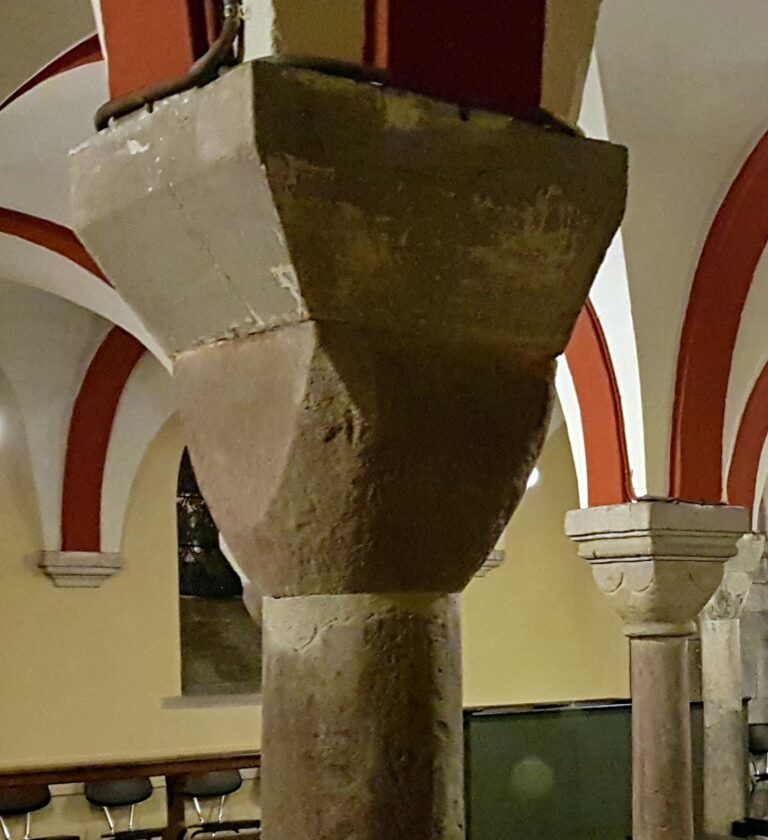
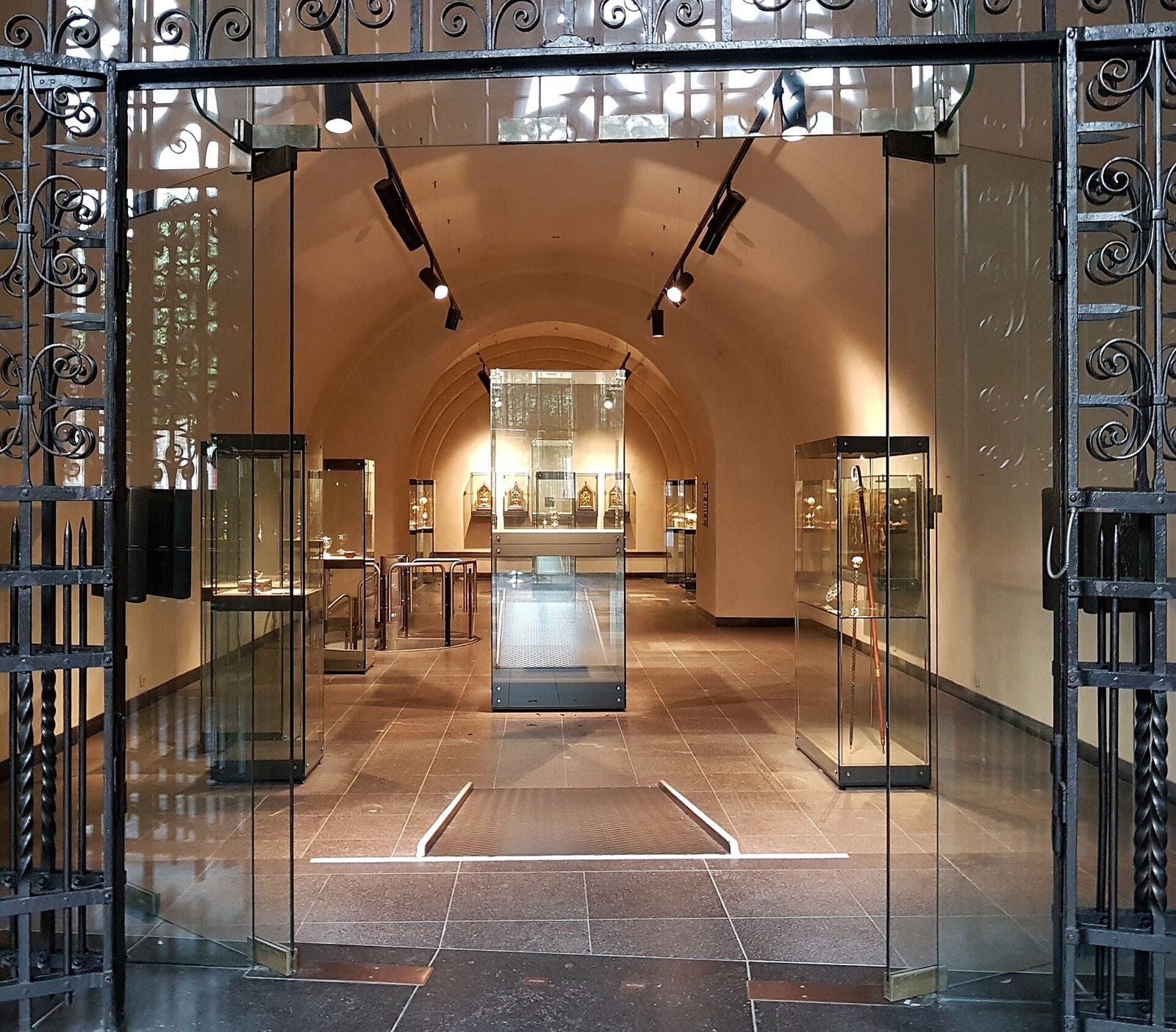
The treasury occupies both levels of a double chapel, with an additional room on each floor. Built of coal sandstone, the chapel has thick walls and few windows. Its entrance is from the east cloister, a covered walkway around a courtyard. Inside, steps descend to the lower chapel, while a staircase in a side room leads to the upper one. Another stairway from the lower chapel’s front room reaches a basement where remains of an earlier church can be seen.
The double chapel
Lower chapel
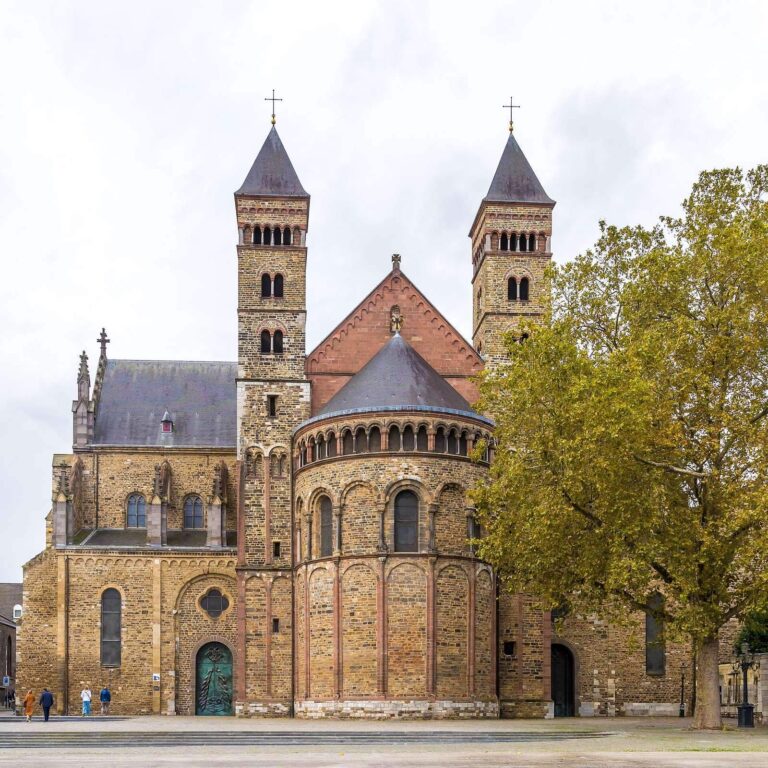
Built in the second half of the eleventh century under Provost Humbertus, a senior cleric who headed the church chapter, the double chapel is among the oldest surviving parts of the church. The lower floor has two rooms. The front room served as a burial chapel for provosts and deans. Behind it, a chamber known as the old sanctuary appears to have held the main treasury for centuries; its use for that purpose is securely associated with the year 1340. The dark, vaulted space had four relic cupboards with iron-bound doors.
Upper chapel
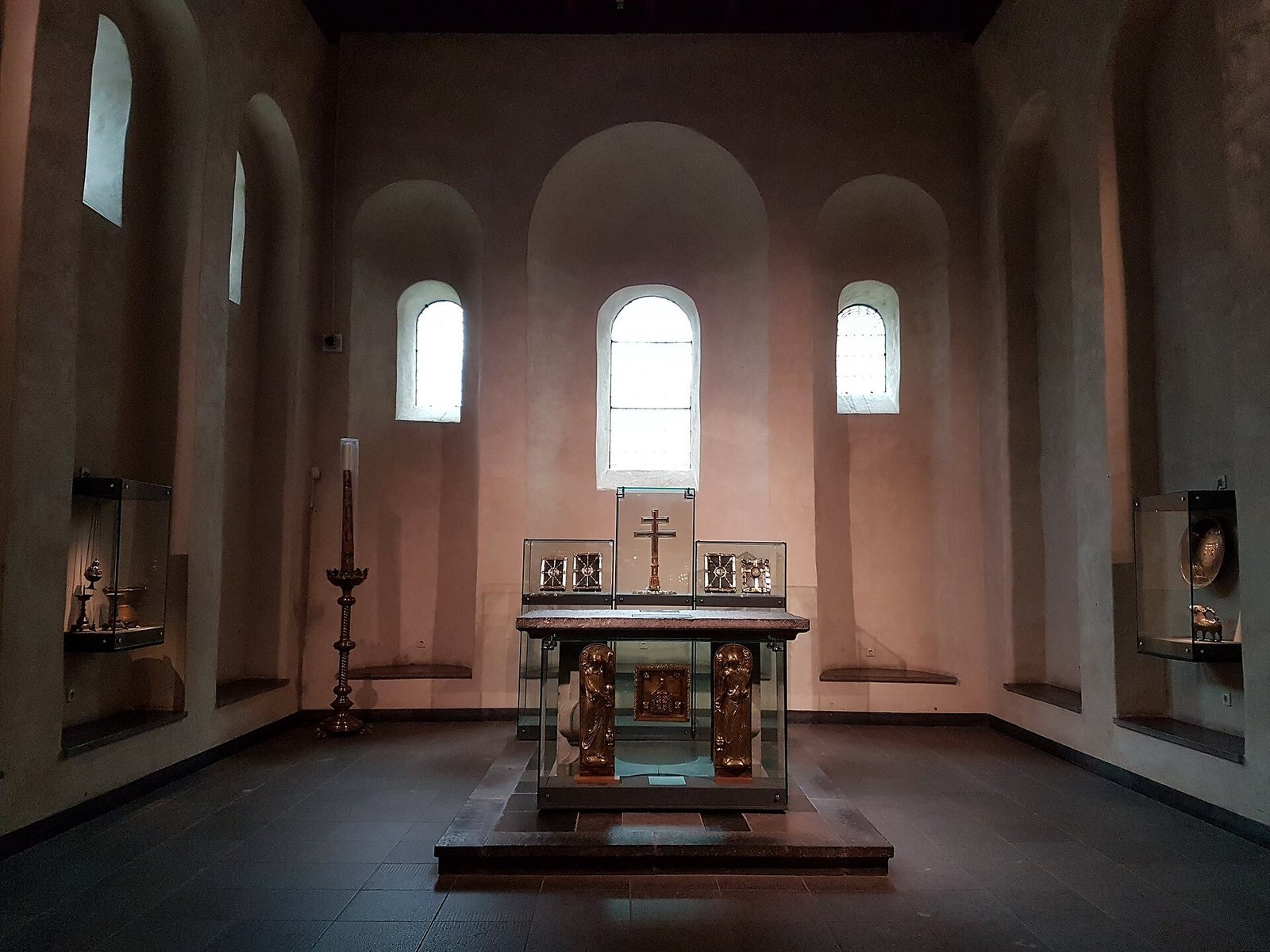
A small room on the north side of the choir bay, the upper chapel is entered through a door from the sanctuary. It held objects including the key, drinking cup, crozier, and pilgrim’s staff of Saint Servatius in 1525, and these were also shown to visitors there. The room continued to serve this purpose in the seventeenth century. Art historian Fred Ahsmann considers it plausible that it had been used as a treasury as early as the twelfth century.
Cloister features and basement
Late-fifteenth-century capitals in the cloister opposite the lower chapel entrance show angels holding church treasures, including the key, the saint’s bust, and the three cloths. A wall painting from the period of Cuypers’s restoration remains above the former entrance in the west cloister. Tiles from the double chapel are now in the cloister garden. The basement contains visible wall remains from an earlier church.
Objects associated with Saint Servatius
Key, crosses, and staffs
The silver Key of Saint Servatius is an ornamental cast object from the early ninth century. The wooden Pectoral Cross, probably made in the first half of the eleventh century, is fitted with gold and silver, enamel, gemstones, and an ivory figure of Christ. A twelfth-century portable altar is made of green serpentinite, a metamorphic stone, with silver fittings. The collection also includes a ninth-century wooden pilgrim’s staff with silver fittings and a carved ivory crook, as well as a twelfth-century wooden crozier with an ivory-and-silver crook. The latter replaced the original staff transferred to Quedlinburg. A worked bloodstone seal in a silver setting is dated between the thirteenth and fifteenth centuries.
Cup and travelling vessels
A first-century Roman drinking cup is made of millefiori glass, whose patterned glass rods create flower-like designs. It is displayed with a seventeenth-century silver cup shaped like a pineapple. A silver travelling chalice and paten, the plate used to hold Eucharistic bread, date to the thirteenth century.
Shrine and bust
The Shrine of Saint Servatius, also known as the Noodkist, is an oak chest covered in gilded copper and ornamented with enamel, rounded polished gemstones, fine wirework, and a brown decorative finish. Dating to about 1160, it once stood on the church’s main choir and is now in the north transept. Four original gabled reliquaries that accompanied it were sold in 1843; nineteenth-century copies accompanied the shrine when it left the treasury in 2020.
The gilded-silver bust of Saint Servatius is a portrait-shaped reliquary made after the 1579 sack to replace the largely destroyed original. Part of the saint’s skull may remain inside. Eight worked silver plaques showing scenes from his life, removed from the earlier bust, are now in Hamburg’s Museum für Kunst und Gewerbe.
Relics and other reliquaries
Cross and arm reliquary
The 73-centimetre patriarchal cross, a cross with two horizontal bars, is made of silver and contains relics of the True Cross. Its base was made around 1490 by Maastricht silversmith Master Ulrich Peters; the cross itself is probably older. A 71-centimetre silver reliquary of Saint Thomas takes the form of an arm and contains a crystal cylinder that may hold one of the apostle’s arm bones. Godfrey of Bouillon, a Frankish nobleman and leader of the First Crusade, may have given the relic around 1100. It was first kept in another container, replaced in the fifteenth century.
Other reliquary forms
The collection includes twelfth- and thirteenth-century Limoges enamel boxes, thirteenth- and fourteenth-century ivory horns and caskets, and cattle or aurochs horns with silver fittings from the fourteenth and fifteenth centuries. Five fourteenth-century table reliquaries are made of gilded copper. Three silver bust reliquaries from the same century represent John the Baptist, Saint Livinus, and Saint Lambert. Other forms include reliquaries shaped as heads, arms, feet, ostrich or cassowary eggs, and ivory caskets. The collection also holds numerous copper reliquaries from the nineteenth and twentieth centuries and a richly decorated coconut reliquary from the seventeenth century. Vessels for displaying relics and ivory reliquary caskets are among the other forms represented.
Worship and textiles
Liturgical objects
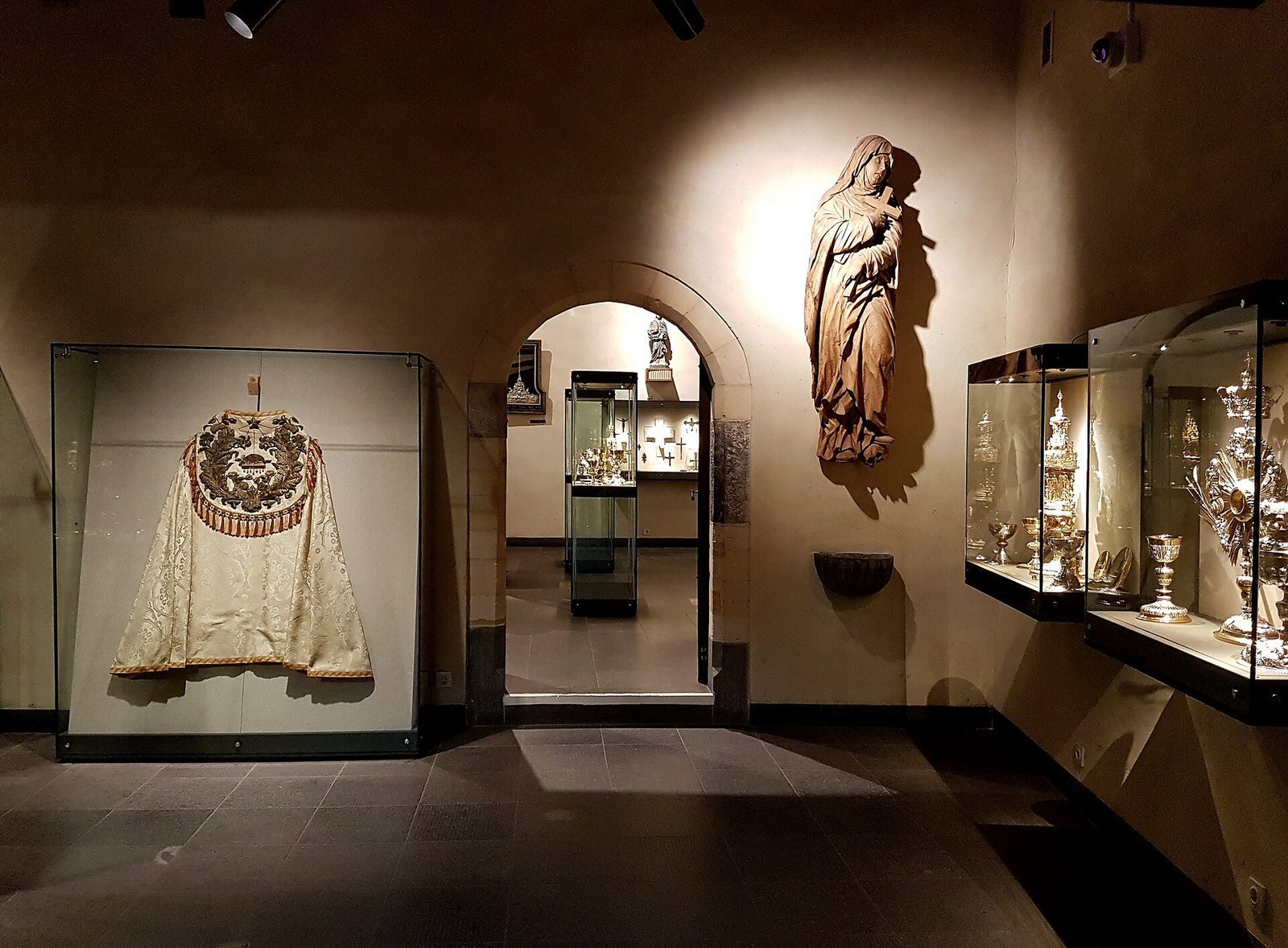
The liturgical collection brings together surviving medieval pieces, some very old crosses, and many Baroque chalices and vessels for displaying the consecrated host or relics. It includes Maastricht-made silverwork, tin objects, a twelfth-century processional cross from the Meuse region, and communion silver loaned by Maastricht’s Lutheran church.
Textiles
The medieval fabrics include the so-called alb of Saint Servatius, a long white garment worn by clergy that came from the shrine, and the robe of Monulfus, an early bishop of Maastricht. Early medieval silk fragments came from Constantinople, Egypt, and Central Asia, with some dating to the seventh century. Other medieval textiles are from the Meuse-Rhine region, Spain, Italy, and the Middle East. Part of the upper chapel is darkened to protect the fragile fabrics, and a plaque there records the appreciation of the basilica and treasury boards.
Artistic holdings
Paintings, prints, and books
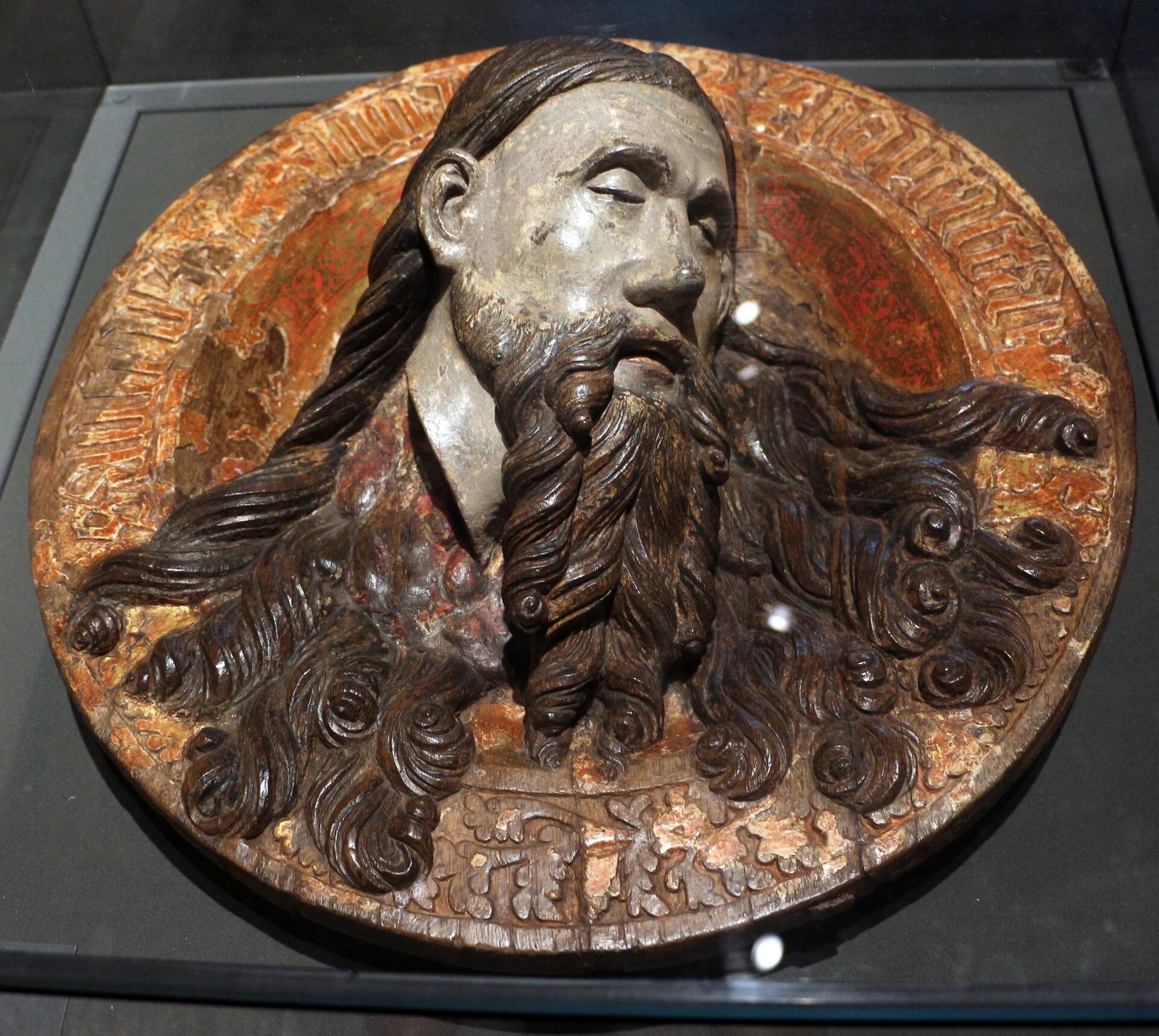
The treasury displays paintings, prints and engravings, illuminated books, and other works, although not all belong to the historic church treasury. A painting of the True Image of Jesus, associated with the circle of fifteenth-century painter Jan van Eyck, is now in Munich’s Alte Pinakothek. Other works include a fifteenth-century panel of the Holy Kinship, depicting Jesus and Mary’s extended family and showing Saint Servatius as a boy; a miniature Crucifixion in the Eden book; a possibly South Netherlandish Holy Trinity from the sixteenth century; and Johannes Bosboom’s view of the church’s westwork, its monumental western section, painted in 1848–49.
Sculpture and metalwork
Two twelfth-century gilded-copper reliefs of angels holding censers came originally from the treasury of the Church of Our Lady. Two carved pieces of a hardstone baptismal font date from the same period. Other sculptures include a Saint Anne with the Virgin and Child and a Saint John the Evangelist from the workshop of the Master of Elsloo; a Christ before Caiaphas associated with the circle of Tilman Riemenschneider; and a beam bearing portrait busts of the twelve apostles, made around 1500. The metal crucifixes include examples from the fifth and sixth centuries. Some sculpture and other artworks belong to a wider collection with works displayed elsewhere in the church.
Ivory carving
Medieval ivory caskets include elaborate carvings of people and animals. One casket from the eleventh or twelfth century, perhaps made in southern Italy or Sicily, shows clear Arab influences. Other ivory works include a probably French Annunciation and Madonna and Child from about 1340–50, a possibly French Crucifixion of the fifteenth century, and a possibly German Adoration of the Magi from that century. A German fifteenth-century relief depicts the Adoration of the Shepherds. The holdings also include a sixteenth-century openwork ivory box and a Baroque ivory image of Christ before his crucifixion from the workshop of Ulm sculptor and ivory carver David Heschler.
Archaeological remains
Burials and early church remains
Excavations in the lower chapel in 1981–82 revealed graves of provosts and canons beneath the floor of the lower treasury chamber. The oldest epitaph dates to 1296. Walling uncovered in the same area was first interpreted as part of a twelve-sided central building, but was later identified as belonging to a church from the late tenth or early eleventh century. That building had polygonal ends to the arms of its cross-shaped plan. Its remains can be seen in the double chapel basement.
Humbertus’s grave cross
A lead grave cross found in the 1980s belonged to Humbertus, who died in 1086 and was buried beneath the church floor. The cross carries an extensive inscription and provides important evidence for the church’s building history.
Finds from the church complex
The treasury also displays finds from elsewhere in the church and its immediate surroundings. Other archaeological material is held in the lapidarium, a place for displaying or storing stonework and fragments, in the eastern crypt. It includes part of a Roman sarcophagus, four early Christian gravestones, Frankish sarcophagi, building fragments from the Merovingian and Carolingian churches, an eleventh-century cenotaph, and pieces of a Gothic rood screen, a partition between the choir and the rest of a church. Larger architectural fragments and grave crosses are set along the cloister walls.