Trakai Peninsula Castle: A Medieval Brick Gothic Fortress in Lithuania


Site at a Glance
- Rating
- 4.8
- Popularity
- Medium
- Country
- Lithuania
- Primary era
- Medieval
- Eras represented
- Medieval, Early Modern
- Civilizations
- Grand Duchy of Lithuania, Polish–Lithuanian Commonwealth
- Site type
- Military
- Remains
- Castle
On this page7 sections
History
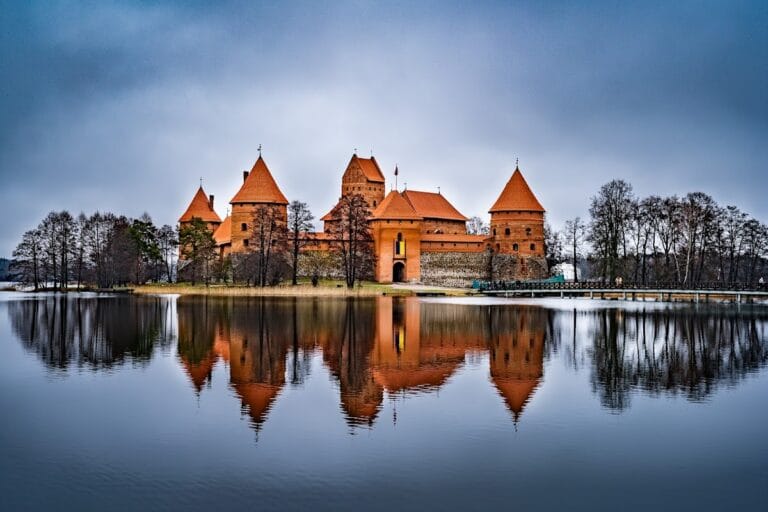
Trakai Peninsula Castle is a medieval fortress in Trakai, Lithuania, built by Kęstutis, Duke of Trakai, around 1350–1377 in the Brick Gothic tradition. It stood on a peninsula between Lakes Galvė and Luka and helped defend Trakai and Vilnius, the political center of the Grand Duchy of Lithuania, against the Teutonic Knights, a German military-religious order that fought Lithuania and other Baltic powers.
Foundation and military role
Kęstutis established the castle during the third quarter of the fourteenth century as an important defensive position. A moat separating the fortifications from the town strengthened the site’s protection. Its position supported the defense of Trakai and the approach to Vilnius during conflicts with the Teutonic Knights.
The castle was attacked in 1382 and 1383 during the civil war between Vytautas, Kęstutis’s son, and Jogaila, his political rival. Fighting reached the fortress again in 1390 during a later civil war. The castle was rebuilt after these attacks, preserving its role within the military landscape of the Grand Duchy of Lithuania.
Residence, decline, and destruction
The Treaty of Melno, concluded in 1422, settled a major conflict involving Lithuania, Poland, and the Teutonic Order. After the treaty, the castle’s strategic defensive importance declined, although the grand dukes continued to use it as a residence. Grand Duke Sigismund Kęstutaitis was murdered at the castle on 20 March 1440.
By the sixteenth century, the castle had deteriorated and served mainly as a prison for political opponents of the grand dukes. Russian forces destroyed it during the Russo-Polish War of 1654–1667, and it was never rebuilt as a castle. In 1678, Marcjan Aleksander Ogiński, Voivode of Trakai, a high-ranking territorial governor in the Polish-Lithuanian Commonwealth, transferred the ruins to the Dominicans, a Catholic religious order.
Monastery and modern conservation
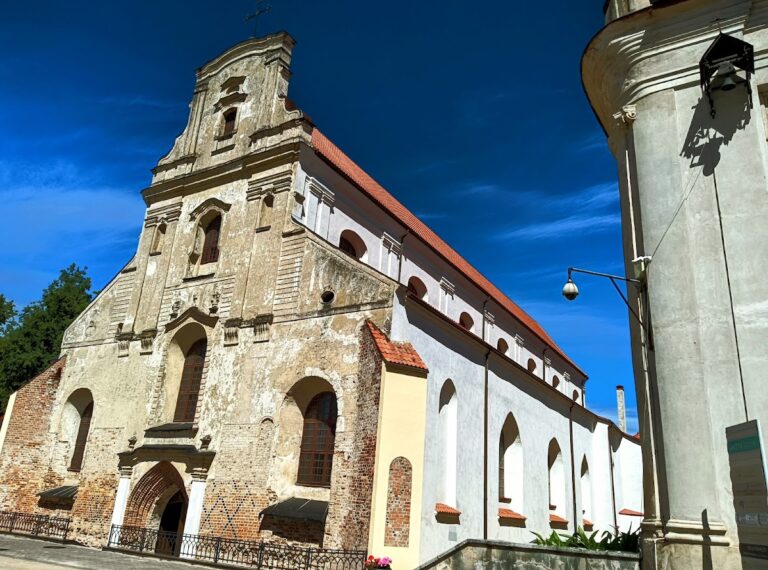
During the 1770s, the Dominicans built a monastery and church on the former castle grounds. These buildings became part of the castle ensemble, and their principal structures survive alongside the medieval remains.
By the twentieth century, only several castle towers remained, and they were in a dangerous condition. E. P. Tyszkiewicz investigated and described the ruins in 1854. The site received national-monument status in 1933. Archaeological excavations and conservation of the fortifications began in the 1950s, followed by Soviet restoration work that reconstructed the lost tower tops under the supervision of Bronius Krūminis and Stanislovas Mikulionis. Reconstruction resumed in 2002. Trakai Peninsula Castle is included in Trakai Historical National Park and became a national cultural monument of Lithuania on 12 June 1998.
Remains
The surviving site occupies a peninsula between southern Lake Galvė and Lake Luka. Its fortifications were separated from the town by a moat approximately 12–14 metres wide. The fortress used both brick and stone and followed a Brick Gothic building tradition, in which brick served as the principal structural and decorative material.
Fortifications and towers
The castle was enclosed by walls approximately 10 metres high and had six or seven square-section towers, generally described as seven. Three larger towers, each measuring about 15 by 15 metres, protected the vulnerable southwestern side. Several towers and sections of the enclosing fortifications survive. Their lost upper parts were reconstructed during Soviet restoration, and further reconstruction resumed in 2002.
A description made in 1414 by the traveller Gilbert de Lannoy presents a different picture of the castle, calling it very old and saying that it was built entirely of wood and wattle enclosed by turf. This account contrasts with the brick-and-stone construction associated with the surviving fortifications and the castle’s classification as Brick Gothic.
Dominican buildings
The former castle grounds also contain the Dominican monastery and church built during the 1770s. Their principal structures survive as part of the later architectural ensemble, occupying the site after the medieval fortress had been destroyed and transferred to the Dominican order.
Nearby sites