Senieji Trakai Castle: A Medieval Lithuanian Fortification
Site at a Glance
- Rating
- 4.6
- Popularity
- Low
- Country
- Lithuania
- Primary era
- Medieval
- Eras represented
- Medieval, Modern
- Civilizations
- Grand Duchy of Lithuania, Russian
- Site type
- Military
- Remains
- Castle
On this page11 sections
History
Senieji Trakai Castle is a fortified medieval site in Lithuania, generally dated to the late thirteenth or fourteenth century and associated with the development of Lithuanian rule around Trakai. A historical tradition attributes the first brick enclosure to Grand Duke Gediminas, whose early fourteenth-century reign was linked to the expansion of Lithuania and the transfer of the capital from Kernavė to Trakai before 1321. Medieval references to “Trakai Castle” do not always make clear whether they concern Senieji Trakai or the later castle at present-day Trakai.
Dynastic conflict and siege warfare
Kęstutis’s Trakai Castle was mentioned in 1375, when forces of the Teutonic Order, a German military-religious order that campaigned repeatedly against Lithuania and intervened in its dynastic conflicts, established a night camp opposite the fortification. In February 1377, those forces attacked what was called a “new Trakai Castle.”
On 20 July 1382, the castle surrendered to Jogaila, who had Teutonic support, and Jogaila transferred it to Skirgaila. Kęstutis soon made an unsuccessful attempt to recover it. On 12 September 1383, the castle surrendered to Vytautas after a battle in which two bombards, large early cannons used in siege warfare, fired at it from opposite sides. The Teutonic forces supporting Vytautas left a garrison of 60 men under John Rabe.
Jogaila and Skirgaila led a Lithuanian army against the castle about two weeks later. The siege lasted six weeks, from 24 September to 3 November, and included the use of machines designed to demolish masonry. After the surrender, the garrison withdrew to Prussia, while the castle suffered severe damage. A 17 m section of its walls collapsed.
Abandonment and monastic occupation
In 1390, Skirgaila burned the castle during the Teutonic attack on Vilnius. The site was then abandoned as a castle and was not rebuilt, because Kęstutis had established a new fortification at Trakai. In 1405, Grand Duke Vytautas granted the former castle to Benedictine monks, members of a Western Christian order following the Rule of Saint Benedict, and founded a church there. The monastery later occupied the former castle area.
Tradition associates the site with the wedding of Grand Duke Kęstutis and Birutė and places Vytautas’s birth there in 1350. Archaeological work later clarified the earlier fortification and the subsequent monastic occupation. The Institute of History surveyed the site in 1955, while investigations led by Albinas Kuncevičius between 1994 and 1997 covered 355 m². Evidence indicates that the castle was built on an unoccupied site. A cultural layer about 1 m thick, dating from the fifteenth to eighteenth centuries, belongs to the period of Benedictine occupation.
Senieji Trakai Castle, its outer bailey, and its settlement became a protected cultural monument under a Lithuanian government resolution of 13 February 2008. The protected territory covers 7.91 hectares, and archaeological finds from the site are kept at the National Museum of Lithuania.
Remains
Fortifications and castle courtyard
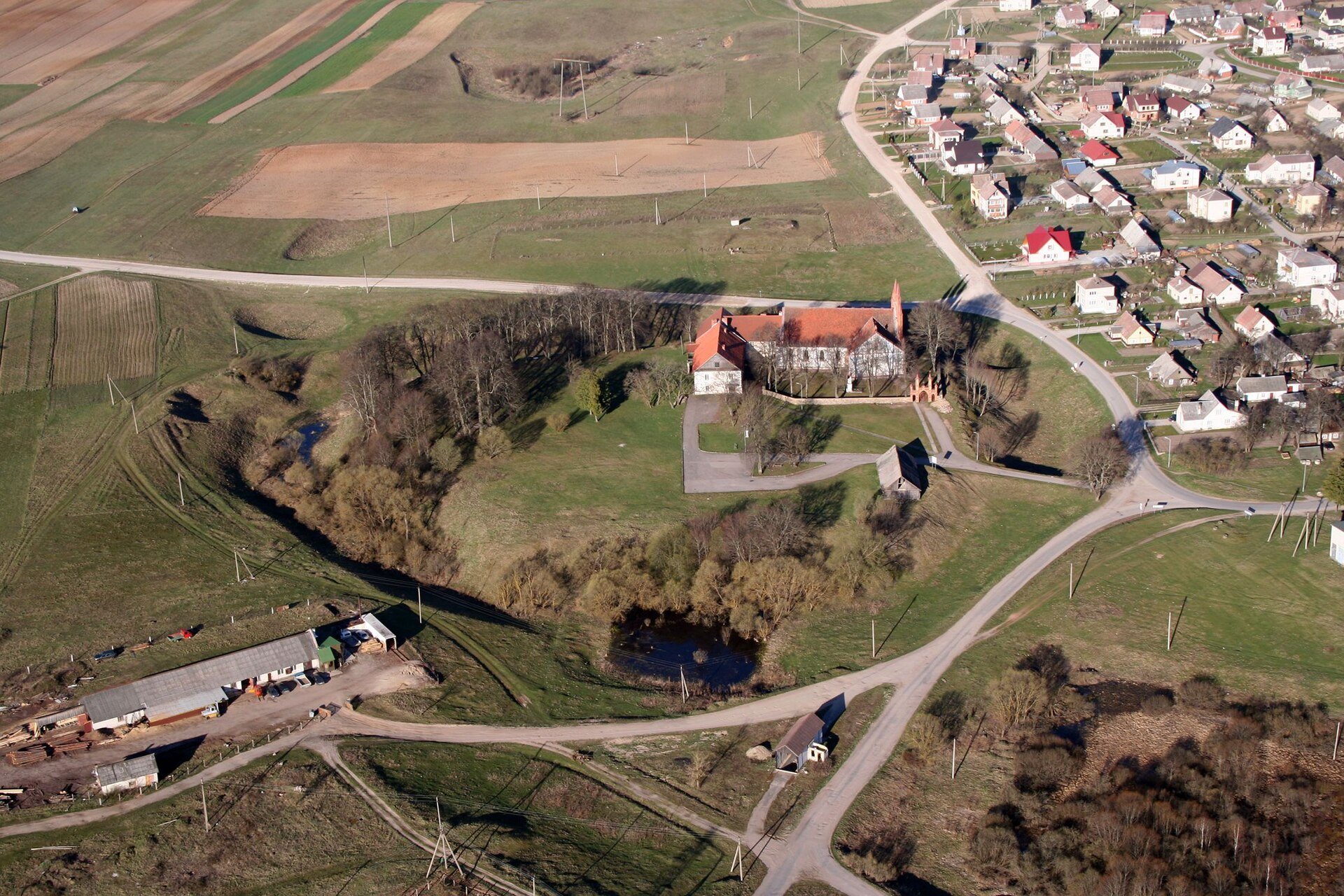
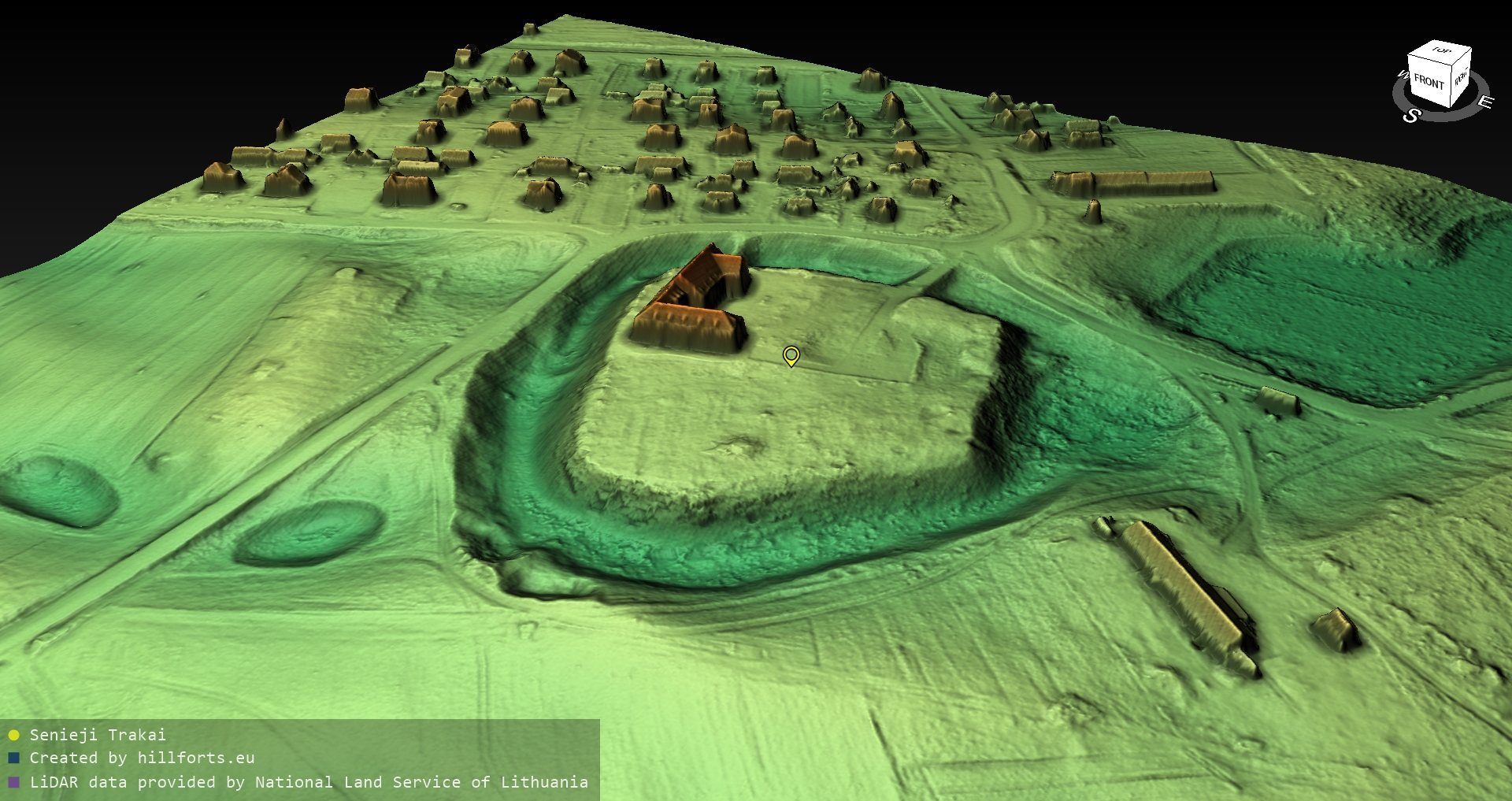
The castle occupied a small elevation on the western shore of an unnamed lake. Its elongated rectangular courtyard measured about 150 by 130 m and was oriented from west to east. A ditch about 40 m wide and 6–8 m deep surrounded the site on the north, west, and south. Its upper part was paved with stones and was formerly filled with water. The northern section was later filled to create an entrance.
Enclosure wall
Excavations identified a rectangular enclosure wall around the edge of the elevated area. The wall was approximately 2 m thick and 4 m high. Large stones and bricks formed its structure, which was covered with roofing tiles. Builders placed it on the hill terrace, then cut down the higher central part and used the soil to fill against the inner face of the walls. This created a level courtyard inside the enclosure.
Inner galleries and central division
Wooden galleries stood along the inner side of the enclosure walls. The cultural layer associated with them contained 102 iron crossbow-bolt heads, four bow-arrowheads, knives, cylindrical locks, keys, scissors, rings, a bracelet, clay spindle whorls, and wheel-thrown pottery. An east-west ditch through the central part of the site indicates that the castle included an outer bailey, probably on its southern side. A bailey was an enclosed area within or beside a castle’s defensive system, used for buildings and other activities outside the main enclosure.
Monastic buildings and later occupation
Church and monastery
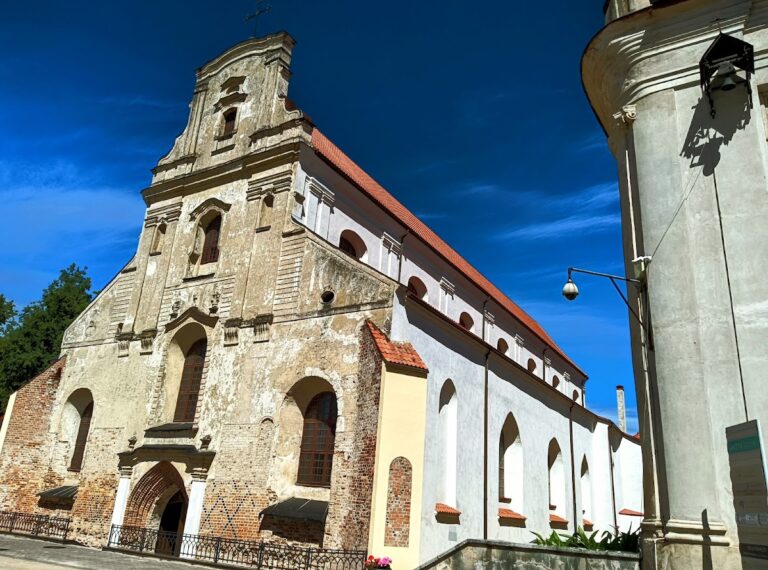
In the northwestern part of the former courtyard, a 2 m-high mound supports the Church of the Annunciation of the Blessed Virgin Mary and Saint Benedict, built in 1899. A monastery building constructed after 1770 stands nearby, while a wooden storehouse occupies the northeastern part of the site. Residential buildings are thought to have stood near the church and churchyard.
Present ground surface
Former buildings and economic activity have heavily disturbed the castle area. The courtyard is now grass-covered, with large linden trees along its southern, western, and northern edges. The later structures and ground layers occupy the former fortified enclosure and reflect the site’s transformation from a castle into a monastic complex.
Settlement south of the castle
A settlement extended south of the castle across approximately 2 hectares. Excavations in 1995 and 1996 revealed a fourteenth-century cultural layer up to 1.5 m thick. Finds included iron crossbow-bolt heads, knives, awls, spur fragments, pieces of chain mail, bronze brooches, pendants, bracelets, an earring, a small cross, whetstones, and wheel-thrown pottery. Together, these remains define a settled area associated with the fortified site and provide material evidence for activity beyond the castle enclosure.