Tour de Falhiès: A Medieval Lookout and Defensive Tower
Site at a Glance
- Rating
- 5
- Popularity
- Very Low
- Country
- France
- Primary era
- Medieval
- Eras represented
- Medieval
- Civilizations
- French
- Site type
- Military
- Remains
- Castle
On this page9 sections
History
Early tower and medieval lordship
The Tour de Falhiès is a medieval lookout and defensive tower at Velzic in Cantal, France. Built before the 11th century, it belonged to a warning network established by Aurillac Abbey, a medieval Benedictine monastery, to alert the region to Viking incursions through the Dordogne valley. The date when the abbey granted the tower as a fief, land held through a feudal relationship, is unknown. The surviving remains date to the 11th century, while a castle was built in the 13th century. Its builders are unknown, and whether they were the lords of Velzic is uncertain.
The fief of Velzic was separated from that of Laroquevieille, which had been granted to the Montal family with the right to build a castle and maintain a lookout. Another part of the territory belonged to the Tournemire family, lords of La Peyre-en-Jordanne at Lascelle. In 1451, Aymeric de Montal sold the lordship of Velzic to Philippe de Tourdes, a knight. Géraud Labeau, a consul of Aurillac, was the first known owner of the fief. His son Pierre de Falhiès married Agnès de Tourdes in 1571.
Later ownership and abandonment
Members of the Lacarrière family held lordship over the tower in the second half of the 17th century. In 1689, Pierre’s grandson Guillaume de Falihès sold the castle and estate to the Frayssi de Veyrac family. The estate later passed by inheritance to the Sénezergues family and then to the Lacarrière family.
The tower was still inhabited in 1885. Marthe Désirée Roger-Ducos (1822–1855), wife of Dr Jean-Antoine Capelle de Puechjean, died there. After the death of their daughter Marie-Amélie, who had lived at Falhiès, the tower and its outbuildings were abandoned. In the early 20th century, stones from the tower were reused in several nearby barns.
Archaeology and commemoration
The Aurillac Regional Archaeological Society organized archaeological work at the site. In 1986, lit smoke devices at the summits of the Falhiès and Saint-Simon towers and Saint-Étienne Castle in Aurillac recreated the warning network visually, and the system worked successfully. Since 1992, Falhiès has also been a stopping point on the Saint-Géraud route, which commemorates places associated with Gerald of Aurillac, a medieval count and religious founder venerated as a saint.
Remains
Tower and defensive layout
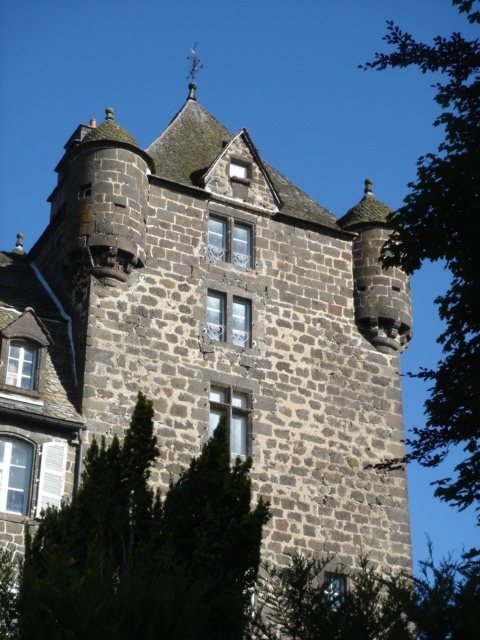
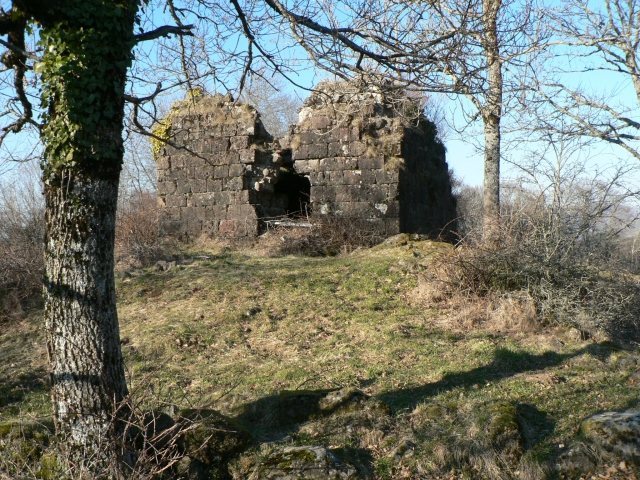
The remains stand at 920 metres on the edge of the Coyan plateau, overlooking the Jordanne valley. The square tower, whose plan follows a model also seen at Saint-Étienne Castle in Aurillac and at Saint-Simon and Naucelles, formed a corner of scallop-shell-shaped fortifications. Its exterior measures about 8 by 8 metres, and its walls are 1.8 metres thick. Well-laid ashlar masonry survives. A projecting turret stood above the access path.
The tower had at least four storeys, with a ladder that could be withdrawn providing access to the first floor. A passage within one wall carried food and other necessities between levels; its outer opening survives on the north façade.
Associated structures
Northern annex
A few metres north of the tower are the ruins of an annex building, including the remains of a bread oven.
Stone cross
A stone cross erected at the site in 1983 overlooks the plateau and faces Coyan.