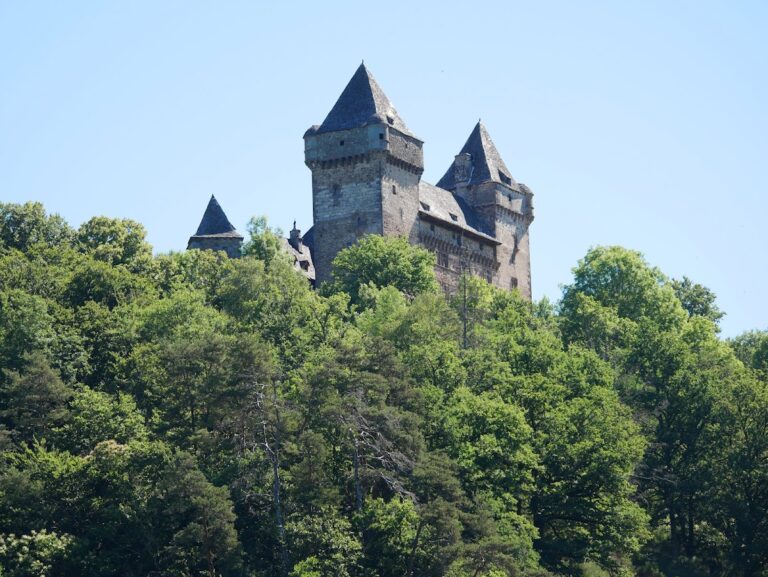
Comblat-le-Château: A Medieval Castle Complex in France


Site at a Glance
- Rating
- 5
- Popularity
- Very Low
- Country
- France
- Primary era
- Early Modern
- Eras represented
- Medieval, Early Modern
- Civilizations
- French
- Site type
- Domestic
- Remains
- Castle
On this page14 sections
History
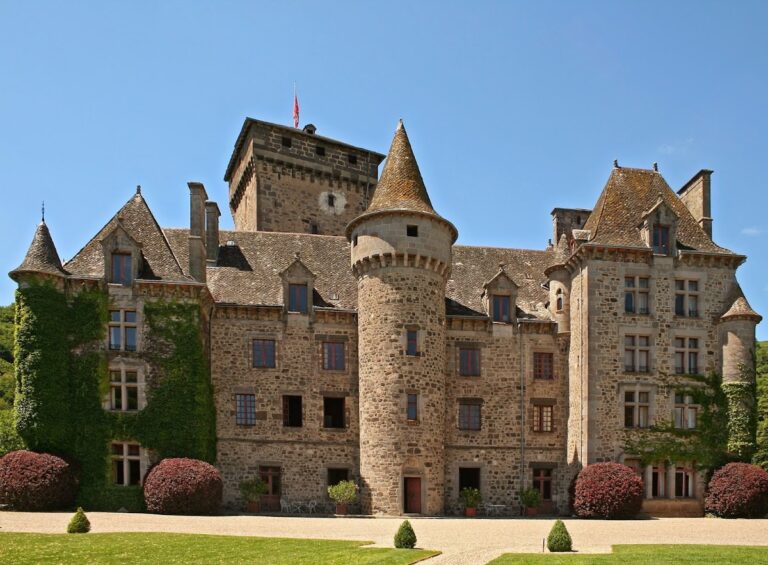
Comblat-le-Château, also known as the Château de Comblat, is a French medieval castle complex at Vic-sur-Cère in the historic region of Auvergne. Built in the 15th century on the site of the earlier fort of Vallayrane, it developed as a seigneurial residence and later became associated with the officials responsible for pacifying Upper Auvergne. The present donjon, or fortified principal tower, was constructed in the 16th century, while a residential wing was added in the early 18th century.
Early lordship and the fort of Vallayrane
The wider Comblat area included Comblat-le-Puech, the village of Comblat, the Pont de Comblat and its settlement, and the Manoir de Comblat. A Middle Paleolithic site at Comblat-le-Pont provides evidence of human activity in the wider area long before the château was built. The place-name was written Comlat until the 15th century and Comblat thereafter. It has been interpreted as deriving from an ancient term for a mound or hillock in a plain.
In 1266, Guillaume and Deodat de La Cère acknowledged possession of the Domus de Cera de Comlat, understood as a manor rather than a castle. The powerful La Cère family and its cadet branch, the La Garde family, held several fortified and manorial sites in the locality, including the fort of Viallard, the Domus de La Garde and the Domus de Comblat. Guirbert de La Garde was recorded as co-lord of Comblat in 1291.
Another 1266 record names the wife of G. Gausselmi in connection with rights and possessions at Comblat and the fort of Valairana. Around 1300, the Griffeuil family was also associated with the lordship of Vic and Comblat. These references place the later château within a landscape of overlapping lordships and fortified residences.
Construction and the Vixouze and Cabannes families
In 1343, Gaucelin, lord of Viescamp, received permission to build a castle at Comblat on the site of the earlier fort of Valeyrane. His daughter Hélis de Viescamp, described as lady of Comblat, married Géraud Palach. The Palach family, whose origins lay at Palach near Laroquebrou and whose later members became wealthy bourgeois of Aurillac, subsequently held Comblat.
Pierre de Palach was lord of Comblat and co-lord of Cols. His daughter Geralde de Pallat, lady of Comblat, married Guiral de Vixouze and established the Vixouze line, while her sister Jeanne de Palach, lady of Cols, married Jean de Lavaissière. Jacques de Vixouze and then his son Raymond held Comblat. In 1513, Raymond received authorization from Louis de Joyeuse, bishop of Saint-Flour, to build a chapel at the estate.
Raymond’s daughter Antoinette de Comblat became his universal heir from 1561. She had married Jean I de Cabannes in 1541. Jean served as a captain in the French Guards, an elite military formation of the French monarchy, from 1563, became a gentleman of the king’s chamber in 1575, and represented the notables of Haute-Auvergne before Henri III, king of France from 1574 to 1589. Henri III charged him with preparing a pacification plan for Upper Auvergne. Jean built the present donjon and made his will there in 1588.
Administrative residence and eighteenth-century inheritance
From 1586 to 1789, Comblat served as the residence of the commis and later the vice-baillis responsible for pacifying Upper Auvergne. A vice-bailli was a senior official acting for a bailli, an officer with administrative and judicial authority over a territorial district. Ownership and inheritance passed through the Cabanes-Comblat, Lacarrière de Comblat and La Baume Pluvinel families.
Jean II de Cabanes-Comblat succeeded his father in the captaincy of the French Guards and in other court offices. In 1586, he served as equerry to Queen Marguerite of Valois during her stay at Carlat and again represented the Haute-Auvergne notables before Henri III. Antoine de Cabanes-Comblat married Catherine d’Apchier on 6 August 1610. During this period, the mineral waters of Vic-en-Carladez were mentioned in Jean Blanc’s 1605 work on French natural waters.
Their son Louis de Cabanes-Comblat was followed by François de Comblat, a captain in the Coëtlongon Regiment. François married Philiberte Colinet at Aurillac in 1700. In 1716, he received a commission from the king’s physician Poirier to exploit the mineral springs of Vic.
Also in 1716, Françoise de Cabanes-Comblat, heiress of Comblat, transferred the estate through her marriage to François-Joseph Lacarrière. Louis XV ennobled him in 1722. He was the son of Antoine-Raymond Lacarrière, the fourth vice-bailli of Upper Auvergne, and became provost general of the Marshals for Guyenne in 1720, sitting at Montauban. This office combined military-police and judicial authority over serious offenses.
Antoine-Raymond’s portrait remained in the château’s dining room until 1940. A local tradition held that his severe, penetrating gaze exposed anyone who lied before it. Raymond Lacarrière, born at Vic around 1720, served first as an ensign in the French Guards and later as a musketeer in the king’s household. In 1761, he received a commission from Jean-Baptiste Sénac to exploit Vic’s mineral waters. His surviving correspondence describes the Battle of Fontenoy, in which he took part with the Count of Anteroches.
Revolutionary upheaval and later owners
François-Louis Lacarrière de Comblat served as an ensign and later as a sublieutenant in the French Guards. He married Marie-Philipine Teilhard in 1789 and joined the Coalition of Auvergne. Much of his property was seized as national property and later bought back by the brother of Jean-Baptiste Coffinhal. François-Louis was executed in 1795 after the Quiberon landing, leaving a daughter, Amélie de Lacarrière de Comblat.
Amélie, who lived from 1790 to 1860 and belonged to the Cantal Society, bought back Comblat. She married Séraphin-François-Gabriel de la Baume Pluvinel in 1811. He was an ordinary gentleman of the household of King Charles X. Their descendant Henry Gabriel de la Baume Pluvinel inherited the estate and carried out irrigation works that earned him a silver medal from the Ministry of Agriculture in 1884.
Henry Gabriel received the painter Paul Signac at Comblat. Signac’s visits are represented by several views made in 1886 and 1888. Aymar de la Baume, an astronomer and member of the Academy of Sciences, inherited the estate in 1896 after the death of his uncle. He helped found the journal La Veillée d’Auvergne and was buried in the cemetery of Vic-sur-Cère.
Twentieth-century transition and protection
In 1949, Geneviève de la Baume Pluvinel transferred the château to the Cantal department. It first housed a domestic-science school and later a girls’ agricultural college. She also donated a group of portraits of her Lacarrière ancestors, including Antoine-Raymond de Lacarrière, to the Hippolyte de Parieu Museum in Aurillac.
Comblat-le-Château entered the inventory of historic monuments in 2002, with protection extending across the property, interiors, dependencies, gardens and park. Its original function was a seigneurial residence, and it is currently a private dwelling.
Remains
Fortified and residential buildings
The donjon
The château’s core is a 15th-century donjon remodelled in the 16th century. The tower served both defensive and residential purposes, and its present form is associated with the building campaign undertaken by Jean I de Cabannes. The former kitchen occupies the donjon’s ground floor, while the archive room is located on the highest level of the north tower.
The south wing
A south wing was added at the beginning of the 18th century in the Classical style. Its interiors retain decoration from the same period, including wood panelling, which is fitted wooden wall covering used for decoration and insulation. The protected rooms also contain monumental fireplaces and 18th-century fireplaces with painted overmantels, the decorated wall areas above fireplaces.
Dependencies and interior features
Chapel and service buildings
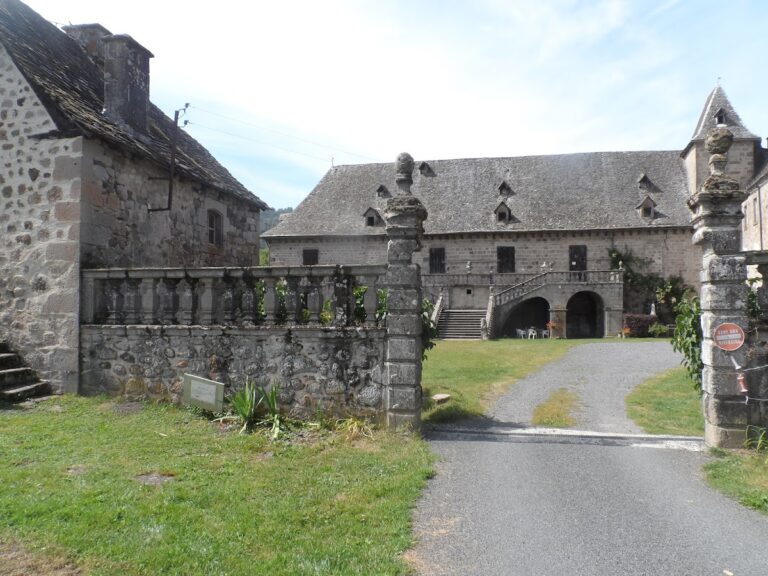
The early-18th-century expansion was accompanied by dependencies that probably date from the same period. They include a chapel and service buildings. The chapel forms part of the protected group of buildings associated with the château, along with the former kitchen, archive room, entrance vestibule, staircase and first-floor chambers.
Garden pavilion
A garden pavilion survives among the dependencies and contains painted decoration. Its period decoration belongs to the same architectural campaign as the south wing and the associated service buildings.
Gardens and park
The grounds combine gardens arranged on terraces with a basin and a fountain. They also include the château’s notable park. Together with the tower keep, later residential expansion, chapel, service buildings and decorated interiors, these landscaped grounds form the surviving physical composition of Comblat-le-Château.
Nearby sites