Björksta Church: A Medieval Parish Church in Västerås, Sweden
Site at a Glance
- Country
- Sweden
- Primary era
- Medieval
- Eras represented
- Medieval, Modern
- Civilizations
- Swedish
- Site type
- Religious
- Remains
- Church
On this page22 sections
History
Bronze Age landscape and medieval foundation
Björksta Church is a medieval parish church in Västerås, Sweden, first built in the thirteenth century. It serves Kungsåra Parish, a local church community within the Diocese of Västerås, an administrative church district in the Lutheran Church of Sweden. The church may have been founded by a wealthy family from a nearby farm. Its original western tower has also been taken to suggest that it began as a private estate church.
The wider Björksta district was prosperous during the Bronze Age, when several hundred rock carvings were made in the area. Local tradition credits a queen named Klava with building the church, or with supplying brick for its tower. The tower’s key-shaped decorations were said to honor her.
During the 1340s, the church was enlarged eastward with a new choir. A note found when the high altar was taken apart in the seventeenth century gave its consecration date as 21 November 1349. The altar held relics associated with the Lord’s table, the cross of Saint Andrew, the shroud of Erik the Holy, Saint Olaf, and Catherine of Alexandria, an early Christian martyr.
Later medieval changes
Four vaults were added in the 1460s or 1470s. In the final decades of the fifteenth century, the brick tower was raised, and the southern porch was probably built. Medieval wall paintings were made in several campaigns during the fourteenth and fifteenth centuries.
Lightning fires and rebuilding
On 11 July 1617, the day after parish priest Nils Mattsson died, lightning struck the tower spire. Fire damaged the tower and much of the roof, melted the bells, and consumed many interior furnishings and church documents. A replacement spire, covered with shingles, was finished nearly a decade later. Another lightning strike on 4 July 1701 caused a fire confined to the spire.
A low, pyramid-shaped tower cap was built in 1738. Lightning set it alight on 15 January 1858, and the fire also destroyed much of the nave roof. The subsequent rebuilding gave the tower its present form and included repairs to the roofs over the nave, sacristy, and porches.
Twentieth-century renovation
A major interior renovation in the 1950s shortened the nave, recreated the medieval three-part choir window, and added a free-standing limestone altar table. The organ gallery and its 1860 front were removed, and the organ was moved to the porch. The floor and pews were renewed, keeping only the doors and ends of the 1783 pews. Paintings that had been covered over in the 1740s were uncovered and conserved by Sven Dalén.
Remains
The church has a rectangular main worship space, with a sacristy to the north, a porch to the south, and a tower at the west end. Stone and brick are visible on much of the exterior, while the interior preserves brick vaults, medieval paintings, and furnishings from several later periods.
Exterior and churchyard
Church fabric
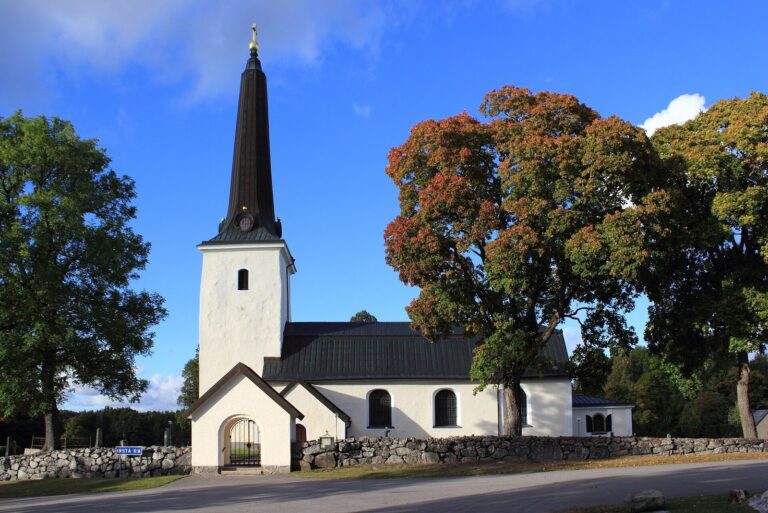
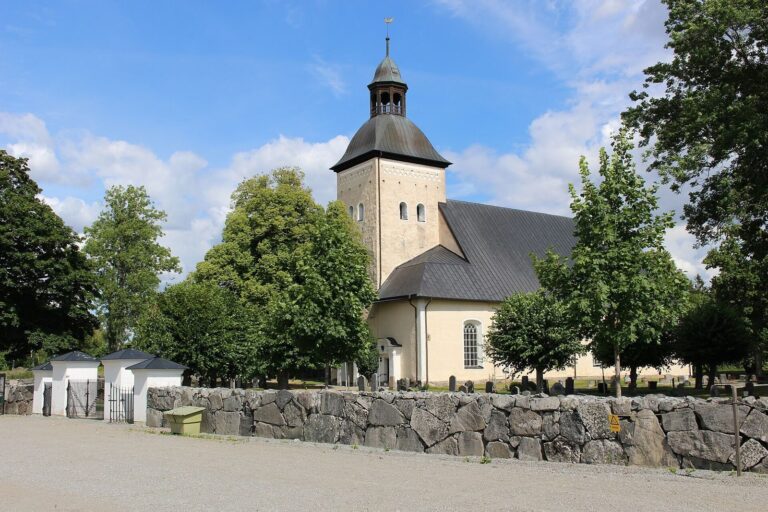
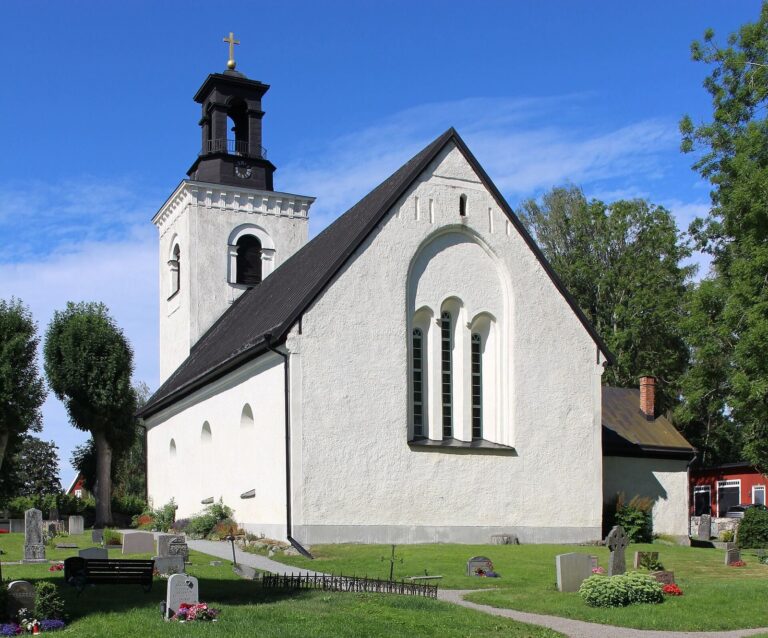
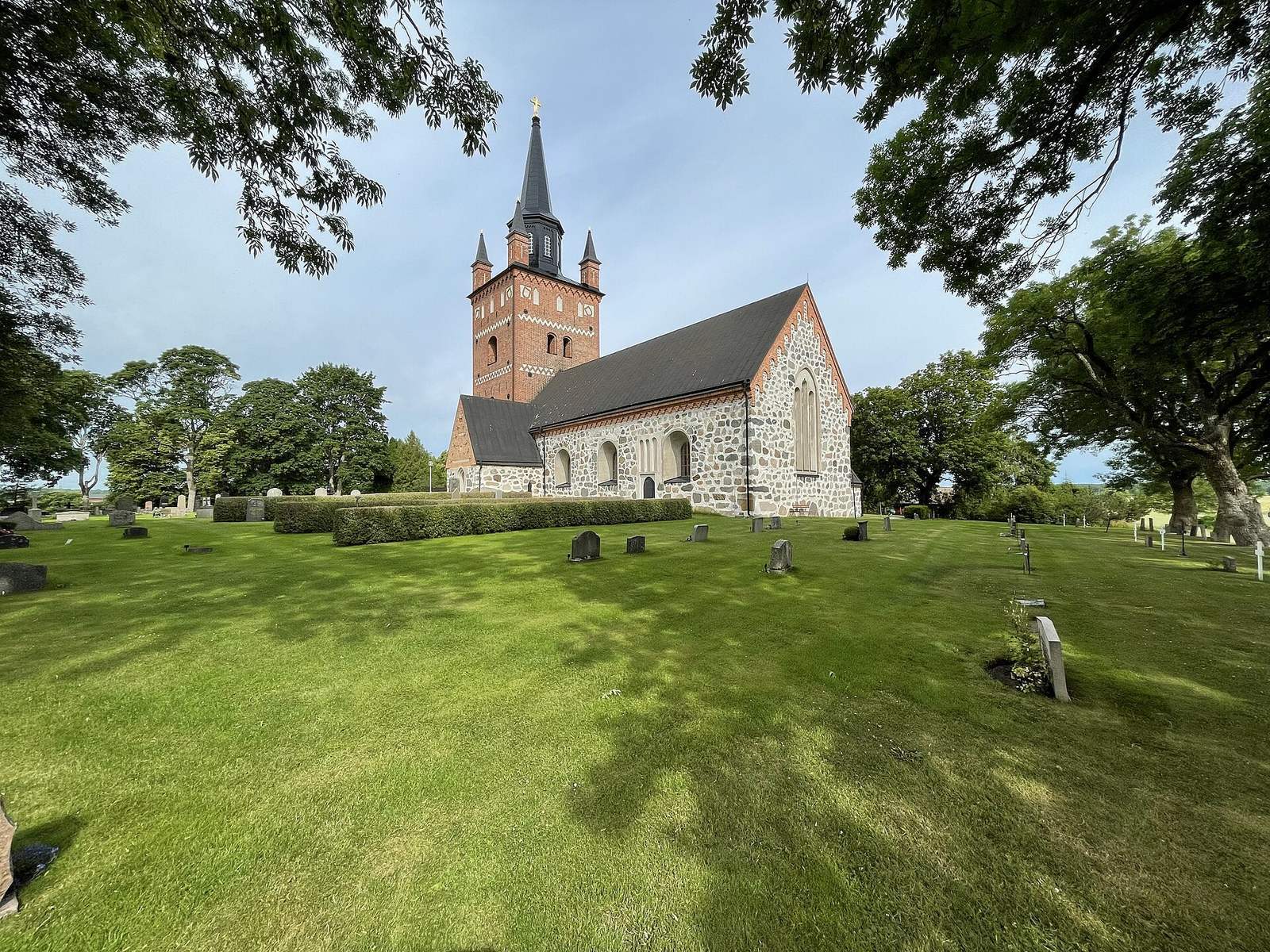
The church’s western section is its oldest, a smaller grey-stone structure with a narrow tower. The walls are largely unplastered, apart from the recesses around the windows. Natural stone forms most of the masonry; brick frames windows and doors, appears high on the porch gable and tower, and makes a patterned strip below the roof edge. Recessed decorative arches that do not pass through the wall adorn the porch gable and tower.
Sheet-metal covers the gabled roofs over the nave and its extensions. The tower’s distinctive crown, dating to 1860, combines a copper-covered lantern, an open or windowed structure atop a tower, with a pointed spire and four small corner turrets. The nave has three round-arched windows on each long side, and the tower also has round-arched windows. In the east gable, a three-part choir window contains stained glass.
Churchyard and carved stones
A dry-stone wall, built without mortar, encloses the older churchyard, whose present extent dates back at least to the late eighteenth century. A newer cemetery with a memorial grove was consecrated in 1978 on the slope west of the church and is bounded by a low hedge.
Near the porch, a stone block set into the church wall bears 58 cup marks, small cup-shaped prehistoric carvings, as well as one channel-shaped and one oblong depression. A rock slab immediately north of the churchyard, partly beneath it, carries four ship figures, a wagon, and 30 cup marks.
Four ring stones stand in the churchyard. These marked points where bells were to begin ringing as a funeral procession approached; the start point depended on the payment, with stones indicating one, three, or six riksdaler, a former Swedish currency unit. The final ceremonial ringing of this kind took place in 1951. Björksta may once have had fourteen such stones, and eight survive. This type of feature is preserved only in eastern Västmanland.
Interior and wall paintings
Plan and vaults
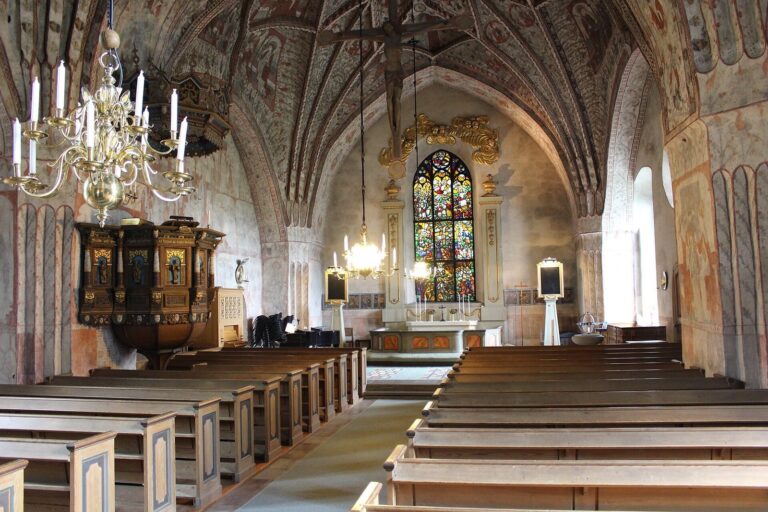
The one-aisled interior has a polished limestone floor and enclosed pews. Three cross vaults, formed by intersecting barrel-shaped ceilings, cover the nave; a star vault, with ribs arranged in a star pattern, spans the choir. The tower room also has a star vault, while the sacristy has a cross vault. The organ stands on the floor beside the porch.
Paintings on the choir walls
Paintings survive on the choir walls and in its vaults. Three groups, made by three different artists during the fourteenth and fifteenth centuries, are now badly damaged. On the east and south choir walls and in the window recess are individual figures, plant designs, and a scene known as the Mass of Gregory the Great, in which the suffering Christ appears before the pope.
The window recess contains two seated figures on either side. Moses, holding the tablets of the Ten Commandments, is to the north; to the south, King David holds a harp. Figures below them may be prophets. Two badly damaged figures beside the window may represent the apostles Peter and Paul, while a standing figure on the north wall may be Saint Dorothea. These are the oldest paintings and probably date to the first decades of the fifteenth century, before the vaults were built.
Paintings in the choir vaults
Paintings in the choir’s star vault probably date to the early 1460s and are closely related to work in the choir vault of Strängnäs Cathedral. Most of the small figure medallions are badly damaged and cannot be identified. A larger medallion in the northern bay shows Christ as the Man of Sorrows; opposite it is a blessing bishop. The plant decoration around the medallions is better preserved than the figures.
The paintings in the second vault from the east are later, date to the 1470s, and preserve their figures better. They are attributed to the Roslag Master, a conventional name for an unidentified painter associated with medieval church paintings in the Roslagen region. The images show the four Church Fathers, influential early Christian theologians: Augustine, Gregory the Great, Ambrose, and Jerome. Each sits on a large throne resembling a sarcophagus. Inscribed bands are only partly legible, and plant designs surround the figures.
Furnishings and objects
Saint Olaf and baptismal fonts
A wooden sculpture made in a Rhineland workshop during the first half of the fourteenth century depicts Saint Olaf, a Norwegian king venerated as a saint, with a troll beneath his feet. The bronze baptismal font was made by Master Peder of Västerås and is decorated with rosettes. Its Latin inscription gives the year 1529 and names Canon Olof Andersson, a member of a cathedral chapter. That was the year Andersson took office as parish priest, and the font may have been his gift to the church. A foot from a medieval sandstone font is also preserved there.
A seventeenth-century brass baptismal basin shows Abraham preparing to sacrifice Isaac.
Communion vessels
The church preserves a fourteenth-century paten, a plate used with a chalice in the Eucharist, and a chalice whose bowl was altered later. The owners of Målhammar gave the church a container for the communion host in 1636.
Pulpit and portrait
The pulpit and its sounding board, a canopy that helps project a speaker’s voice, date to 1652 and were probably made in Denmark or northern Germany. Sculptures on its sides show Jesus holding a globe representing the universe, among evangelists and apostles. Peter carries a key and Philip a cross-staff. Later paint and gilding from the eighteenth and nineteenth centuries were scraped away in the 1950s.
A painting dated 1710 beside the sacristy portrays the priest Andreas Georgii Schedvimontanus (1560–1652), his two wives, and their 19 children. It depicts 12 sons and seven daughters, although the family had 14 sons and five daughters.
Lighting
Six chandeliers remain in the church, the oldest dating to the seventeenth century. Four light arms from the same century are in the choir.
Bells, organ, and objects now in a museum
Bells
The tower holds two bells. The larger, weighing 1,970 kilograms, was cast by Johan Beckman in 1905; its inscription describes this as its fifth casting. The smaller weighs one tonne and was first cast in 1742, then recast after the 1858 fire. Its inscription says that both bells were recast after that fire by N. P. Linderberg of Sundsvall, with God’s help.
Organ
The church organ was repaired by Sven Strömberg in 1710. Eric Löfberg worked on an older instrument with six stops in 1741; a stop controls a set of pipes. By 1773, parts of a pedal and chimes from an earlier church organ remained. Jonas Ekengren of Stockholm built a ten-stop organ in 1779, with two hand-played keyboards and an attached foot-operated pedal. Anders Gustaf Nygren of Stockholm made a six-stop organ in 1860 with one keyboard and an attached pedal. A 15-stop organ followed in 1930, built by Magnussons Orgelbyggeri AB of Gothenburg. The present mechanical organ, made by A Magnussons Orgelbyggeri AB in Mölnlycke, was installed in 1975.
Former church objects
A fifteenth-century door with decorative iron fittings and a runic inscription once served the south entrance and is now in the Historical Museum. The museum also holds the lower part of a monstrance, a vessel for displaying the consecrated host, probably made in the fifteenth century.