Vallby Church: A Medieval Church in Enköping, Sweden
Site at a Glance
- Country
- Sweden
- Primary era
- Medieval
- Eras represented
- Medieval, Early Modern
- Civilizations
- Swedish
- Site type
- Religious
- Remains
- Church
On this page15 sections
History
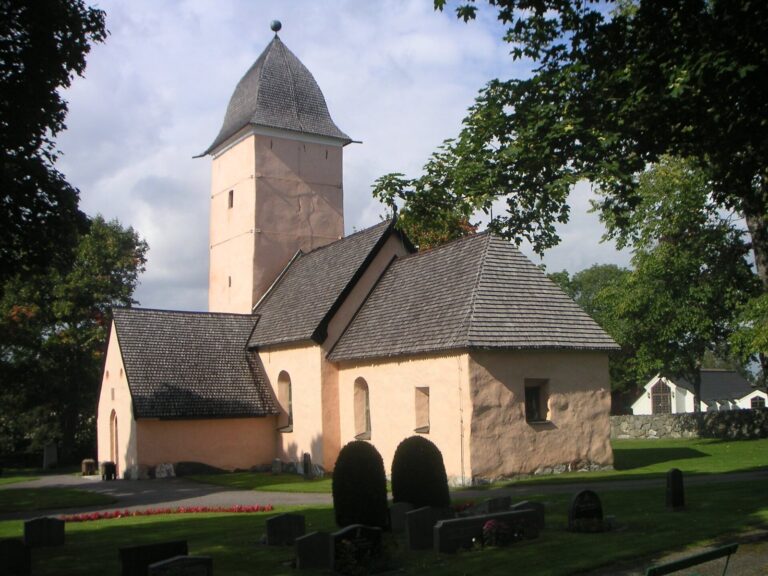
Vallby Church is a medieval church in Enköping Municipality, Sweden. It belongs to Boglösa parish in the Diocese of Uppsala, part of the Lutheran Church of Sweden, and stands on land belonging to a royal estate. The church’s western section dates to the Romanesque period, a medieval European architectural style.
Medieval origins and enlargement
During the Folkung period, a medieval Swedish era associated with the royal House of Bjelbo, the nave was extended eastward to twice its original length. The enlarged church became a hall church, with a unified, hall-like interior.
Brick vaults were added around the middle of the 15th century, and a porch followed later in the medieval period. The tower’s construction date is uncertain. It may have been built in the 15th century, after the nave was vaulted, but it was in place by 1637, when a spire was installed. An unidentified master painted Renaissance-style murals in the church around 1520.
Changes from the 18th century onward
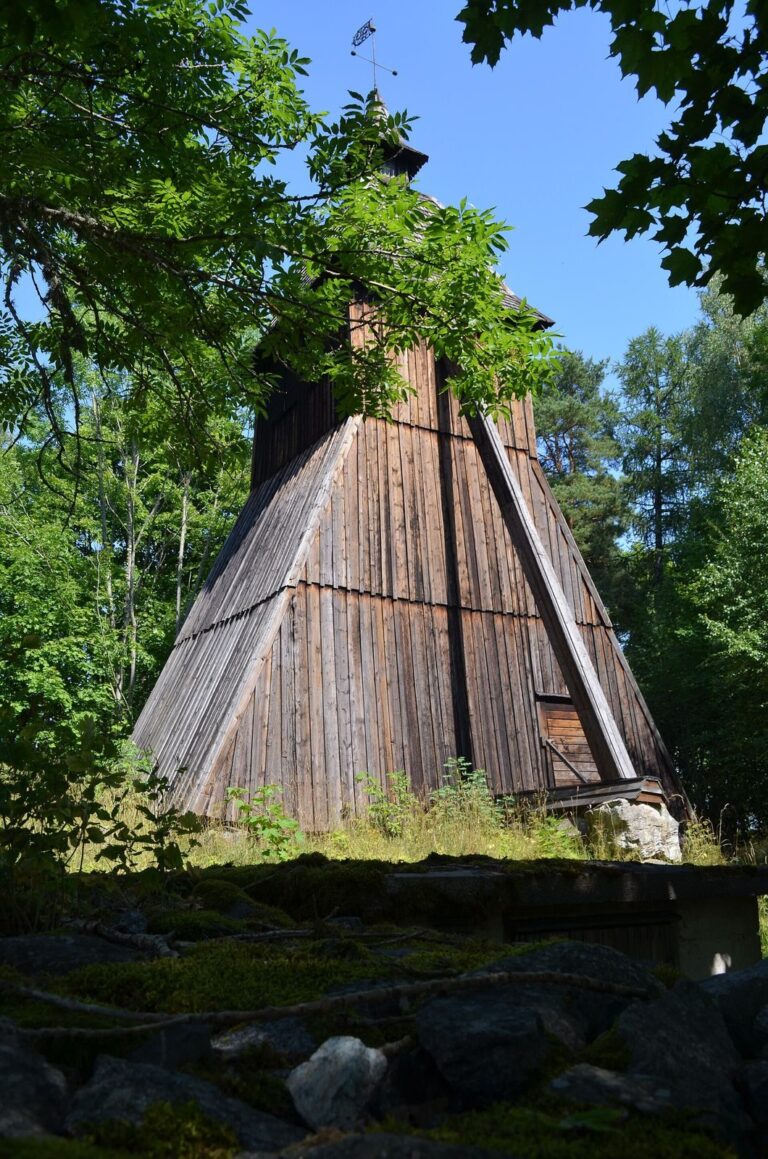
The present brick sacristy was built in the 1740s, probably replacing an earlier one on the same site. The exterior walls were plastered in 1741, and the interior was plastered and whitewashed the following year. A freestanding bell tower in the churchyard was demolished during the 19th century, and its bells were transferred to the church tower, which was remodeled in the middle of that century.
Architect Knut Nordenskjöld restored the church in 1921, including modernizing its enclosed 18th-century pews. The wall paintings were uncovered and conserved in 1958. Electric lighting, an organ blower, and electric bell ringing were installed in 1946.
Remains
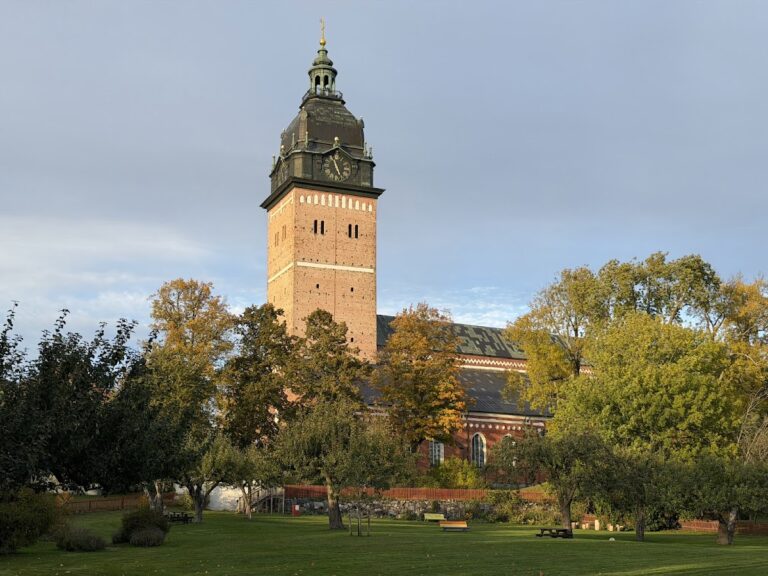
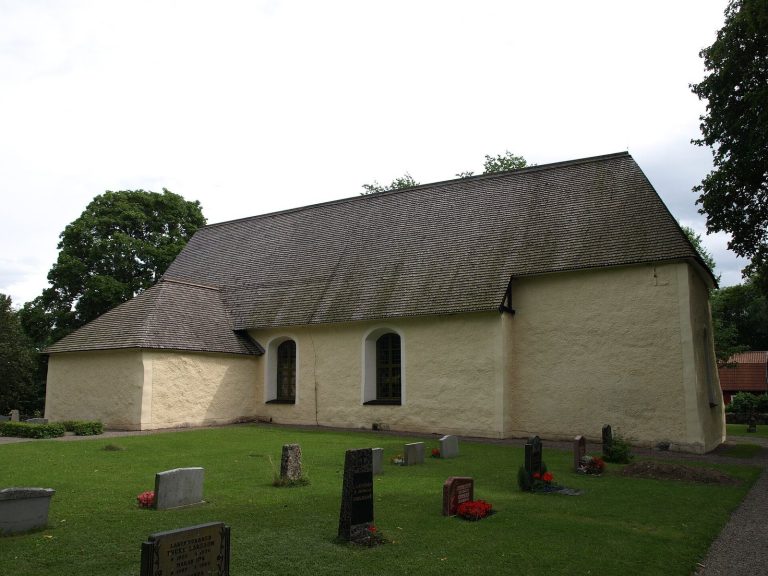
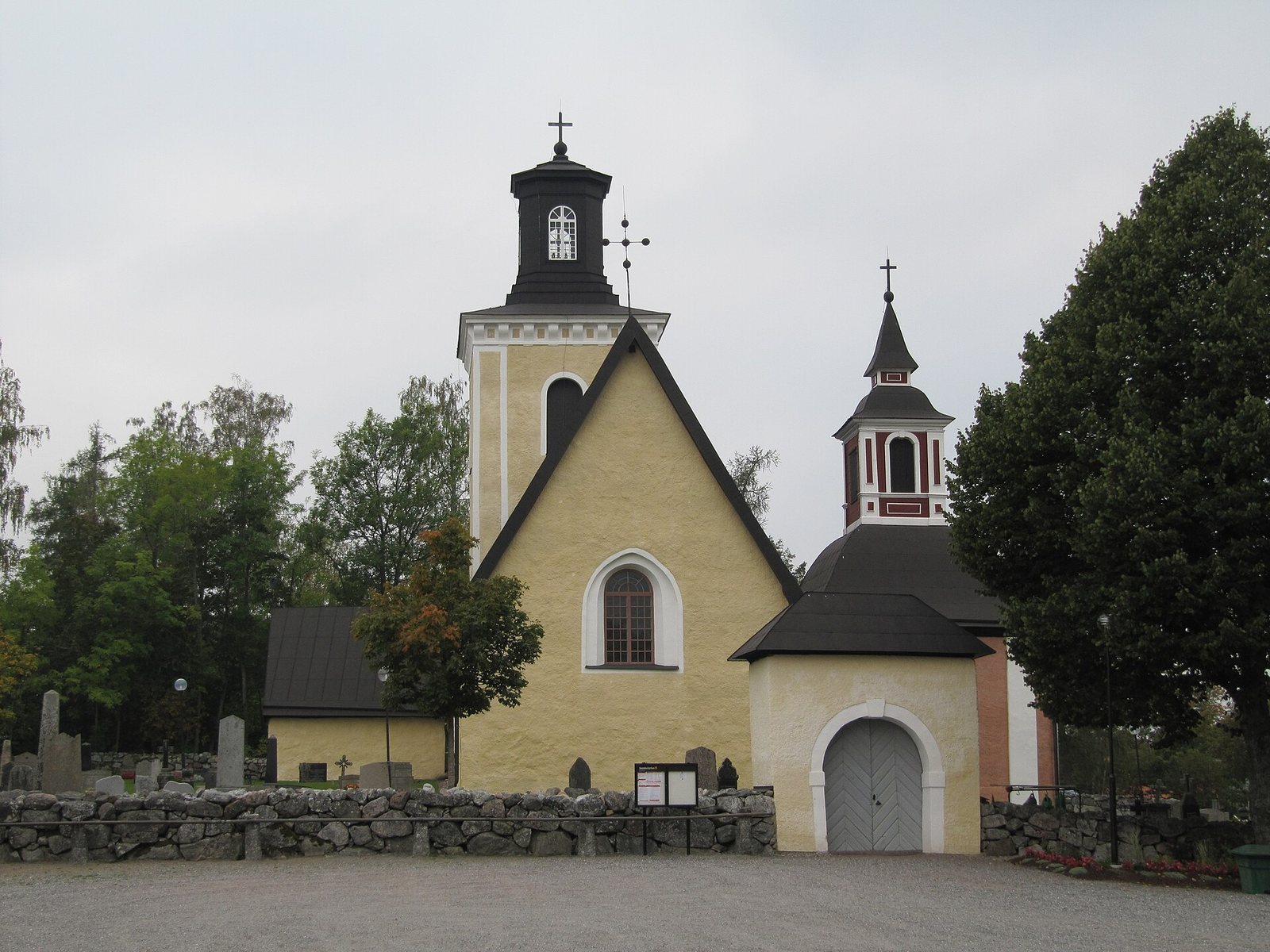
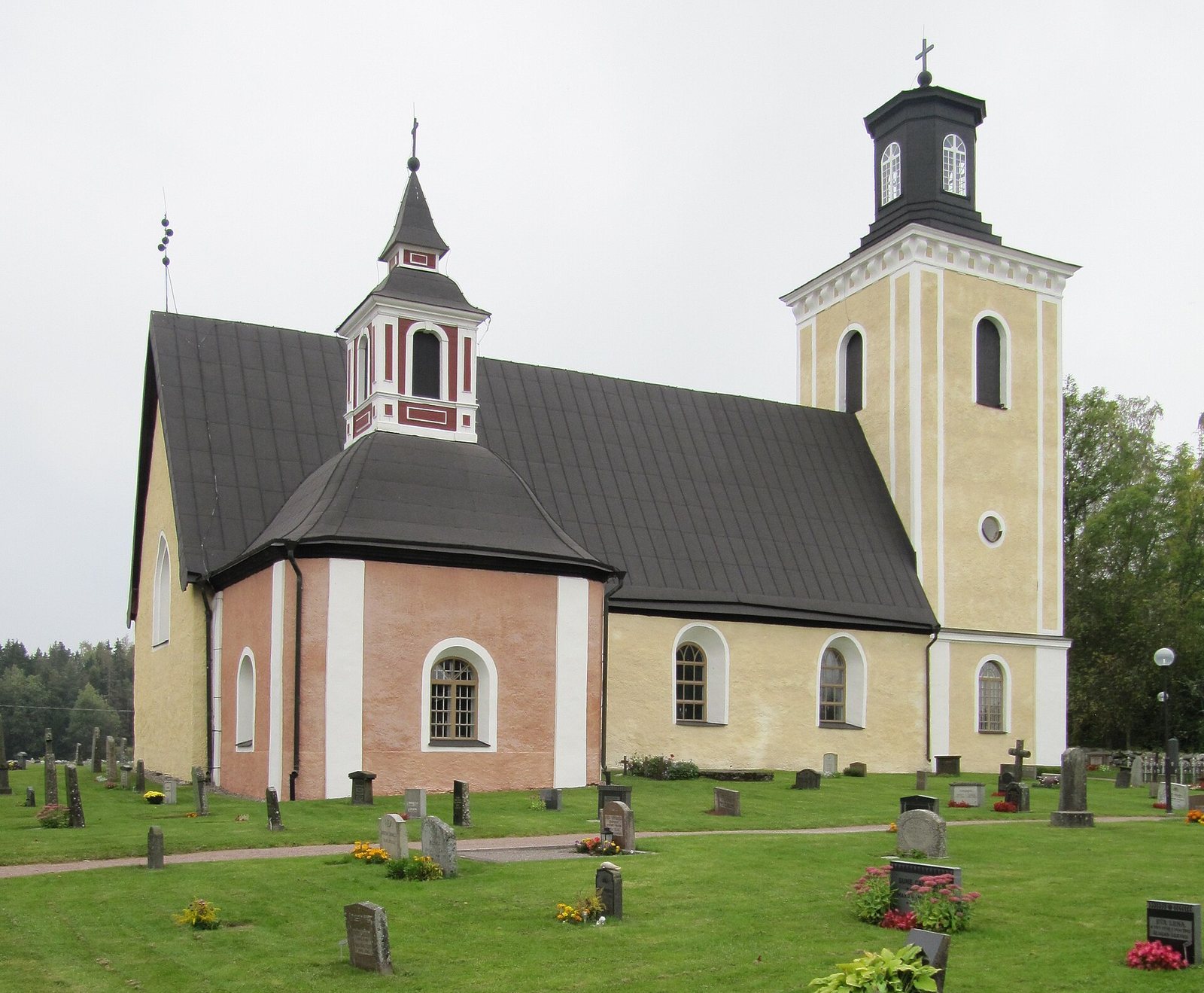
The elongated church is built mainly of grey stone, with a tower at the west end, a porch on the south side, and a brick sacristy at the northwest. The churchyard is enclosed by a wall, and the building preserves medieval architectural features alongside later furnishings and artwork.
Building and churchyard
Nave and vaults
The western part of the nave is the oldest section. The eastern extension has walls that are narrower and higher than those of the original church. Its brick cross vaults, ceilings formed by intersecting vaults, rest on wall arches and projecting masonry supports in the two eastern bays. In the western section, raised walls provide anchorage for the vaults without additional supports.
Tower, porch, and sacristy
The tower, porch, and sacristy form the church’s principal attached structures. The porch has a brick cross vault that is not original. The tower and sacristy each have a tower cap with a lantern, a raised structure, topped by a cross on a globe.
Churchyard
A wall laid in 1759 encloses the churchyard. Roofed gateways, known as lychgates, pass through its eastern and northwestern sides. The wall was formerly capped with a wooden roof.
Art and furnishings
Murals and crucifix
Renaissance-style murals survive in the chancel, the area around the altar, and in the eastern bay of the nave. A 15th-century triumphal crucifix, a crucifix displayed prominently in a church, hangs on the chancel’s north wall. Its cross-end panels carry symbols of the evangelists, while a sculpture of the grieving Mary sits above Christ’s head. Red threads once hung from Christ’s figure to represent flowing blood.
Altarpiece and pulpit
The altarpiece has a richly carved, gilded frame. Sculptor Johannes Liung carved it, and court painter Georg Engelhard Schröder painted it. Queen Ulrika Eleonora, queen of Sweden from 1718 to 1720, gave it to the church in 1740 after a petition from the pastor, with Emerentia Düben’s intercession. The pulpit was made in 1654. In 1749 it was moved from the south side of the church to the north, altered, and repainted.
Baptismal objects
A preserved bowl from a baptismal font, a vessel that holds water for baptism, dates from the 12th century or around 1200. A smaller gilded baptismal bowl was donated by Agnes Pels of Hornö in memory of her late husband, Secretary Ivar Scheffer.
Vestments
Three chasubles, the outer garments worn by priests during the Eucharist, were donated in the 18th century; two are now in Enköping Museum. A notable medieval chasuble is made of Florentine silk damask, a patterned woven fabric, from the last quarter of the 15th century. Its unusual pomegranate design includes a princely crown and a diamond ring from the Medici coat of arms. The embroidered cross on its back and panel on its front are from the same period. Its lining, made in northern Italy in the latter half of the 14th century, is related to several ceremonial cloaks, or copes, at Uppsala Cathedral.
Organ
Lars Ersson of Enköping built an organ for the church in the 1650s. Jonas Gren and Petter Stråhle of Stockholm contracted to make a replacement in 1763, which Carl Wåhlström of Stockholm completed in 1765 for 8,000 daler, a historical Swedish currency denomination. That instrument had ten stops, or sets of pipes, one hand-operated keyboard, and an attached foot pedal. Johan Eriksson of Boglösa parish renovated it in 1875. The present organ was built in 1931 by E. A. Setterquist & Son of Örebro. It operates pneumatically, using air pressure to control its mechanism, and has Roosevelt windchests, which distribute air to the pipes. It also has three fixed combinations, preset selections of stops, and a stated compass of 56/30. Its façade comes from the 1765 organ.
Silver and other furnishings
The church’s silver includes a 1745 chalice for taking communion to the sick and communion jugs dated 1745 and 1828. A gilded bridal crown was reworked in 1865.