Torres de Serranos: Valencia’s Historic Medieval Gate
Visitor Information
Google Rating: 4.6
Popularity: Very High
Official Website: www.visitvalencia.com
Country: Spain
Civilization: Medieval European
Site type: Military
Remains: Gate
History
The Torres de Serranos stands in the historic center of Valencia, Spain, at C. de la Blanqueria, 1. It was built by the medieval Christian city authorities in the late 14th century, replacing an earlier Islamic gate known as Bab al-Qantara from the 11th century. Construction began on April 6, 1392, under the direction of master stonemason Pere Balaguer, and was completed by March 1398. The gate served as the northern entrance to Valencia’s fortified medieval walls.
Throughout the late Middle Ages, the Torres de Serranos functioned as a defensive structure and ceremonial gateway. It marked the main northern access to the city along royal roads from Catalonia and Aragon. The gate also acted as a triumphal arch and featured open upper-level spaces where nobles and visiting dignitaries could observe public celebrations.
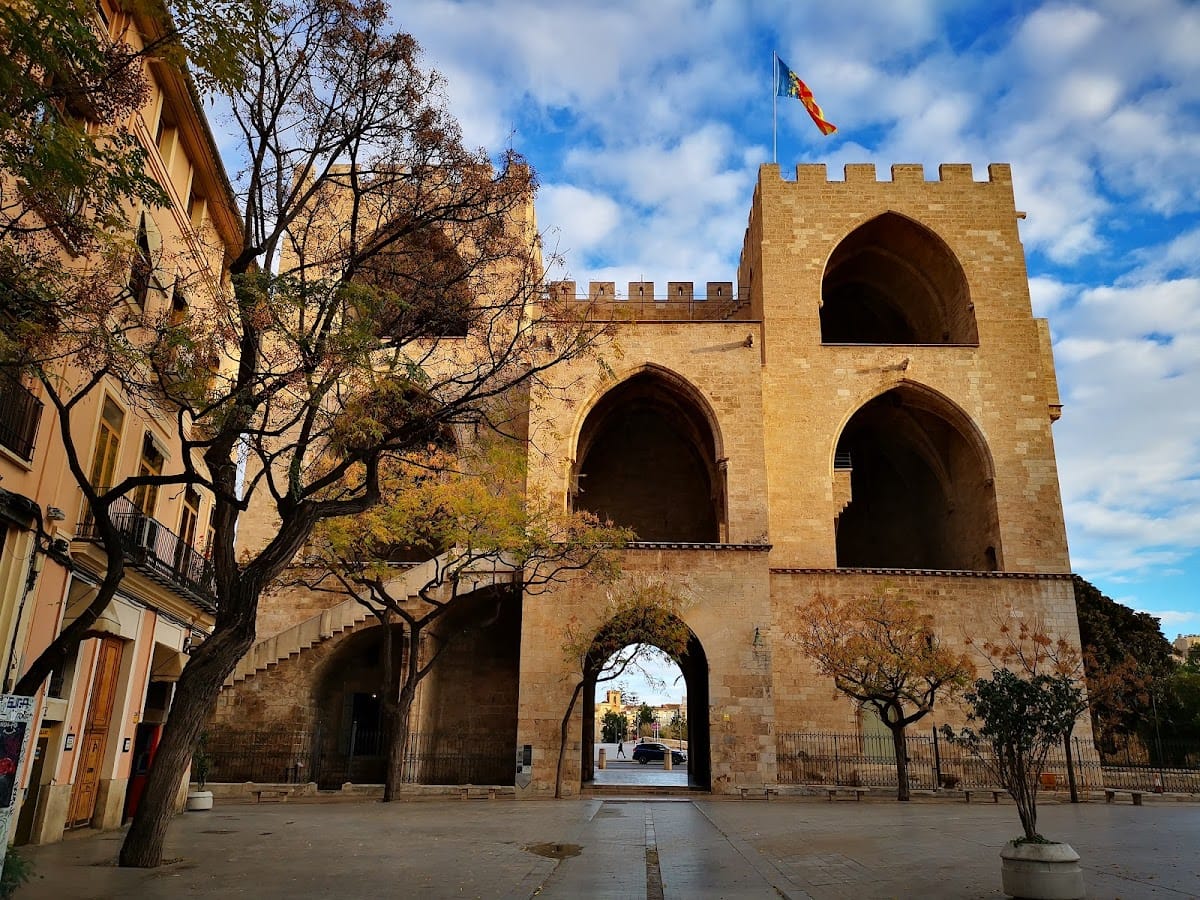
In 1586, following a major city fire, the gate’s role shifted when it was converted into a prison for nobles and knights. This new use led to the bricking up of the previously open arcades and the addition of barred windows. Later, it served as a general prison. This prison function helped preserve the gate when the city walls were demolished in 1865, although the surrounding moat was partially filled in 1871.
Between 1893 and 1914, the Real Academia de Bellas Artes de San Carlos undertook a major restoration led by sculptor José Aixá. This work reopened the towers’ interiors and reconstructed lost architectural details. In 1931, the Torres de Serranos was officially declared a protected historic-artistic monument.
During the Spanish Civil War from 1936 to 1938, the gate was used to shelter evacuated artworks from the Museo del Prado. To protect the collection from bombings, a 90-centimeter-thick concrete vault was installed, along with layers of rice husks and earth. After the war, the gate was restored to its original medieval appearance.
Further cleaning and restoration took place in the 1980s and again in 2000. Today, the Torres de Serranos remains one of Valencia’s best-preserved medieval monuments, retaining its historical significance and protected status.
Remains
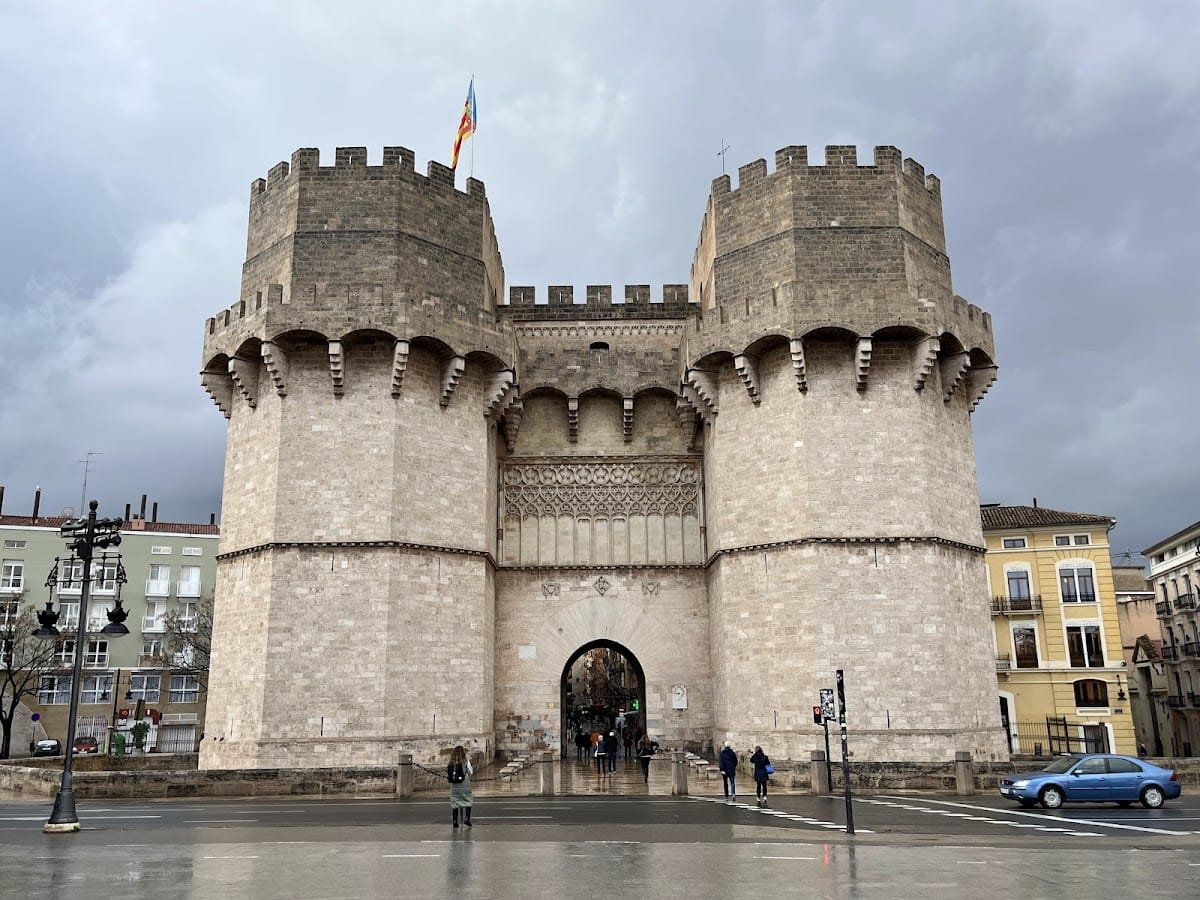
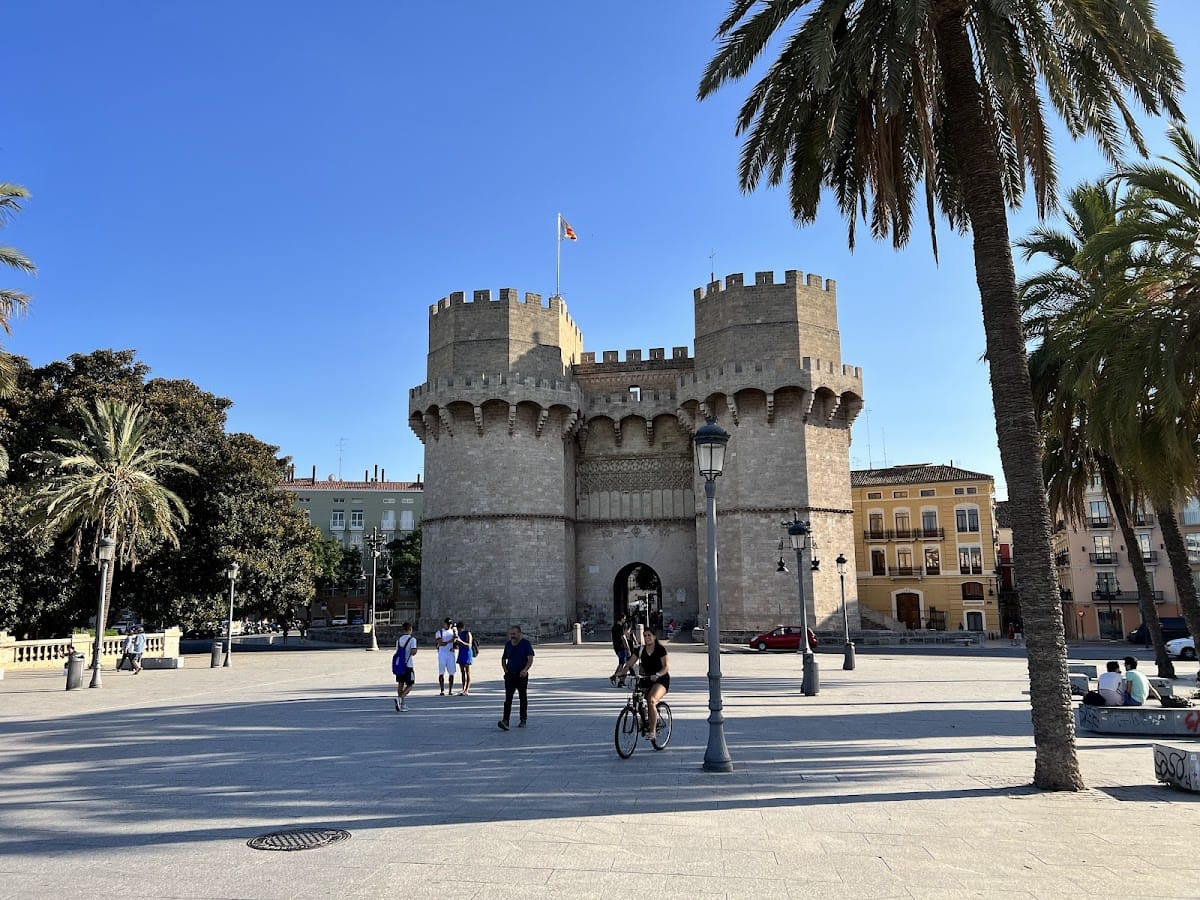
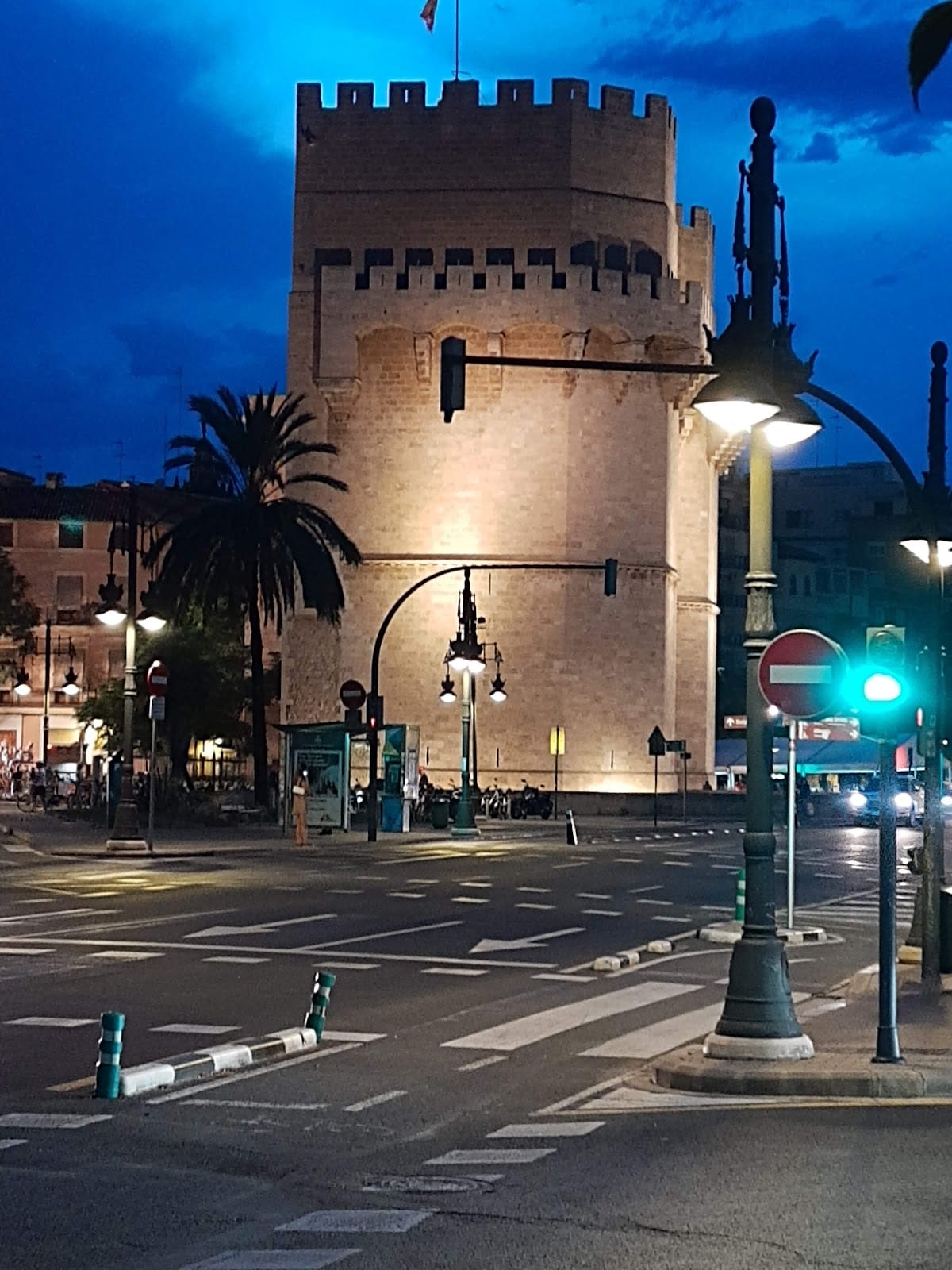
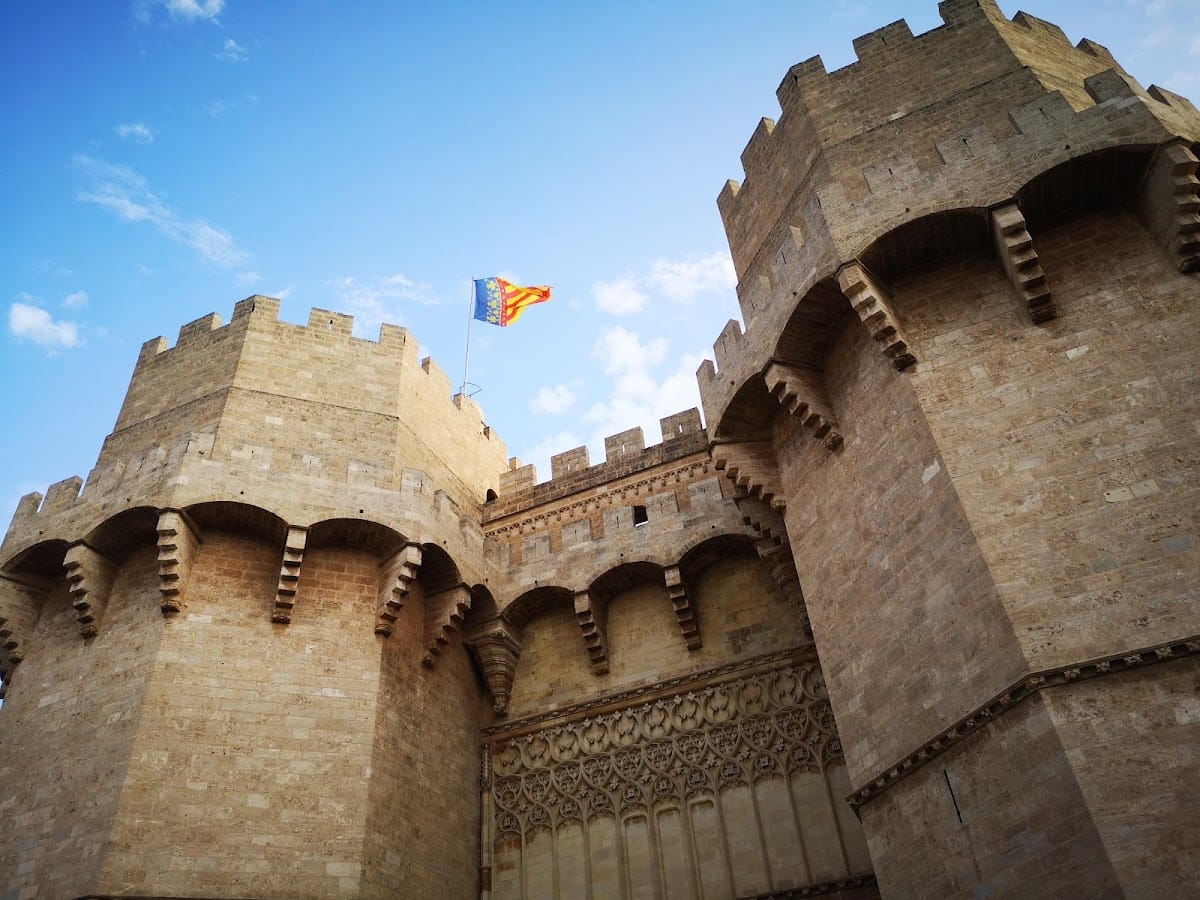
The Torres de Serranos is a large Gothic gate composed of a central gatehouse flanked by two massive towers. Its design reflects the Valencian variant of Gothic architecture with decorative elements from the Flamboyant Gothic style. The towers have an irregular shape, rectangular on the city side and pentagonal on the exterior, a form intended to better withstand artillery attacks.
Each tower contains three vaulted floors topped by a terrace. The lower floors feature ribbed cross vaults, where the ribs transition into decorative stone supports called corbels. The upper floors originally had open pointed-arch niches facing the city, which were later walled up during the gate’s use as a prison. The central gatehouse is closed by a semicircular arch with a subtly emphasized keystone and is crowned by a terrace accessible via stone stairs attached to the left tower.
The gate’s thick masonry walls are covered with dressed limestone sourced from nearby quarries in Alginet, Benidorm, Rocafort, and Godella. Decorative features include Gothic stone tracery above the passage, a carved frieze above the machicolations (openings for dropping objects on attackers), heraldic shields above the entrance arch, and sculpted animal figures on the corbels supporting the vault ribs. Four gargoyles rest on large pedestals at the rear of the structure.
Defensive elements such as machicolations and a battlemented walkway supported by stepped corbels and barrel vaults are present. The original battlements were removed around 1775 but were reconstructed during the early 20th-century restoration. The city-facing side was intentionally left open without walls to prevent the gate from being used as a fortress against the city itself. This openness was later closed off when the gate served as a prison.
Most of the decorative details visible today are reconstructions from the late 19th and early 20th centuries. Originally, the façade’s blind ornaments were painted with red ochre, and the vault ribs and corbels were polychromed by artists Marçal de Sax and Pere Nicolau. The gate is in excellent condition and remains one of the best-preserved parts of Valencia’s medieval fortifications. It has been protected as a cultural heritage site since 1931.
Nearby sites