Castell del Puig: A Medieval Fortress in Spain


Site at a Glance
- Rating
- 4.2
- Popularity
- Low
- Country
- Spain
- Primary era
- Medieval
- Eras represented
- Medieval
- Civilizations
- Crown of Aragon, Taifa of Valencia
- Site type
- Military
- Remains
- Castle
On this page11 sections
History
Castell del Puig is a medieval fortress in El Puig de Santa Maria, Spain, built by Muslim forces probably in the eleventh century to guard the northern approach to Valencia. Also known as Castillo de Cebolla, Castillo de la Patá, and Castillo de Enesa, it originated as the Muslim stronghold of Yubayla. Its position on the hill above the settlement gave it a defensive role in the approaches to Valencia.
Earlier occupation and El Cid
Activity on and around the hill began before the fortress. Abundant Iberian-period pottery and important Roman finds point to earlier use of the site and its surroundings. The hill was called Podium in the Roman period, while its Arabic name was Gabol. Later medieval Christian forms included Juballa, Cepullam, and Çebolla.
During a Muslim retreat, the fortress was destroyed to prevent Christian forces from using it. In 1093, El Cid, the Castilian military leader Rodrigo Díaz, captured the site and rebuilt and strengthened its defenses. He also enclosed a settlement with walls, creating the foundation of the present municipality of El Puig. Timber and stone taken from the sacking of a suburb of Valencia were used in the fortress and the settlement.
The conquest under James I
Muslim forces later recaptured the fortress and settlement. During their withdrawal, they destroyed them again in an effort to deny the site to James I of Aragon, whose campaigns brought Valencia under Aragonese Christian rule. James I conquered the site in 1237, rebuilt the castle, and named the settlement El Puig de Cebolla.
James I also founded a Mercedarian monastery, an institution that became important to the settlement’s history and growth. The place subsequently acquired the name El Puig de Santa Maria. In 1240, James I granted part of the surrounding territory to Arnau de Cardona. His chronicle referred to the location as Puig de Enesa and Puig de Santa. The name Çebolla was also associated with a district where the original settlement may have stood.
A local tradition connects the hill with a story about a bat that visited James I before the conquest of Valencia and was interpreted as an omen of victory. The precise location associated with this legend remains theoretical.
Aragonese and later conflicts
In 1349, Peter IV of Aragon, known as Peter the Ceremonious, donated the settlement and castle to Jérica. During the Castilian-Aragonese War of 1356 to 1369, a conflict between the two realms, Peter IV ordered the castle’s destruction in 1365. Castilian troops also occupied the castle during the War of the Two Peters, the broader fourteenth-century struggle between Peter IV of Aragon and Peter I of Castile.
Centuries later, the settlement supported Archduke Charles during the War of the Spanish Succession, the early-eighteenth-century contest for the Spanish throne between the Bourbon claimant Philip V and Charles’s supporters. Philip V punished the settlement after the conflict.
Protection and archaeological recovery
The castle was protected by Spain’s 1949 castle-protection decree and by the 1985 Historical Heritage Law. It was declared an Asset of Cultural Interest in the monument category on 25 June 1995 and received the ministerial registration R-I-51-0010924 in 2002. From 1 June 2026, the castle entered a phase of archaeological recovery and restoration.
Remains
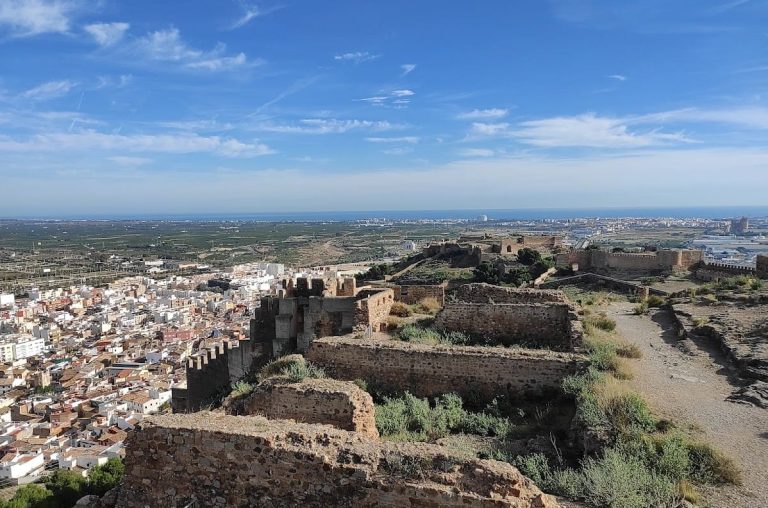
The ruins occupy the summit of the Muntanya del Castell, one of two hills rising above the plain at El Puig. The elevated position overlooks the settlement and provides views across northern Valencia. The surviving complex consists of medieval fortification walls, several towers, the remains of a keep, and auxiliary buildings. Most of the towers are rectangular or square, forms associated with the Muslim fortress tradition.
Fortified summit
Main fortress
The main enclosure was constructed chiefly with mortar and rodeno, a local reddish sandstone. On the southern slope, along part of the access route, sections of wall were made from rodeno slabs bonded with earth. These surviving fragments, together with the tower remains, keep, and auxiliary structures, preserve the outline of a hilltop fortress that is now ruinous but remains physically identifiable.
Dry ditch
A deep, dry ditch surrounded the castle. It hindered direct entry and made it more difficult for attackers to construct tunnels approaching the defenses. The ditch held water only after rainfall, so its defensive effect depended primarily on its depth and position around the enclosure.
Northwestern detached tower
On the northwestern side of the hill stood a roughly square albarrana tower, a detached defensive tower outside the main fortification. It was positioned about 70 metres from the principal fortress and at a lower level, with a bridge connecting it to the main enclosure. Whether that bridge was permanent or movable is uncertain. The arrangement could allow the tower to be isolated from the main defenses while extending the defenders’ field of fire across the approach.
Later traces
A trench dating from the Spanish Civil War remains visible on one of the mountain’s slopes. It forms a later military trace within the wider archaeological landscape of the hill, alongside the medieval walls, towers, and auxiliary constructions.
Nearby sites