Torre Quezzi: A Circular Military Support Work in Genoa


Site at a Glance
- Rating
- 4.6
- Popularity
- Very Low
- Country
- Italy
- Primary era
- Modern
- Eras represented
- Modern
- Civilizations
- Kingdom of Sardinia
- Site type
- Military
- Remains
- Tower
On this page9 sections
History
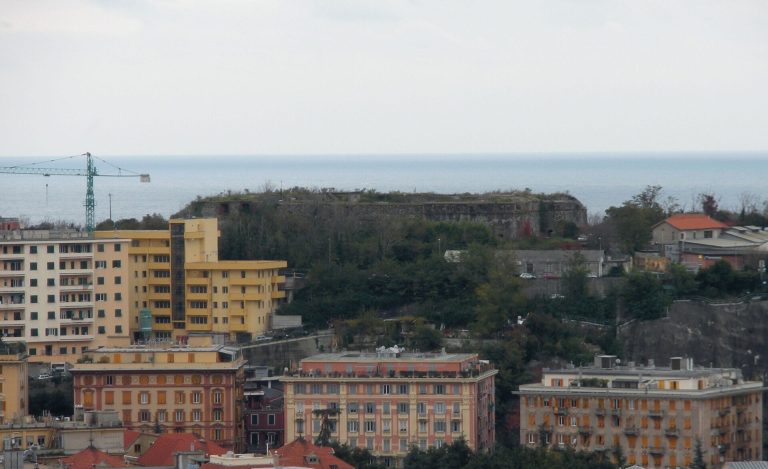
Torre Quezzi is a circular military work in Italy, built by the Royal Sardinian Corps of Engineers between 1818 and 1823 on the heights of Quezzi above Genoa. The Royal Sardinian Corps of Engineers was the military organization of the Kingdom of Sardinia responsible for designing and constructing defensive works before Italian unification. The tower formed part of Genoa’s hilltop defensive system and stood at about 318 metres above sea level.
Construction and defensive purpose
The work was built to compensate for the inadequate defenses of Forte Quezzi along the mountain’s northern ridge. That ridge offered enemy troops a position from which they could attack the fort, so Torre Quezzi was conceived as a small circular support work to reinforce this vulnerable side of the mountain.
A military report of 1830 judged Forte Quezzi’s position ineffective but considered the smaller tower to occupy an excellent defensive position. Several later projects proposed strengthening and enlarging Torre Quezzi with bastions, projecting gun platforms, and a form comparable to Forte Begato, another fortification in Genoa’s hilltop system. These proposals remained at the design stage, and the tower was never modified in this way.
Abandonment and later condition
After almost a century of military use, the tower was abandoned by the military authorities around 1909 and converted into a restaurant. It was finally abandoned in the immediate postwar period. The removal of its metal components and floor tie rods then contributed to the collapse of the floors.
Torre Quezzi is now completely abandoned and is occasionally used as shelter for local shepherds’ flocks. Its conservation is precarious, and restoration has been considered necessary for both the structure and the immediately surrounding area. The tower and the area around it are recognized by the European Union as a Site of Community Importance and, under the Habitats Directive, as a Special Area of Conservation because they provide habitat for the rare Tyrrhenian gecko, also known as the European leaf-toed gecko, Euleptes europaea. The species was formerly called Phyllodactylus europaeus.
Remains
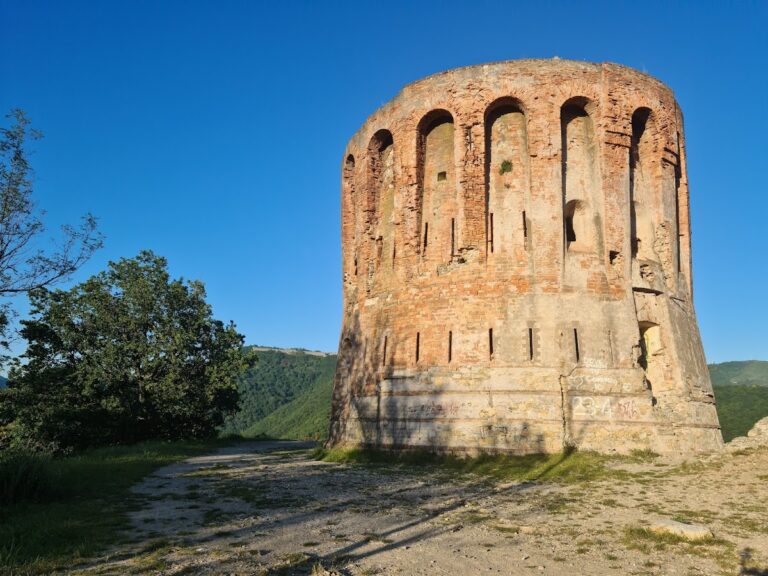
Torre Quezzi survives as a circular brick structure about 15 metres in diameter and 17 metres high. Its truncated-conical body rises from the heights overlooking the Bisagno Valley, near the Valnoci Aqueduct reservoirs and an asphalted open area. Pilasters integrated into the walls at mid-height support the parapet that crowns the roof. The roof and much of the rest of the construction are ruinous.
Outer defenses and artillery openings
Entrance and machicolations
Machicolation openings are arranged on the inner sides of the pilasters. These openings, through which defenders could drop objects or defensive materials onto attackers, were originally protected by massive grilles that could be opened. The entrance was defended by a semicircular ditch and a drawbridge. The drawbridge has disappeared, but a counterscarp wall survives in front of the entrance. This outer wall of the ditch also supported the bridge when it was lowered.
Cannon loopholes
A large cannon loophole remains on the eastern side of the first floor. Its opening flares downward, and the artillery piece placed there was intended to defend the tower rather than fire offensively. Another loophole is visible on the upper floor, where its straighter line of fire provided a different artillery position.
Interior and upper terrace
The interior was arranged on three floors supported by four load-bearing pillars. Service stairs leading to the floors were built into one of the pillars. The floors have largely, or almost entirely, collapsed following the removal of their metal components and tie rods.
The upper terrace is now inaccessible. A small casemate, or protected chamber within the fortification, provided access to it. The terrace was designed to resist bombardment, with a thick layer of earth intended to absorb the impact of period artillery. A small marble cover originally occupied the centre of the ceiling. It could be opened to assist the removal of gun smoke through a circular vertical chimney connected to the interior.
The armament consisted of two 8-pounder cannons, two long howitzers, and two small cannons. An 8-pounder was named for the weight of its projectile, while a howitzer was a relatively short-barrelled gun designed to fire along a curved trajectory. Depending on military requirements, the garrison could number between 20 and 50 personnel.
Walls and protected habitat
The tower’s walls provide habitat for the Tyrrhenian gecko, a protected species described as the smallest European vertebrate. In Liguria, it is also found on the islands of Tino and Tinetto in the province of La Spezia. Its presence on Torre Quezzi’s masonry contributes to the protected status of the tower and the surrounding area.