Forte Quezzi: A Historic Defensive Fortification in Genoa


Site at a Glance
- Rating
- 4.4
- Popularity
- Very Low
- Country
- Italy
- Primary era
- Modern
- External website
- Open
- Eras represented
- Early Modern, Modern
- Civilizations
- French, Genoese
- Site type
- Military
- Remains
- Fort
On this page8 sections
History
Forte Quezzi is a military fortification in Genoa, Italy, conceived around 1747 on the eastern heights above the Bisagno valley. Its development followed the 1746 advance of an Austro-Piedmontese army, which besieged the heights of nearby Monte Ratti above Quezzi. Together with Forte Santa Tecla and Forte Richelieu, it was intended to form part of a major defensive system protecting Genoa.
Foundation and interrupted construction
On 27 August, Jacque de Sicre, the first engineer of the army of the Infante of Spain, announced the beginning of work on the Quezzi redoubt, a small enclosed defensive work, and at Camaldoli. Design problems and a lack of funds prevented the planned fortification from being completed. By the siege operations of 1800, the abandoned position had fallen into ruins.
The siege of 1800 and Napoleonic rebuilding
General Andrea Massena, the French commander responsible for Genoa’s defense during the 1800 siege, ordered work to resume because of the site’s strategic importance. Engineers considered completion almost impossible because materials and labor were scarce. Contemporary witnesses nevertheless claimed that the fortifications were completed in three days and three nights. Their sudden appearance was said to have discouraged the enemy from attacking during or after the construction.
The position was improved again in 1809 with French funding under the Imperial Napoleonic Corps of Engineers. The bastioned enclosure, formed by projecting defensive sections, was rebuilt in stone, and a two-storey barracks with a terrace above it was constructed. The assault on Genoa was later imagined by the Italian writer and patriot Ippolito Nievo in The Confessions of an Italian, where his protagonist supposedly witnessed the severe bombardment of Forte Quezzi in 1800.
Savoyard service and decline
After Genoa was annexed to the Kingdom of Sardinia in 1814, the Savoyard military engineering commission confirmed the position’s strategic value and ordered further, limited improvements. The fort was intended to prevent an enemy from advancing into the Bisagno valley. Its barracks could house 70 men, with room for another 105 to sleep on straw spread across the floor.
The fort’s military importance ended in 1830, when a report judged it to be in poor condition and of little defensive value. Rather than authorize further repairs, the authorities recommended allowing it to deteriorate. A report of 1875 reached a similar conclusion. On 14 July 1857, followers of Giuseppe Mazzini, an Italian nationalist and republican revolutionary associated with the movement for Italian unification, attempted to seize the fort during a failed coup.
Abandonment and wartime adaptation
Forte Quezzi was abandoned in 1914 and later leased to private parties. A military report from 1936 described a severely deteriorated structure. The drawbridge had disappeared, fittings from the windows and doors had been removed, many internal staircases had lost their steps, floors had collapsed, and water was entering through the terrace.
During the Second World War, the first floor was demolished to create anti-aircraft positions armed with six 76/45 guns. These installations, along with other defenses on the ridge above the Quezzi neighborhood, formed part of Genoa’s anti-aircraft system. After the war, the fort was completely abandoned and stripped of its remaining contents. It is now owned by the Italian state and is used only as shelter for flocks.
Remains
Forte Quezzi
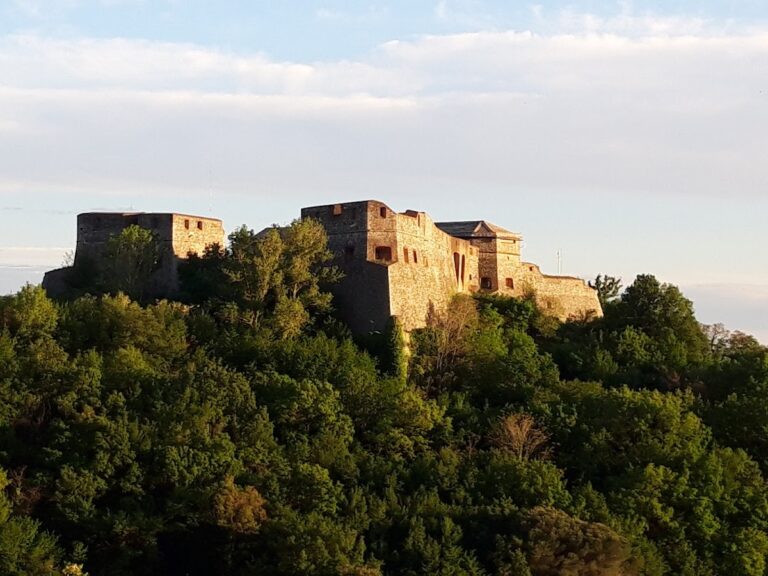
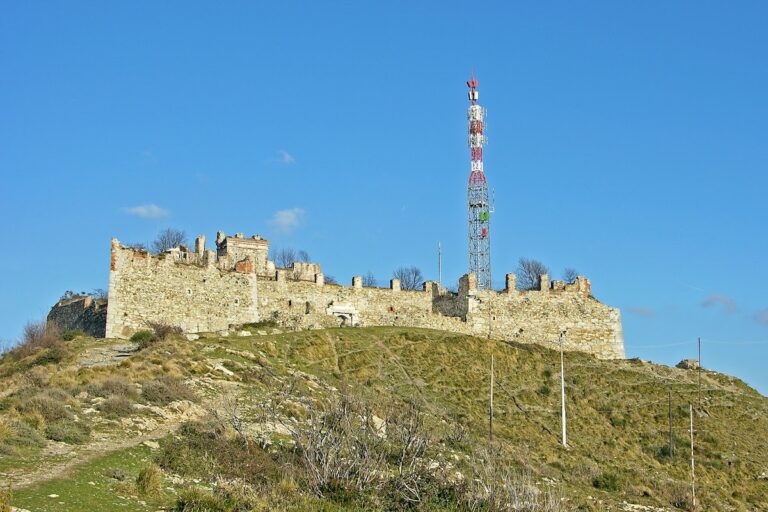
Forte Quezzi stands at approximately 285 metres above sea level on the summit of Colle della Calcinara, overlooking parts of the Bisagno and Quezzi valleys. It is close to Forte Monteratti, another position in Genoa’s hill fortification system. Built in stone, the fort survives largely as a ruin. Most of its walls have collapsed, although the perimeter walls remain identifiable and define the surviving outline.
The main entrance faces the Bisagno valley. A drawbridge once protected the approach, with a Savoyard coat of arms above it, but the bridge is now unrecognizable. Rooms for the guard corps were arranged within the entrance passage. A staircase on the right led into the internal courtyard, where the two-storey barracks opened onto the open space and was topped by a terrace.
The barracks can now be recognized mainly through the ground-floor perimeter walls, which are filled with earth and rubble. The fort was armed with five large howitzers directed toward the north and two smaller cannon defending the entrance. The later demolition of the upper floor for anti-aircraft artillery altered the building substantially. Despite this wartime adaptation, the surviving ruins were described as having been surprisingly spared by bombardment.
Torre Quezzi
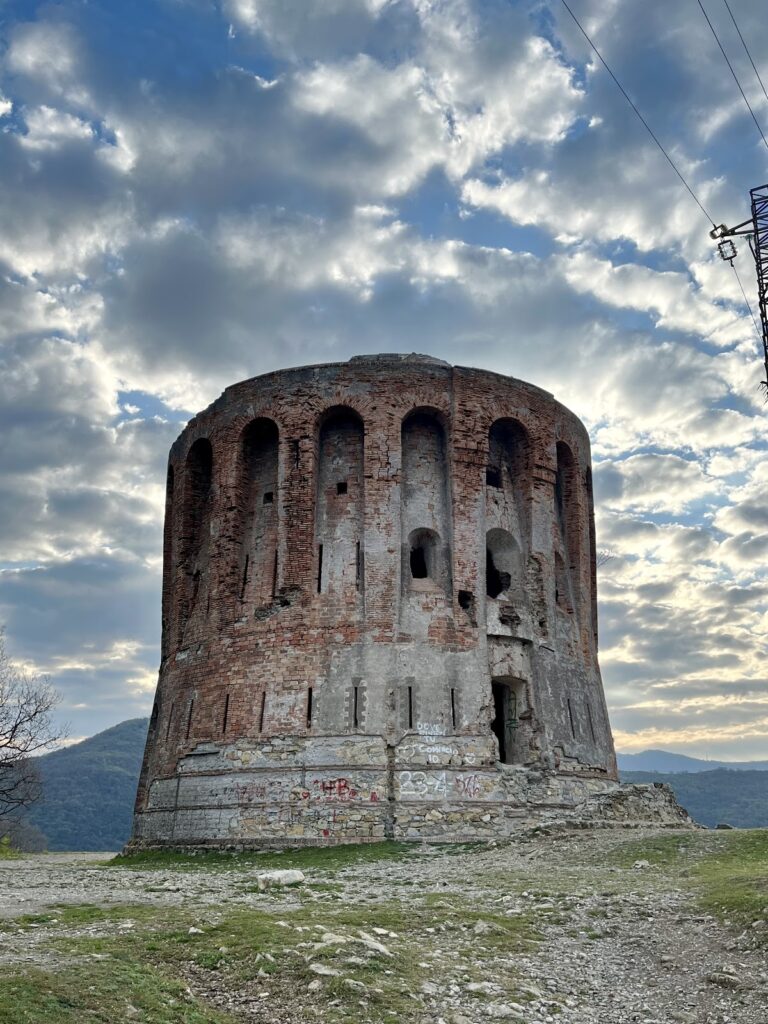
Nearby Torre Quezzi is a separate military structure built by the Sardinian Military Engineers in 1820. It survived in better condition than Forte Quezzi and later fell out of use by the end of the nineteenth century. The tower is now used as shelter for sheep. It is also one of the few habitats of the rare European leaf-toed gecko, Euleptes europaea, and is recognized by the European Union as a Site of Community Importance, a conservation designation for areas important to habitats or species.