San Bartolomeo degli Armeni: an Armenian Catholic Church in Genoa


Site at a Glance
- Rating
- 4.6
- Popularity
- Very Low
- Country
- Italy
- Primary era
- Early Modern
- Eras represented
- Medieval, Early Modern, Modern
- Civilizations
- Armenian, Genoese, Italian
- Site type
- Religious
- Remains
- Church
On this page16 sections
History
San Bartolomeo degli Armeni is an Armenian Catholic church in Genoa, Italy, founded by Basilian monks in 1308. The monks had come from the Black Mountain of southern Armenia while fleeing the Turkish invasion of the region, and the original church was completed during the fourteenth century. Today it belongs to the Archdiocese of Genoa and serves Armenian Catholics in Italy as well as other Catholic worshippers in Genoa and northern Italy.
Foundation and transformation
The church began as a foundation of Basilian monks, members of Christian monastic communities following the rule traditionally associated with Saint Basil the Great. Its first structure was substantially altered in 1595, when a broad single nave was added to the apse. The new nave was considerably taller than the earlier part of the building, changing the proportions of the church while retaining elements of its original core.
In 1650, San Bartolomeo degli Armeni was transferred to the Barnabites, a Catholic order formally known as the Clerics Regular of Saint Paul. The Barnabites continue to officiate at the church. Further renovation took place in 1775, adding another phase to the building’s long history of adaptation.
The Holy Face of Edessa
The church’s history is closely associated with the Mandylion, or Holy Face of Edessa, a Christian relic traditionally linked to an image of Christ’s face miraculously transferred onto cloth. In 1388, the Genoese doge Leonardo Montaldo, the elected head of the Republic of Genoa, received the relic from the Byzantine emperor and donated it to the monks of San Bartolomeo. It was displayed during the week after Pentecost Sunday and became known in Genoa as the santo mandillo. Its authenticity remains debated among scholars.
San Bartolomeo also preserves a relic identified as the foot of Saint Bartholomew, one of the Twelve Apostles. The church’s decorative program developed largely around the Holy Face and includes works made between the fifteenth and eighteenth centuries by Giovanni Battista Paggi, Orazio de Ferrari, Giulio Benso, Lazzaro Tavarone, Giacomo Boni, Luca Cambiaso, Domenico Piola, Anton Maria Maragliano, and other Italian artists.
Nineteenth-century alteration
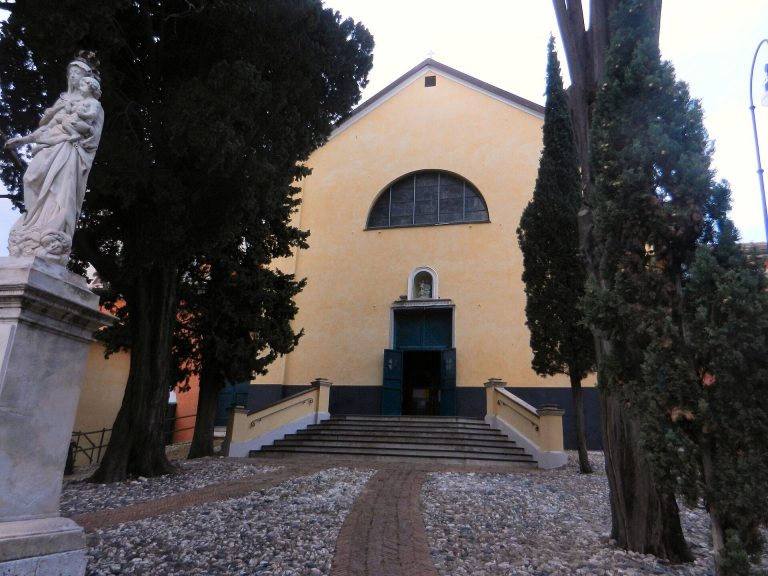
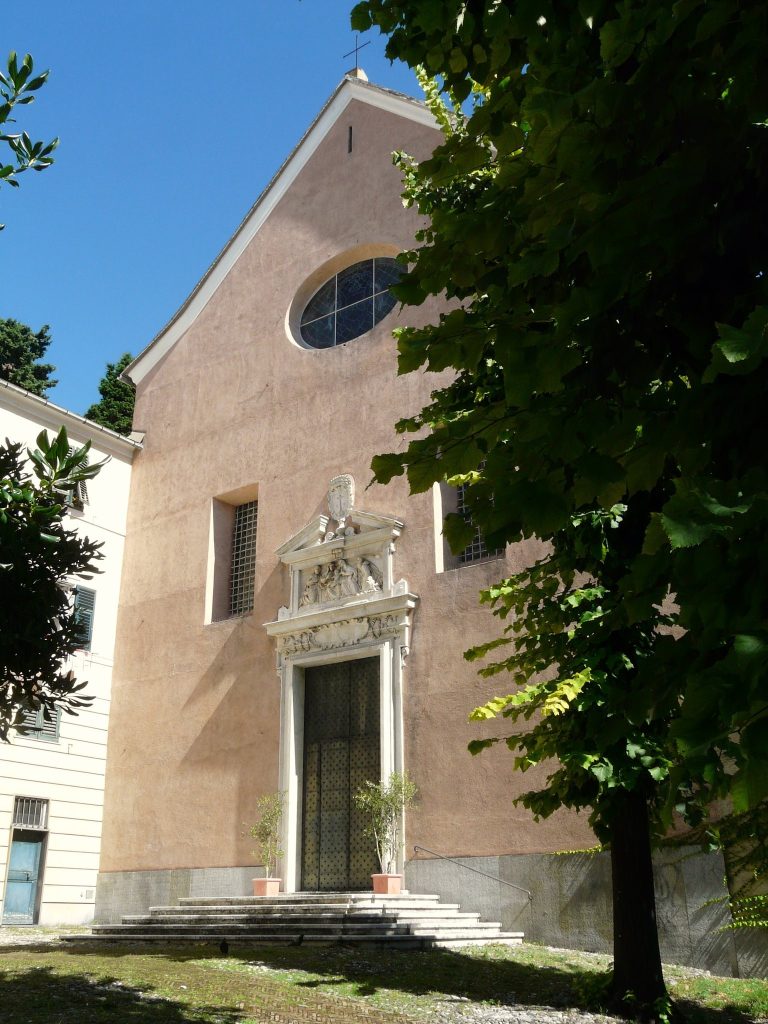
The church was physically curtailed in 1883 when the right-hand chapel, dedicated to Saint Pantaleon, was destroyed to make way for a residential building. The new structure was built against the church, closing it along the façade and right side and concealing much of its exterior. This intervention left the church closely enclosed within the surrounding urban fabric.
Remains
The surviving church combines a probable central-plan primitive structure with the much taller single nave added in 1595. The original portions include the apse, the dome above it, and the chapel at the left-hand end. A nineteenth-century residential building encloses the façade and right side, while the bell tower is the only external structure that projects visibly beyond the surrounding building.
Original structure and later interior
Apse and dome
The apse belongs to the surviving early church and is surmounted by its dome. Together with the left chapel, it forms part of the structure that probably followed a central plan before the sixteenth-century nave was added. The apse also contains a large Baroque crucifix attributed to the sculptor Giovanni Battista Bissoni.
Single nave and vestibule
The broad nave was added in 1595 and rises considerably higher than the primitive structure. Its vestibule vault contains Jesus Giving His Footprints to Ananias by Giovanni Battista Paggi, a sixteenth-century work. The counter-façade and right-hand wall carry scenes of the Holy Shroud by Orazio de Ferrari, Giovanni Battista Paggi, and Giulio Benso.
Sacristy vestibule frescoes
Fifteenth-century frescoes in the vestibule of the sacristy belong to the primitive church. They depict episodes from the Passion and the Crucifixion, together with representations of the Evangelists and the Doctors of the Church, Christian theologians whose teaching has received special ecclesiastical recognition.
Altars, paintings, and sculpture
Main altar
The main altar contains a triptych by Turino Vanni dated 1415. It depicts the Madonna and saints, while its predella, the lower part of an altarpiece, presents scenes from the life of Saint Bartholomew.
Presbytery paintings
The presbytery, the area around the main altar reserved for the clergy, contains Luca Cambiaso’s Resurrection of 1559 and Ascension of 1561. Paintings of Angels by Domenico Piola are also placed on the presbytery walls. Elsewhere in the church are Giovanni Battista Paggi’s Annunciation, Orazio de Ferrari’s Miracle of the Blind Man of Jericho, and Giacomo Boni’s portrait of Blessed Alessandro Sauli, dated 1745.
Crucifixes
Two wooden crucifixes are preserved in the church. One was made by Anton Maria Maragliano, while the large Baroque crucifix in the apse is attributed to Giovanni Battista Bissoni.
Relics and devotional works
Holy Face of Edessa
The Holy Face of Edessa is a linen relic bearing a tempera painting of Christ’s face. The image is enclosed in a precious gold-and-silver filigree frame, made from delicate ornamental metal threads and described as a masterpiece of Byzantine goldsmithing.
Decorative program
The paintings and sculptures form a devotional program centered largely on the Holy Face relic. Alongside the works in the nave, presbytery, vestibule, and sacristy area, the church preserves the relic identified as the foot of Saint Bartholomew.