Forte San Martino: A Nineteenth-Century Fortification in Genoa
Site at a Glance
- Rating
- 4
- Popularity
- Very Low
- Country
- Italy
- Primary era
- Modern
- Eras represented
- Modern
- Civilizations
- Italian, Kingdom of Sardinia
- Site type
- Military
- Remains
- Fort
On this page9 sections
History
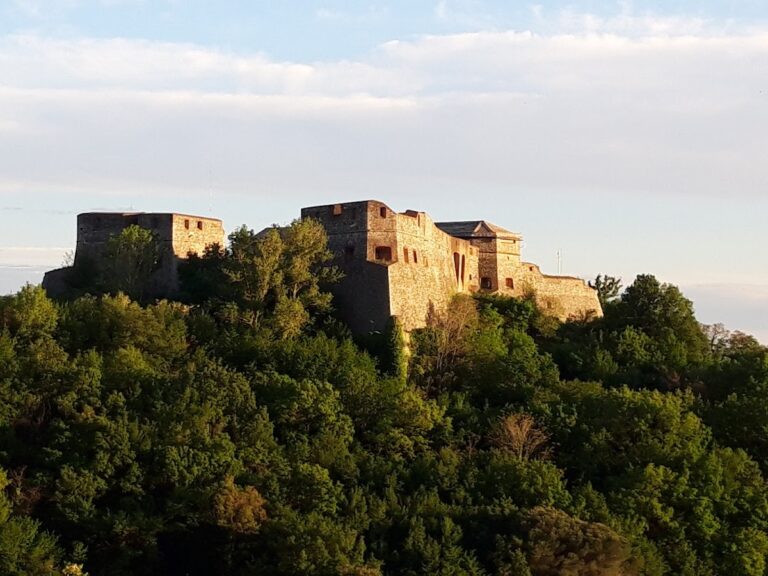
Forte San Martino is a nineteenth-century fortification in Genoa, Italy, built by the government of the Kingdom of Sardinia and completed in 1832. Its proposed purpose was to defend the districts of Albaro and San Martino, although its strategic role later declined as Genoa expanded eastward around the hill.
Proposals and construction
Plans for a fortification on the site were submitted to the authorities of the Republic of Genoa from 1771 onward. During the Napoleonic occupation, the French government approved 180,000 francs for construction in 1807 after a request from the military engineering service, but the project did not begin.
The Savoyard government revived the plan in 1820 and started building the fort. The Kingdom of Sardinia, the pre-unification Italian state ruled by the House of Savoy, became its first owner and user. Construction was completed in 1832.
Changing military role
By the end of the nineteenth century, Genoa’s eastward urban expansion had surrounded the hill with built-up areas, reducing the fort’s original strategic value. A separate San Martino Battery was added in 1889 on the parade area in front of the barracks. It was intended to protect the harbor entrance and the nearby waters.
During the 1930s, the original artillery positions were dismantled and replaced by a battery of four 76/45 anti-aircraft guns. An anti-aircraft battery was a group of artillery pieces intended to engage aircraft rather than ground or naval targets. The fort served in this role during the Second World War.
Wartime violence and abandonment
On 14 January 1944, Fascist militias and the SS executed eight partisans in the moat beneath the drawbridge. The execution was retaliation for the killing of an SS officer on the previous day. The SS, or Schutzstaffel, was a major Nazi paramilitary and security organization.
After the war, displaced families occupied the fort. It was completely abandoned during the 1950s. The property is now owned by the state, and the entrance is closed by a gate. The fort remains abandoned and in very poor condition.
Remains
Forte San Martino stands on Papigliano Hill in Genoa’s San Martino district. Rather than occupying a dominant summit, it is sunk into the hill and enclosed on every side by a moat, a defensive ditch that is now concealed by vegetation. Built from stone and brick, the fort forms a large rectangular earthwork and is entirely surrounded by Genoa’s modern urban fabric.
Main fortification
Barracks and defenses
A three-storey barracks occupies the western side of the fort, with the main entrance located on the uppermost floor. Entry was controlled by a drawbridge, a movable bridge across the moat. The drawbridge has since been removed, preventing unauthorized access to the interior spaces. A powder magazine, a fortified building for storing gunpowder and other ammunition, stood near the southern bastion and was protected by thick walls.
Artillery and accommodation
The earthwork held four 16 GR cannons, four 9 BR Ret cannons, six 21 GRC Ret howitzers, and two 9 Ret mortars. The fort could house 300 soldiers, with room for another 400 in an emergency.
San Martino Battery
The San Martino Battery, built in 1889 on the parade area before the barracks, was equipped with four 24 GRC Ret howitzers. Its surviving structures have been incorporated into commercial premises.