Tomnaverie Stone Circle: An Early Bronze Age Monument in Aberdeenshire
Site at a Glance
- Popularity
- Medium
- Country
- United Kingdom
- Primary era
- Bronze Age
- Eras represented
- Bronze Age
- Civilizations
- Unclassified
- Site type
- Religious
- Remains
- Sanctuary
On this page14 sections
History
Tomnaverie Stone Circle is a prehistoric recumbent stone circle, a ring with a large horizontal stone and upright stones beside it, on a granite hill near Tarland in Aberdeenshire, Scotland, United Kingdom. It dates to about 2500 BC, during the Early Bronze Age.
Early activity and construction
The earliest identified activity at the hilltop was a charcoal-rich pit dating to about 2570 to 2460 BC. A separate deposit of charcoal beneath the cairn, under the former position of the recumbent stone, dates to about 2500 to 2450 BC.
The cairn and stone platform were built before the circle, which was planned for this prepared setting. The hilltop was first used for funeral pyres, leaving burnt material that included cremated human bone. Later evidence of cremation dates to about 1050 to 900 BC. A pit dug in the cairn’s centre in the 16th or 17th century AD also contained cremated bone. The evidence points to funerary acts forming part of broader ritual activity, rather than the monument serving chiefly as a burial place.
Interpretation, quarrying and protection
A 1792 description called the monument a “Druidical temple” and interpreted its local name as “Hill of Worship.” Quarrying beside the circle during the 19th and early 20th centuries damaged it. By 1930, four stones were still standing. Scottish archaeologist and antiquarian Alexander Keiller secured an end to quarrying in 1926 after a dispute with the landowner, Lord Aberdeen.
Tomnaverie became a Scheduled Monument in 1927, a nationally important archaeological or historic site protected by law, and entered state guardianship in 1930. Early care chiefly involved fencing and cutting grass. Excavations led by archaeologist Richard Bradley in 1999 and 2000 established that the cairn and platform predated the circle, overturning an earlier interpretation that the cairn had been added later. Part of the quarry was filled in and the surrounding ground landscaped in 2003. Historic Environment Scotland, the public body responsible for Scotland’s historic environment, now manages the monument.
The excavated sequence makes it unlikely that people gathered inside the circle to observe astronomical events. A possible alignment with Lochnagar and a proposed link to the midsummer full moon at a minor lunar standstill, a recurring period when the Moon’s rising and setting positions span their narrowest range, have both been questioned. The lunar interpretation remains uncertain.
Remains
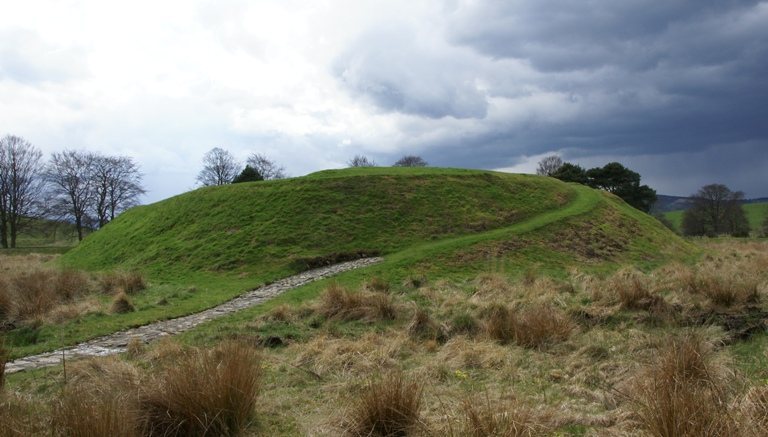
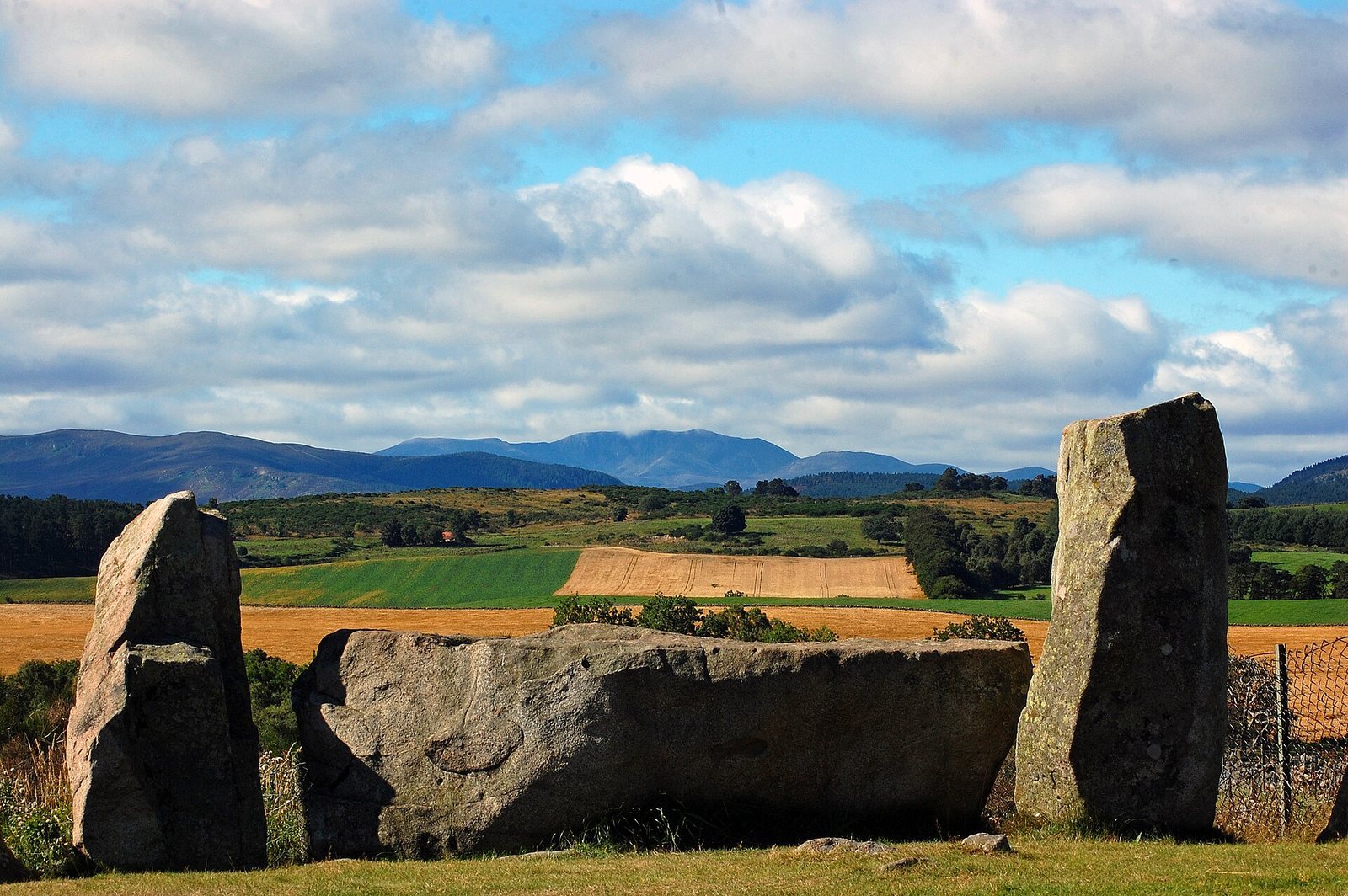
The monument occupies the summit of a small granite hill about 178 metres high in the Howe of Cromar, roughly one kilometre south of Tarland. Its wider landscape includes Lochnagar, about 30 kilometres to the southwest, and the hills of Morven and Clachnaben. The stone ring stands on a constructed platform, with a low ring cairn, a stone structure arranged around an open centre, forming part of the prepared layout.
Circle and stone arrangements
Overall form
The circle measures about 17 metres across. Its original arrangement comprised thirteen granite stones: a large recumbent stone, two flanking stones, and ten further uprights. Ten upright stones and the recumbent stone are now in place. The recumbent stone lies on the southwest perimeter, where it and its flankers face toward the surrounding landscape.
Recumbent stone and flankers
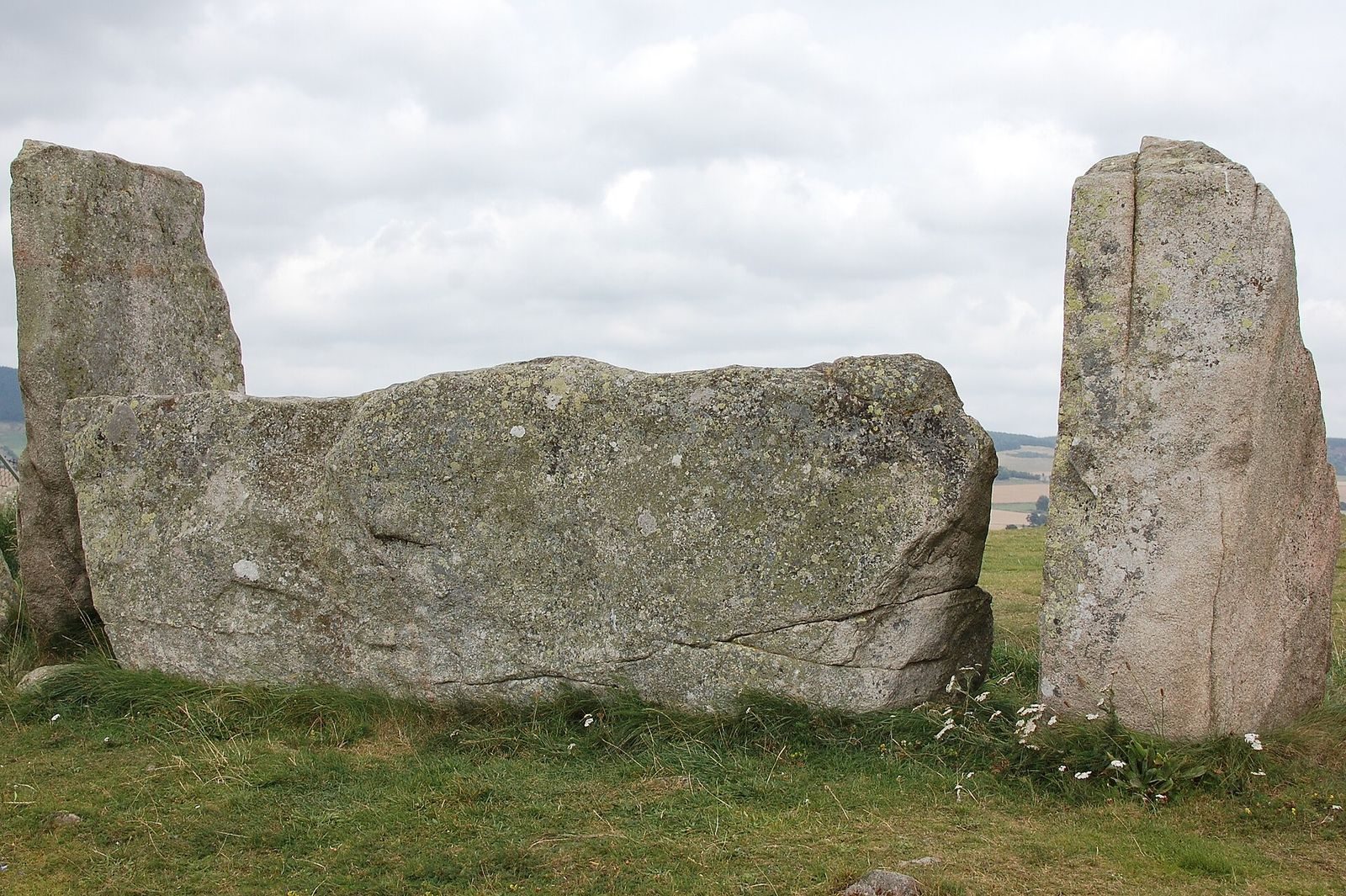
The recumbent stone measures 3.2 by 1 by 1.15 metres and weighs about 6.5 tonnes. Quartz running through it gives the stone a lighter appearance than its companions. Two cup marks, small cup-shaped hollows, appear on it, one on the upper surface and one on the outer face. Its outward orientation is given as 236 to 240 degrees.
The eastern flanker stands 1.8 metres high and weighs about 2.5 tonnes; the western one is 1.9 metres high and weighs about 3.5 tonnes. The flankers and most of the other stones are pale red. One stone on the southeast side is light grey.
Other uprights and their settings
The upright stones become shorter from the flankers toward the opposite side of the ring, while the spaces between them narrow. The uprights appear to have been installed in pairs facing one another, at right angles to the line running through the recumbent stone. The recumbent rests in a shallow hollow on small supporting stones wedged beneath it. The uprights are set into sockets cut into the platform.
Platform and ring cairn
Stone platform
The constructed platform extends up to 24 metres across and rises about 0.6 metres. It was formed by spreading rubble over the hilltop. On the steep southwest slope, terraces of turf and soil supported by boulders extended the cairn’s footprint to accommodate the recumbent setting.
Ring cairn
The polygonal ring cairn measured about 15 metres across and had a clear central court. It was built from burnt material, rubble and boulders. Excavation traced nineteen stones along its outer border, which originally formed a continuous line. On the southwest side, this border turns outward to meet the setting of the recumbent stone. Lines of boulders radiate through the cairn, dividing it into segments.
Restoration and excavated finds
Stone repair
Before restoration, the quarry face had come to within about a metre of a standing stone on the west side. The recumbent stone had been tipped inward, possibly to keep it from falling into the quarry. Both flankers had been pulled from their sockets and toppled outward, and the western one had slipped into the quarry. Restoration returned the recumbent and stones recovered from the quarry to their original sockets where possible. A stone that fell before 1870 was recovered intact from the quarry.
Pottery and worked stone
Six fragments of Beaker pottery, associated with prehistoric communities that used distinctive bell-shaped vessels, were found beneath the northeast edge of the outer platform near the cairn’s border. Other finds included plain pottery from the Late Bronze Age, worked stones and six flint blades. A survey on foot in the surrounding area identified as many as 29 rocks with cup marks.