Royal Necropolis of Saint-Denis: France’s Royal Burial Complex
Site at a Glance
- Popularity
- Very High
- Country
- France
- Primary era
- Medieval
- Eras represented
- Classical, Medieval, Early Modern, Modern
- Civilizations
- French, Roman
- Site type
- Burial
- Remains
- Necropolis
On this page19 sections
History
From a late Roman cemetery to a royal burial place
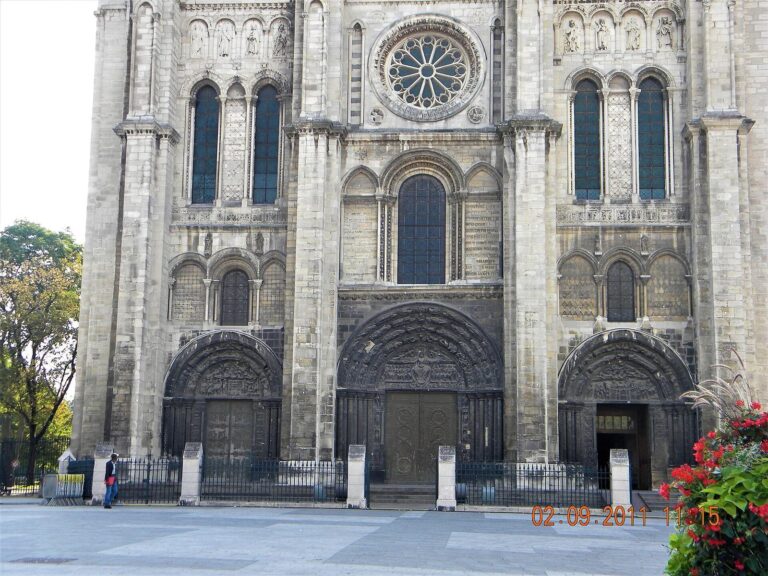
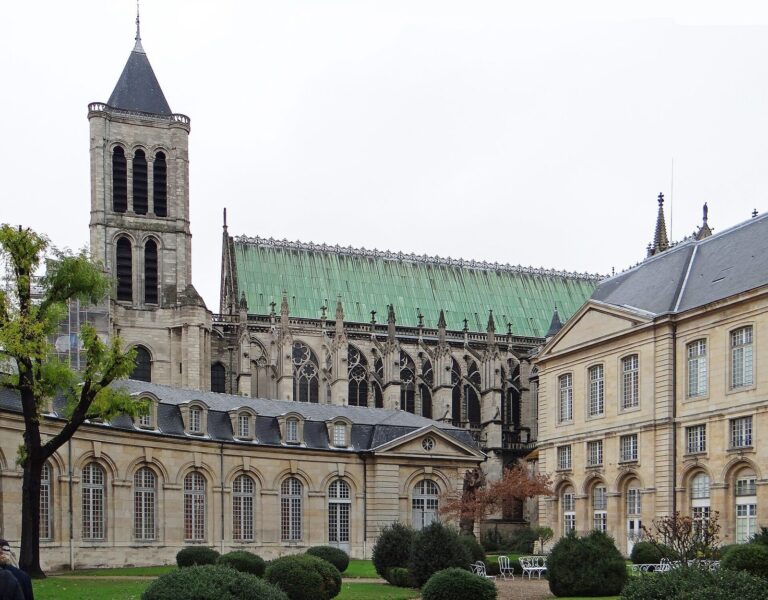
The Royal Necropolis of Saint-Denis is a royal burial complex in France, centered on a church and an earlier mausoleum. A Gallo-Roman cemetery occupied the site by the Late Roman Empire. In the fourth century, a mausoleum was built where the basilica’s high altar now stands, and it became an object of religious devotion. Around 475, Saint Genevieve acquired nearby land and had a church built.
Royal burials began in the Frankish period. Arégonde, a Frankish queen, was buried at the church in the sixth century, and Dagobert I became closely associated with its early royal burial tradition. The role of Saint-Denis as a gathering place for royal burials grew firmer under the Robertians, the family from which the Capetian dynasty emerged, and the Capetians. The burials represent successive ruling houses in Frankish and French history, including the Merovingians, Carolingians, Capetians, Valois, and Bourbons.
Rulers, their consorts, other members of the royal family, and prominent servants of the kingdom whom kings authorized to be buried nearby were interred at Saint-Denis. Royal burials continued from the early Frankish period through the death of Louis XVIII in 1824. Nearly all reigning French kings were buried or commemorated there, with Philip I, Louis XI, Charles X, and Louis-Philippe I among the exceptions. Louis VII was first buried at Barbeau Abbey before his remains were transferred to Saint-Denis in 1817.
War and revolutionary destruction
During the Hundred Years’ War, the tombs of Philip II Augustus, Louis VIII, and Louis IX and his wife, Margaret of Provence, were destroyed. Later, during the French Revolution, the royal monuments and burials faced systematic attack. On 31 July 1793, revolutionary representative Bertrand Barère proposed destroying the royal mausoleums. Tombs were attacked and opened from August, and major exhumations took place in October.
The exhumed bodies were thrown into two common graves north of the basilica and partly covered with quicklime. The destruction also sought materials from tombs and coffins, including metals for the revolutionary war effort. Dom Germain Poirier, a Benedictine monk and former member of the Saint-Denis community, was appointed to witness the exhumations. Many bodies were destroyed or placed in the pits, while others had decomposed or crumbled to dust. Henri IV’s well-preserved body was displayed outside the basilica for several days, then moved between institutions in Paris. By order of Napoleon I, it was eventually taken to the church of Saint-Louis des Invalides.
Restoration and later burials
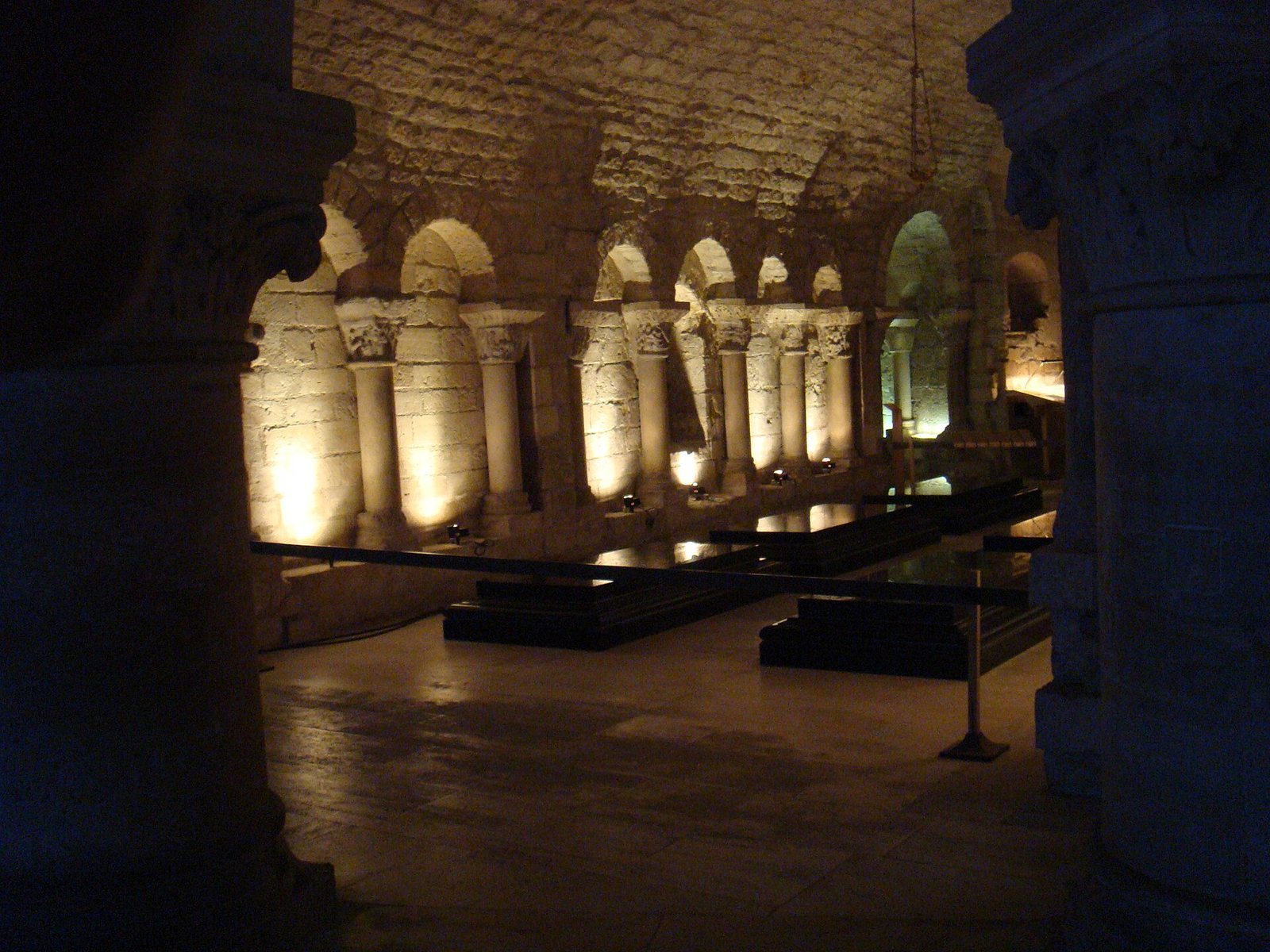
Alexandre Lenoir, a French museum curator, rescued valuable statues and tomb monuments and sent them to a depot at the Petits-Augustins in Paris. In 1816, Louis XVIII asked for the monuments to be returned to the basilica, which was reconsecrated that year. On 19 January 1817, he ordered the recovery of his predecessors’ remains from the graves. Because the quicklime had made identification impossible, the recovered remains were gathered in a sealed ossuary, a place where bones or human remains are kept, in the basilica’s crypt, beneath marble plaques bearing the monarchs’ names.
The Restoration also brought several royal remains to Saint-Denis. Louis XVI and Marie-Antoinette were transferred from the Madeleine cemetery in Paris in 1815. In 1817, Louis VII came from Barbeau Abbey, Louise of Lorraine from a Paris convent, and the daughters of Louis XV, Adelaide and Victoire, from Trieste. A further reorganization took place in 1970, when coffins of princes and princesses, a box of bones, and a cabinet containing hearts were moved to a new crypt beneath the former vaulted royal crypt.
The basilica also received the burials of people who served the monarchy and kingdom, including churchmen, military commanders, and royal officials. These burials extended the necropolis beyond the ruling families themselves.
Remains
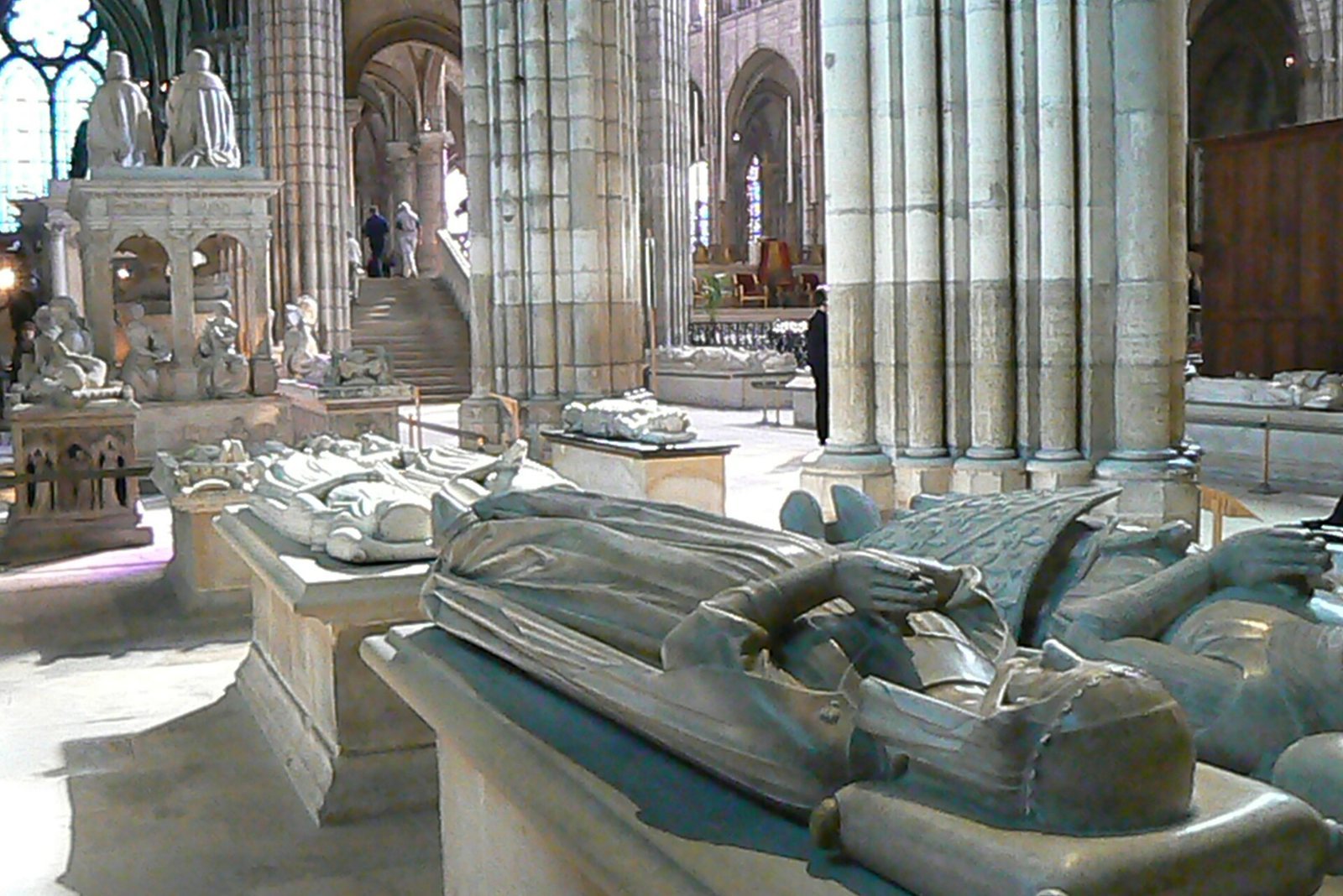
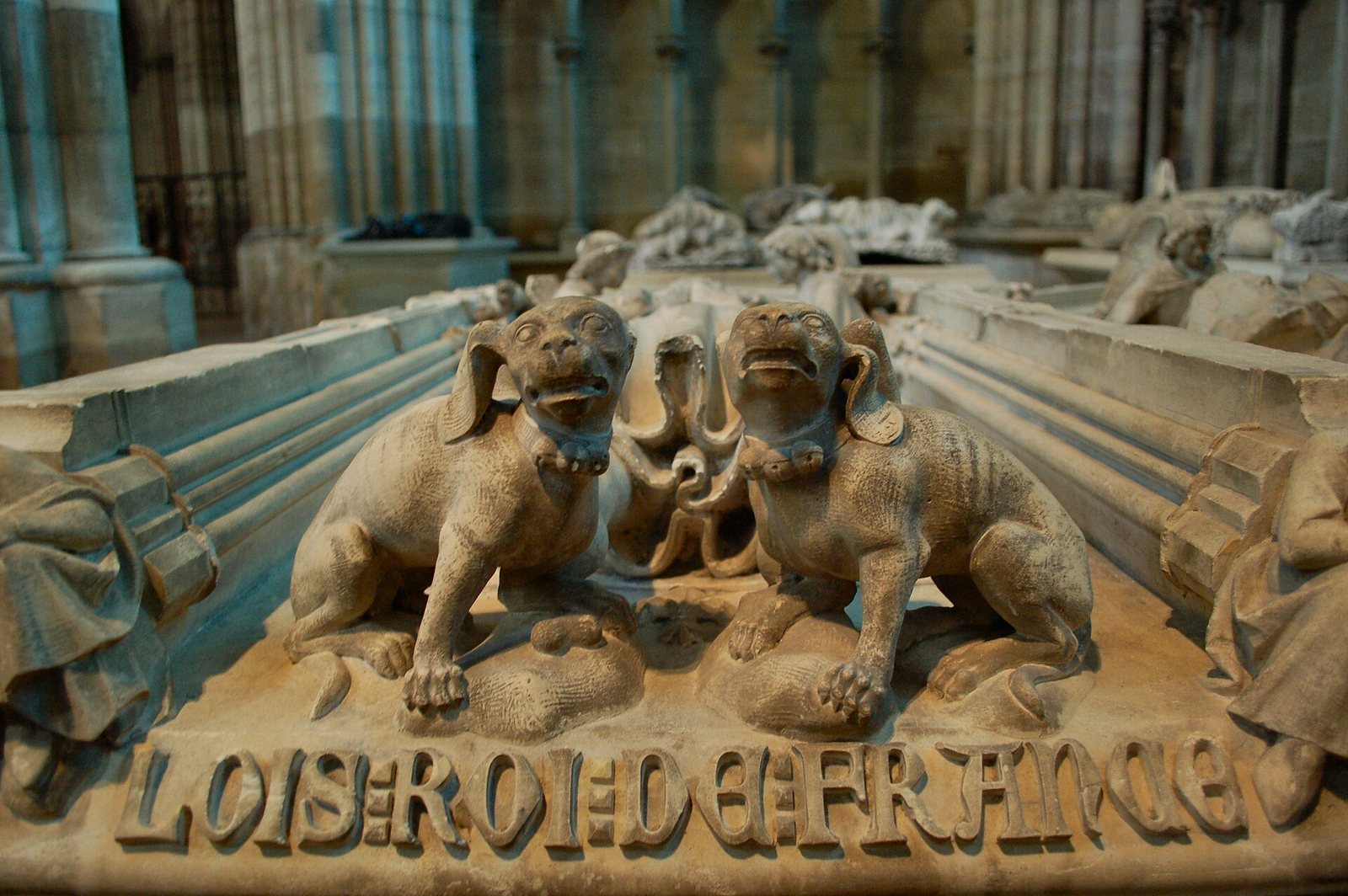
The royal memorials within the basilica range from funerary slabs and sculpted figures to richly decorated mausoleums. The site also includes a royal crypt, a nearby Bourbon chapel, and other burial vaults and memorials. Many monuments commemorate rulers whose remains were later moved, destroyed, or gathered elsewhere in the crypt.
Funerary slabs
Four early royal memorials take the form of funerary slabs, associated with Clovis I, Childebert I, Clovis II, and Fredegund. The slab for Clovis II dates to the twelfth century. Childebert’s memorial and Fredegund’s slab were brought from Saint-Germain-des-Prés, where they had been buried in 558 and 597 respectively; an effigy of Clovis I is also among the transferred monuments.
Medieval royal sculpture
Memorials commissioned by Louis IX
Around 1260, Louis IX commissioned a series of tomb effigies, or sculpted figures, for earlier rulers dating back to the seventh century. The figures are symbolic rather than portrait-like, reflecting how royal ancestors were represented in mid-thirteenth-century sculpture. The group includes memorials to Dagobert I (629–639); Pepin the Short (751–768) and Bertrada of Laon; Carloman I (768–771); Ermentrude, first wife of Charles II the Bald; Louis III (879–882); Carloman II (879–884); Robert II (996–1031) and Constance of Arles; Henry I (1031–1060); Louis VI (1108–1137); Constance of Castile, second wife of Louis VII; and Blanche of Castile (1188–1252), wife of Louis VIII.
Effigies seeking portrait likeness
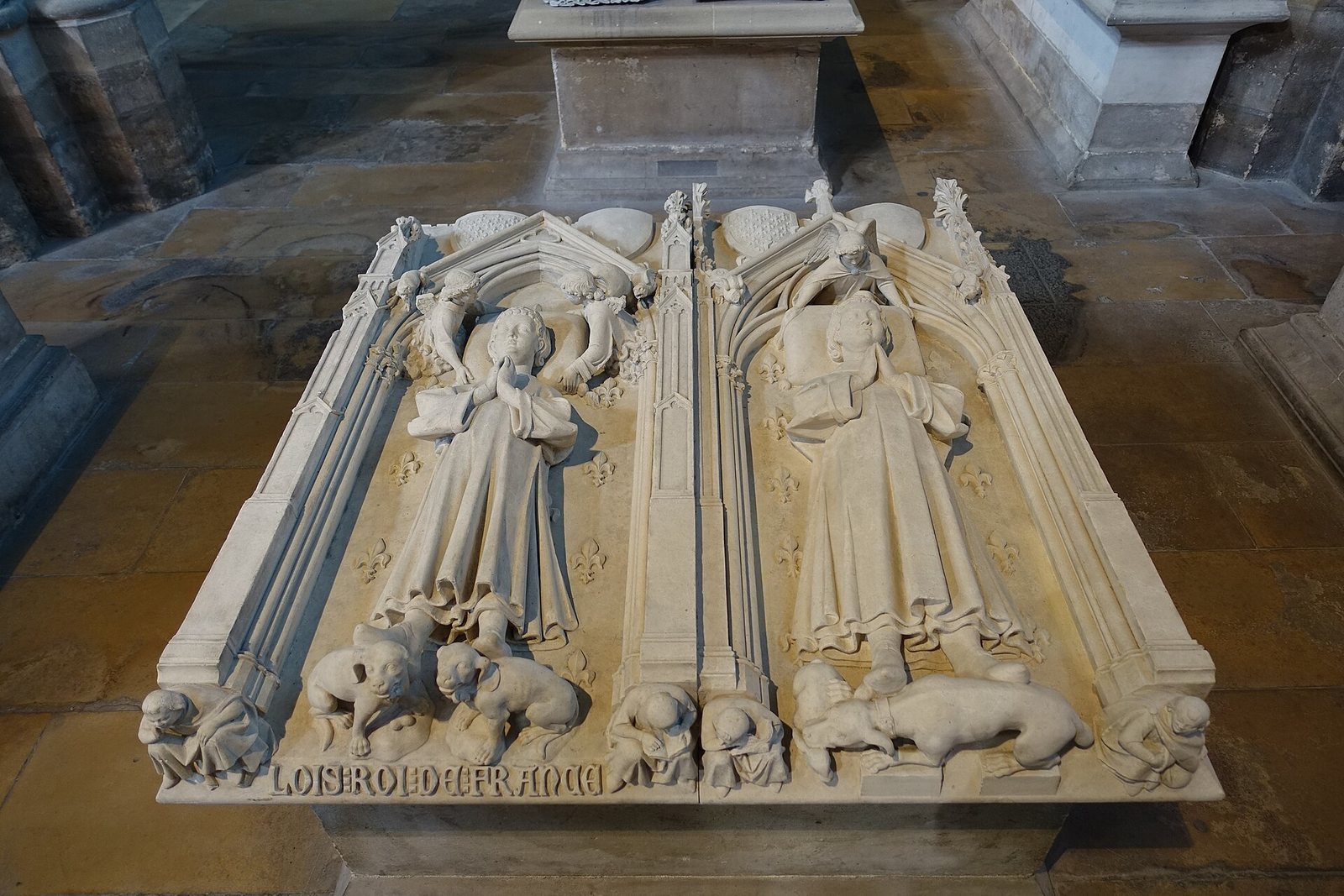
From the tomb of Philip III, who died in 1285, royal effigies increasingly aimed to resemble the people they commemorated. This group includes Philip III and Isabella of Aragon; Philip IV (1285–1314); Louis X (1314–1316) and Clemence of Hungary; John I the Posthumous (1316); Philip V (1316–1322); Charles IV (1322–1328) and Jeanne d’Évreux; Philip VI (1328–1350) and Blanche of Navarre; John II (1350–1364); Charles V (1364–1380) and Jeanne of Bourbon; and Charles VI (1380–1422) and Isabeau of Bavaria.
Renaissance royal mausoleums
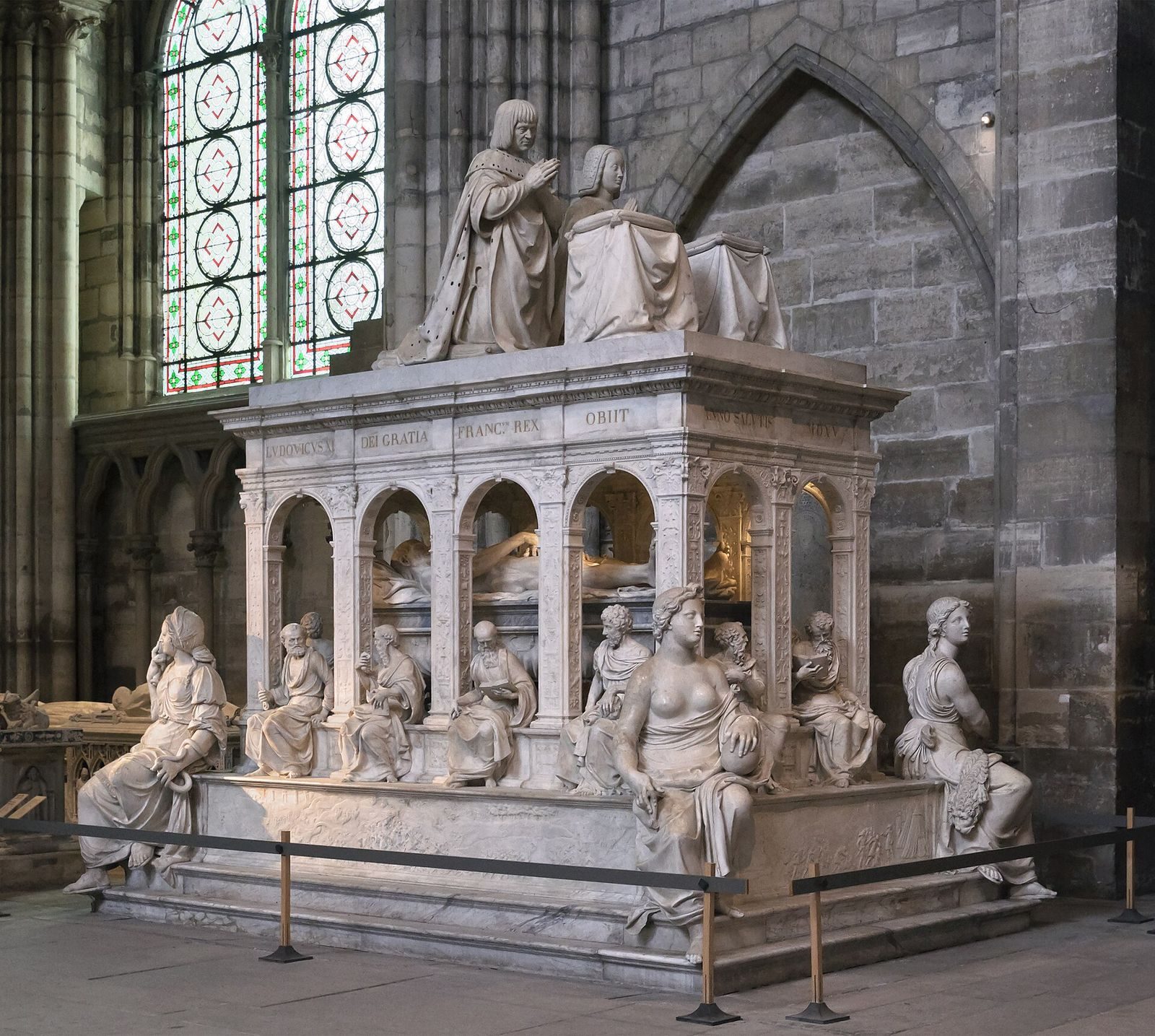
Renaissance mausoleums at the basilica use two levels to present contrasting images of royal death. Above, kings and queens kneel in ceremonial dress in the orant pose, a figure shown kneeling in prayer. Below, they appear nude and rigid in death.
Louis XII and Anne of Brittany
The mausoleum of Louis XII and Anne of Brittany was made by the Juste brothers, sculptors. It belongs to the group of richly decorated, two-level royal memorials.
Francis I and Claude of France
Made by architect Philibert Delorme and sculptor Pierre Bontemps, the mausoleum of Francis I and Claude of France takes the form of an ancient triumphal arch. Its base is decorated with low-relief sculpture, which projects only slightly from its background, including a scene of the Battle of Marignano.
Henry II and Catherine de’ Medici
The mausoleum of Henry II and Catherine de’ Medici was made under the direction of Primaticcio. Catherine, dissatisfied with the funerary image planned for her, commissioned a second transi, a funerary figure depicting a dead body, from Germain Pilon. In this work, sleep takes the place of death. A second tomb, brought from the Valois Rotunda, has marble figures by Pilon based on the wax and wooden images displayed on the sovereigns’ funeral beds. Henry II and Catherine are identified as the only French sovereigns with two tombs.
Royal crypts and Bourbon memorials
Royal crypt
The old vaulted royal crypt contains six tombs, one of them empty. Five royal figures are interred there: Louis VII, Louise of Lorraine, Louis XVI, Marie-Antoinette, and Louis XVIII.
Bourbon chapel and vault
The nearby Bourbon chapel holds nineteenth-century cenotaphs, memorial tombs that do not contain the person’s body, in honor of the Bourbon family. A translucent vase there contains the heart of Louis XVII. The basilica also has a Bourbon vault and a cenotaph of Louis XIV.
Other dynastic and service tombs
Princes and princesses
Other tombs commemorate members of the royal family, including Louis of Orléans, Valentina Visconti, and their sons Charles and Philippe; Charles of Étampes; Margaret, daughter of Philip V; Charles Martel; Leo of Lusignan; Charles of Valois and Maria of Spain; Blanche of Brittany; Robert of Artois; and Louis, the eldest son of Louis IX. Further monuments honor, among others, Charles of Anjou, Jeanne of France, daughter of Philip VI, and Philippe, eldest son of Louis VI.
Royal servants
Tombs and monuments also honor the abbot and royal adviser Suger, the military commander Bertrand du Guesclin, the marshal Henri de La Tour d’Auvergne, Viscount of Turenne, and royal servants Louis de Sancerre and Guillaume de Chastel.