Cave of Swimmers: A Prehistoric Rock-Art Shelter in Egypt
Site at a Glance
- Popularity
- Very High
- Country
- Egypt
- Primary era
- Stone Age
- Eras represented
- Stone Age
- Civilizations
- Unclassified
- Site type
- Civic
- Remains
- Rock Art
On this page7 sections
History
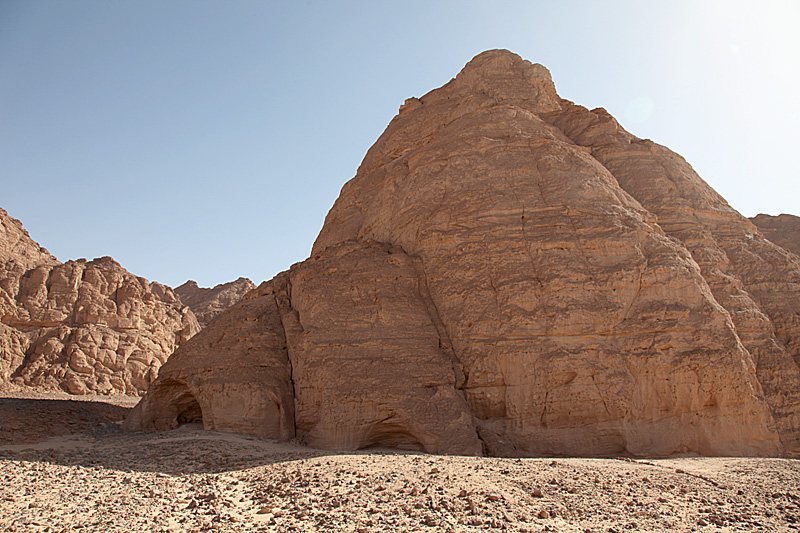
The Cave of Swimmers is a prehistoric rock shelter on the mountainous Gilf Kebir plateau in Egypt’s New Valley Governorate, near the Libyan border. Its paintings are described as Neolithic, a broad prehistoric period associated with food production and settled or semi-settled life, and may date as early as about 8000 BC. The figures have prompted competing interpretations, including that they depict swimmers or people who have died.
Dating and environmental change
The proposed early date places the paintings near the beginning of the African Humid Period, also known as the Green Sahara, when the region was substantially wetter and greener than it is today. The Green Sahara phase is generally dated to about 7500-2300 BC, while the beginning of the Neolithic in the Sahara is placed around 5000 BC. These differing chronologies leave the paintings’ precise date and cultural setting uncertain.
About 5,000 years ago, changes in incoming summer solar radiation, together with related shifts in vegetation and dust, contributed to the Sahara’s drying. The Hungarian explorer László Almásy argued that the figures depicted swimming as part of everyday life in a landscape that was still humid before this climatic change.
Discovery and interpretations
Almásy discovered the shelter and its paintings in October 1933. He devoted a chapter to them in his 1934 book The Unknown Sahara. The book’s first editor added footnotes distancing himself from Almásy’s then-novel interpretation.
Physical scientists tentatively connected the apparent swimmers with two lakes about 200 km south of the shelter. Rock-art researcher Andras Zboray questioned whether the figures depict swimming, suggesting instead that they may be symbolic images of unknown meaning. Hans Rhotert interpreted them as deceased people. Jean-Loïc Le Quellec drew parallels with the Coffin Texts, ancient Egyptian funerary writings, and proposed that the figures were dead souls floating in Nun, the primeval water in Egyptian belief. Egyptian anthropologist Yasser Al-Laithy supported this reading, noting a resemblance to figures in Chapter Nine of the Book of Gates, an ancient Egyptian funerary composition about passage through the afterlife, in the tomb of Ramesses VI, a pharaoh of Egypt’s Twentieth Dynasty.
Similar paintings in nearby shelters, together with the continuous arrangement of figures across much of this shelter, have also prompted the suggestion that ideas expressed in the art later took forms adapted to the layout of the Nile Valley.
Modern pressures
Visitor damage became especially severe after the 1996 release of The English Patient. The shelter shown in the film adaptation was a set made by a contemporary artist, not the actual site. Guide training and litter clearance have been used to reduce further harm, but increasing tourist traffic remains a threat.
Remains
Painted shelter
A continuous line of paintings extends across much of the shelter’s interior. Human figures with bent limbs appear alongside giraffes, hippopotamuses, ostriches and antelopes. About 10 km to the west, the Cave of Beasts is another rock-art shelter with notably well-preserved paintings.
Damage to the rock art
Substantial portions of the shelter have been irreversibly damaged. Painted fragments have been taken as souvenirs, and applying water to increase contrast for photographs caused some rock surfaces to crack. Graffiti has also been inscribed on the rock, while littering adds pressure around the fragile shelter.