Tōfuku-ji Temple: A Tendai Buddhist Temple in Tokyo


Site at a Glance
- Rating
- 4.2
- Popularity
- Very Low
- Country
- Japan
- Primary era
- Modern
- External website
- Open
- Eras represented
- Early Modern, Modern
- Civilizations
- Japanese, Tokugawa
- Site type
- Religious
- Remains
- Monastery
On this page11 sections
History
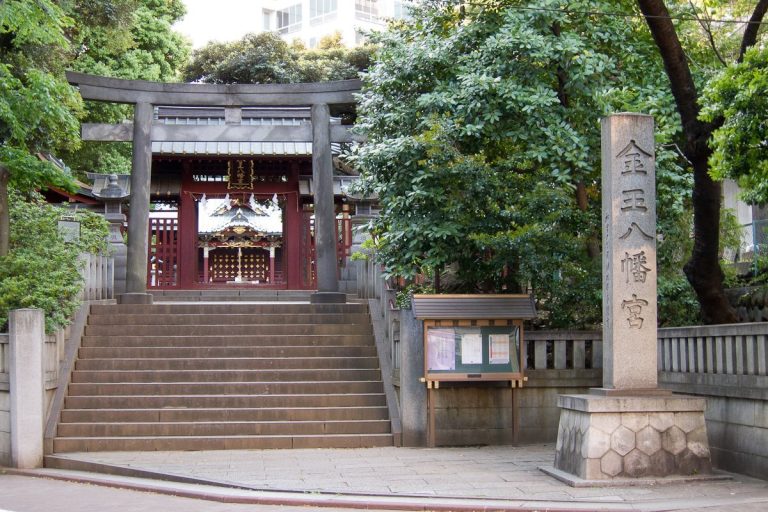
Tōfuku-ji Temple is a Tendai Buddhist temple in Tokyo, Japan, formally known as Shibuyasan Shinno-in Tōfuku-ji. Its history is connected with the Konno Hachiman Shrine, and its principal images are Amitabha Buddha, the Buddha associated with the Pure Land of the West, and Kannon, a bodhisattva associated with compassion.
Origins and medieval development
Between 1046 and 1068, Kawasaki Motoya, a local magnate in the Musashi area, enshrined Hachiman at Shibuya in the Tanisaki estate. Hachiman was a Japanese deity associated with warfare, protection, and the imperial lineage. A Buddhist institution called Shinno-in was established to administer the associated shrine within the former combined shrine-temple system.
In 1092, a lodging where Minamoto no Tsunemoto had stayed during the rebellion of Taira no Masakado was converted into a temple and given the name Shinno-in. The associated Konno Hachiman Shrine had been repaired in 1091 by Minamoto no Yoshiie, a prominent Minamoto military leader of the late eleventh century.
Shibuya Shigeie prayed at the Hachiman shrine because he had no child, and his son Konnomaru was born on August 15, 1141. During the Hogen Rebellion of 1156, a struggle over imperial succession and political control in Kyoto, Konnomaru served in the vanguard of Minamoto no Yoshitomo and distinguished himself in battle. A tradition holds that his guardian image of Kannon appeared as a soldier and protected the troops.
On May 15, 1173, the Buddhist monk Enchin arranged the temple buildings and became regarded as the institution’s founding abbot. He died in 1181 at the age of 111. In 1191, Minamoto no Yoritomo established the Konno Hachiman Shrine and named it Tsurugayama. Yoritomo later founded the Kamakura shogunate, the military government that ruled Japan from the late twelfth century.
In 1202, Shibuya Takashige, a devotee of the abbot Enshō, built a new temple complex. The institution was then renamed Shibuyasan Jōshō-in Enshōji, reflecting another stage in its religious and institutional history.
Destruction, rebuilding, and modern survival
Fighting between the Hōjō and Uesugi forces caused the temple and the associated Hachiman shrine to burn in 1524. During the Summer Campaign of Osaka in 1615, a conflict that ended the Toyotomi regime and consolidated Tokugawa rule, Aoyama Tadatoshi constructed buildings for both institutions.
Further work followed over several centuries. Construction was requested in 1690, and Matsudaira Tadanori, lord of Ueda Domain, repaired the shrine and temple buildings between 1751 and 1763. In 1801, Aoyama Tadahiro donated 150 ryō in gold for additional repairs. By 1840, however, both complexes had become seriously dilapidated. The forty-fifth abbot, Shunkyō, collected donations with assistance from Suzuki Gaka and repaired the shrine and temple.
In 1877, the temple submitted an official temple register, while Watanabe Chitoku, abbot of Hōsen-ji, served concurrently as its priest. The temple’s fifty-first abbot, Sōen, oversaw completion of the main hall on December 17, 1917. The Great Kantō Earthquake of September 1, 1923, damaged the temple, but repairs followed immediately.
During the air raids of March to May 1945, most temples and shrines in Shibuya were devastated, while Tōfuku-ji escaped destruction. A ceremony marking completion of the temple was held on November 27, 1984. The bell, the wooden seated Medicine Buddha, the bronze standing Bodhisattva, and the wooden standing Fudō Myōō are designated as Shibuya Ward tangible cultural properties. Their designations took place in 1976, 2008, and 2014, according to the individual objects.
Remains
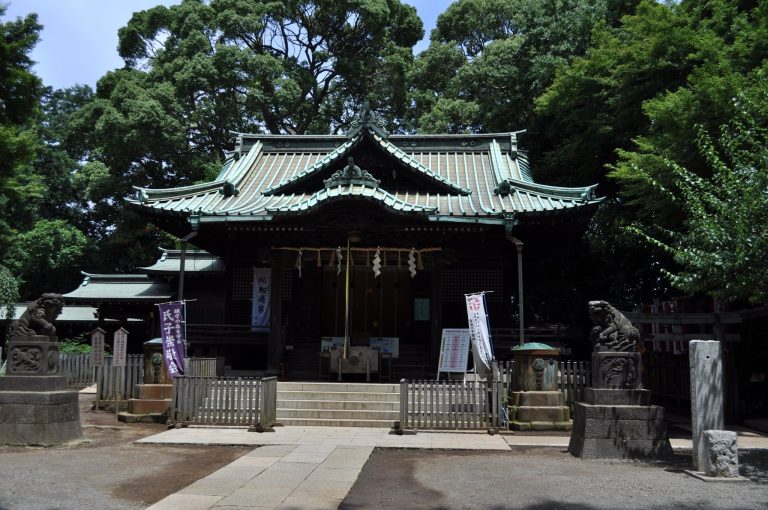
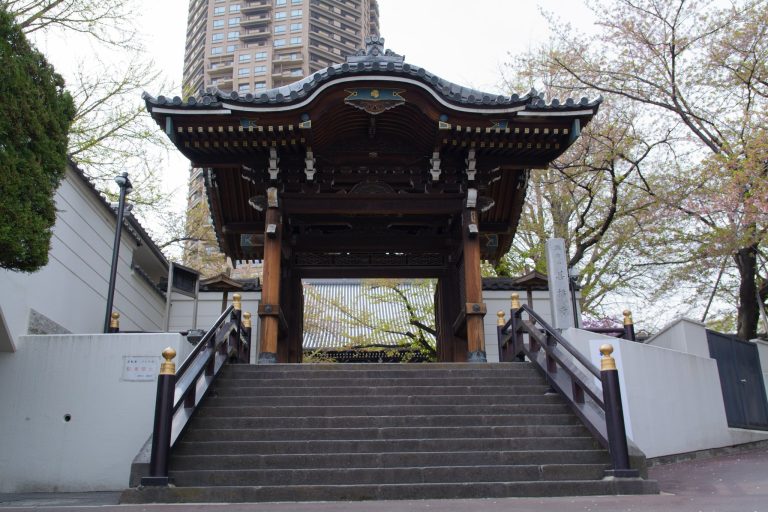
The surviving complex brings together the associated Hachiman shrine, shrine buildings, Buddhist halls, the main hall, and a bell-tower building. These structures and objects reflect the long relationship between the shrine and the Tendai temple, as well as successive phases of construction, repair, and preservation.
Shrine and temple buildings
Hachiman shrine
The Hachiman shrine forms an associated part of the complex. Its front entrance was given a kabuki gate in 1769, providing the entrance with a distinctive traditional gate form. Shrine buildings were constructed and repaired during the rebuilding phases that followed the fire of 1524 and the later interventions of the Edo period.
Main hall
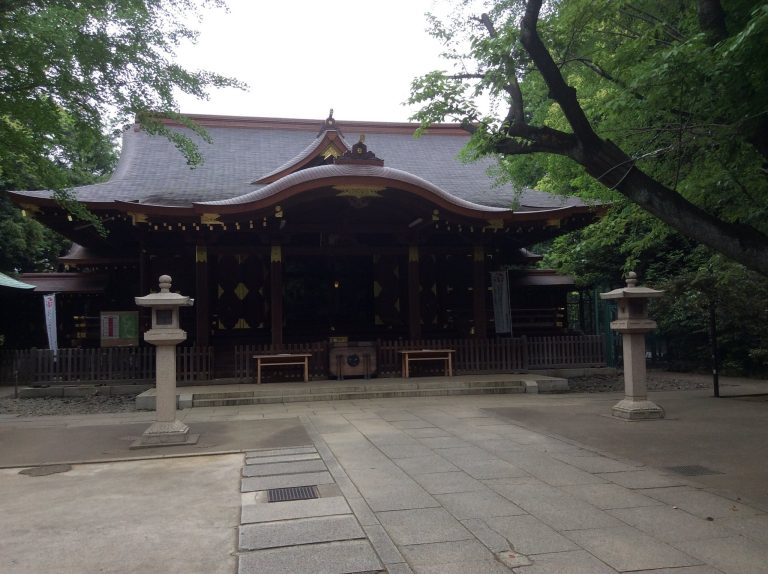
The main hall was completed in 1917 under the temple’s fifty-first abbot, Sōen. It was repaired after damage from the Great Kantō Earthquake of 1923. The hall belongs to the modern phase of the complex and forms part of the group of temple buildings that survived the destruction affecting much of Shibuya during the 1945 air raids.
Bell tower
The temple bell was cast in 1704 under the thirty-seventh abbot, Ejun. A bell tower was built at the same time, bringing the temple’s facilities into proper order. The bell remains part of the temple’s cultural-property inventory.
Images and commemorative features
Buddhist images
The temple’s principal images are Amitabha Buddha and Kannon. Other preserved images include a wooden seated Medicine Buddha, a bronze standing Bodhisattva identified as an attendant in the Zenko-ji-style arrangement of Amitabha Buddha, and a wooden standing Fudō Myōō. Fudō Myōō is a protective Buddhist deity traditionally shown in an immovable and wrathful form.
Bashō monument
A monument inscribed with a verse by Matsuo Bashō was erected in the temple precincts during the Bunka era, between 1804 and 1817. The monument was established by disciples associated with the Taibakudō circle and preserves a literary connection within the religious complex.