Tillinge Church: A Medieval Church in Enköping, Sweden
Site at a Glance
- Country
- Sweden
- Primary era
- Early Modern
- Eras represented
- Medieval, Early Modern, Modern
- Civilizations
- Swedish
- Site type
- Religious
- Remains
- Church
On this page15 sections
History
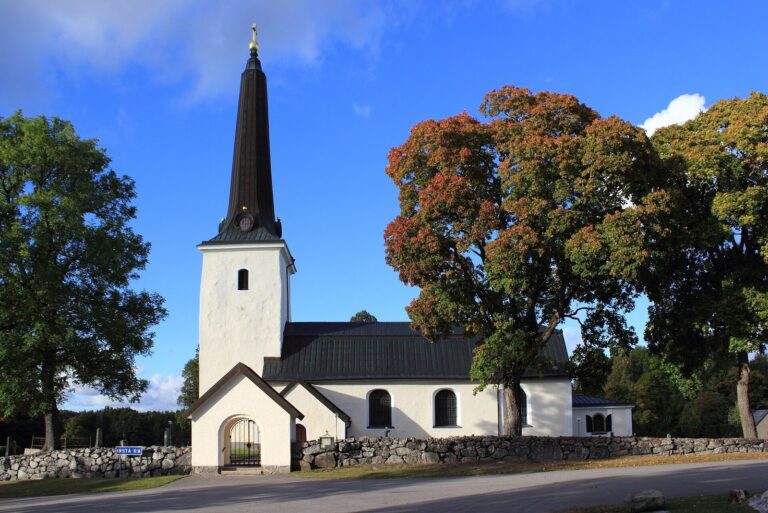
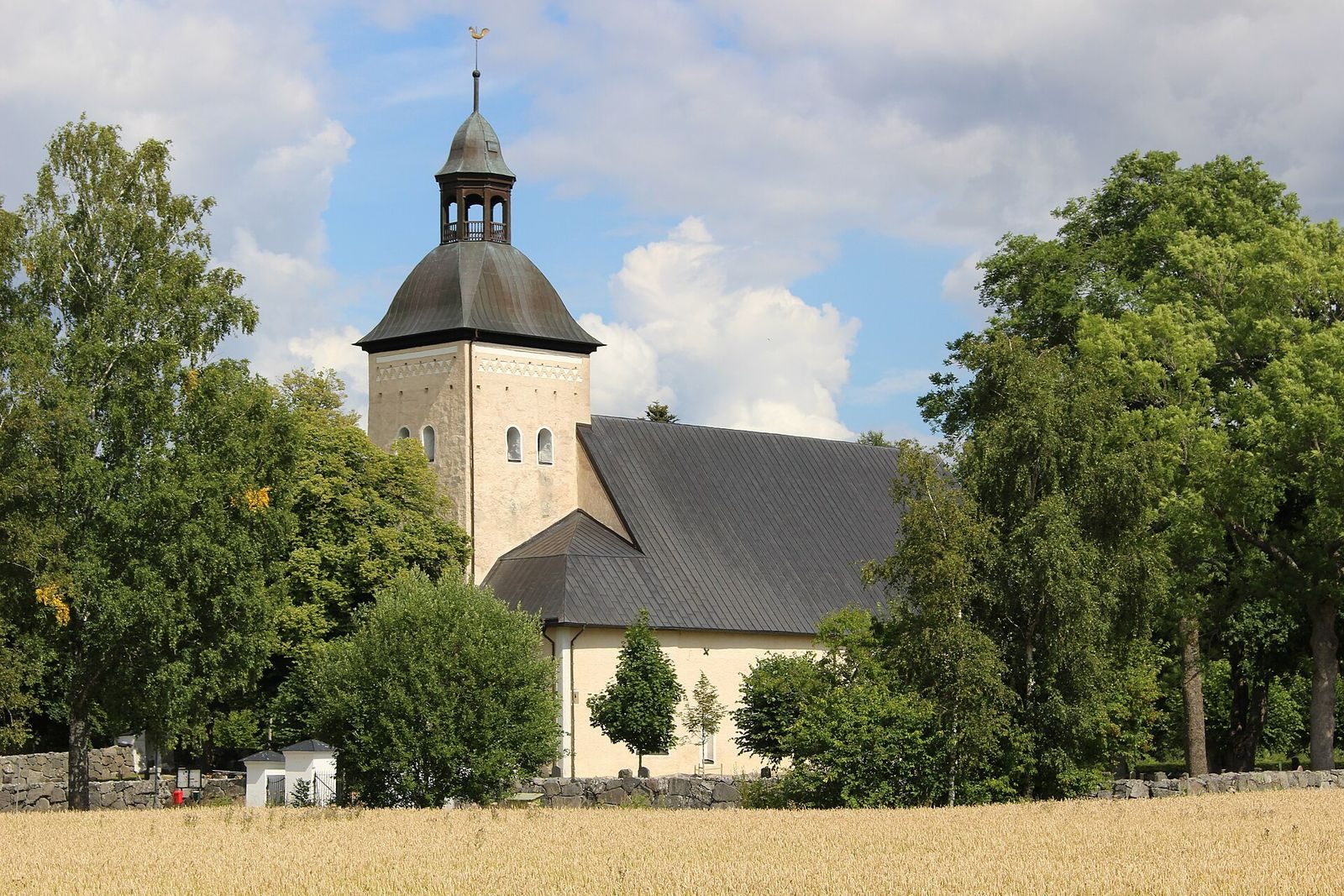
Tillinge Church, about five kilometres west of central Enköping in Sweden, was built in Romanesque style, a medieval European architectural tradition, around 1200. It was consecrated at about the same time. The church belongs to the Church of Sweden, a Lutheran church, and serves the Tillinge and Södra Åsunda parish within the Uppsala Diocese, a regional church administration.
Medieval origins and expansion
The original church was extended eastward around 1300 and adapted as a hall church, with a nave, or main church interior, and side aisles of roughly equal height. A sacristy, a room for clergy and church furnishings, was added on the north side of the chancel, the area around the altar.
During the third quarter of the fifteenth century, a porch was built on the south side. Later work enlarged the church southward and joined the porch to a side aisle. The tower was probably raised and topped with a tall spire during this phase. Late-medieval paintings were added inside and subsequently covered with whitewash.
Early modern rebuilding
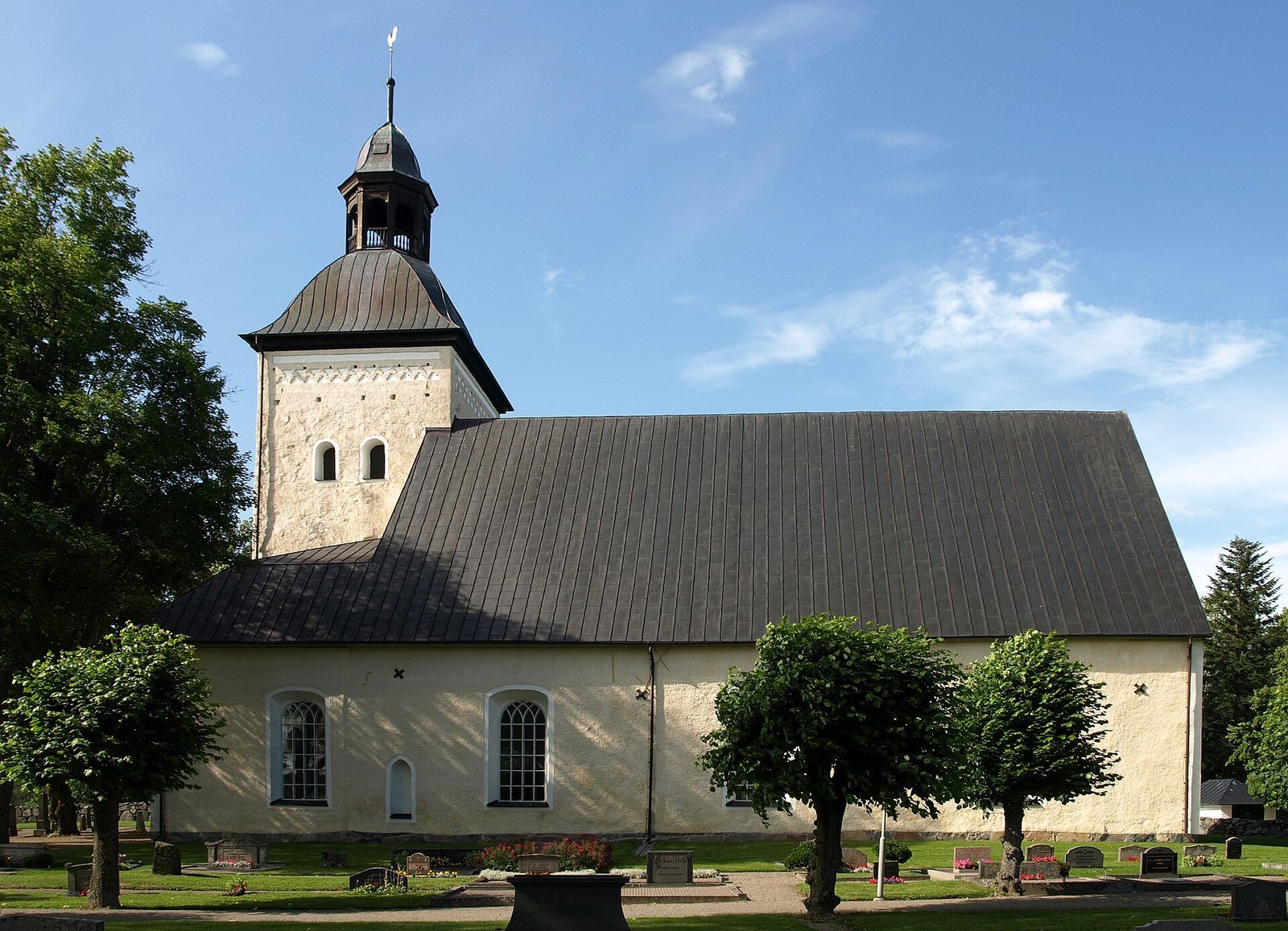
Around 1614, the church was extended south to reach its present width. In 1663, a cellar for communion wine was made in the sacristy. The building’s form changed substantially in the mid-eighteenth century, including the opening of its present north and south windows. In 1743, the bells were transferred from a separate bell house into the tower. Two years later, the tower was raised and decorated with blind arcading, decorative arches without openings. Its simple roof was replaced by a tower hood and a lantern, a raised structure at the top of a tower.
A major restoration in 1765–1766 removed the porch wall and the pillars between the chancel and side aisle. Three brick vaults were built over the interior, giving the church a more unified form. The present porch and the west entrances to the tower and porch were also constructed during this work.
Repairs and restoration
The church stands partly on clay, which has contributed to settlement and repeated repairs. In 1859, the medieval vault in the sacristy was removed and replaced with a flat wooden ceiling. Repairs in 1863 closed both south-side entrances. New floors were laid in the porch and sacristy in 1868, when the wine cellar was filled in.
Work in 1911–1912 strengthened the foundations by removing the chancel vault and east wall and building a new east gable. The tower lantern was opened, and a rusted weathercock was replaced with a gilded-copper one. The roof received black asbestos-cement covering laid in a diagonal pattern. Inside, furnishings were repainted, the gallery was reduced, and new floors and benches were installed. Jan Fridegård’s novel Torntuppen takes its title from the church’s weathercock.
Remains
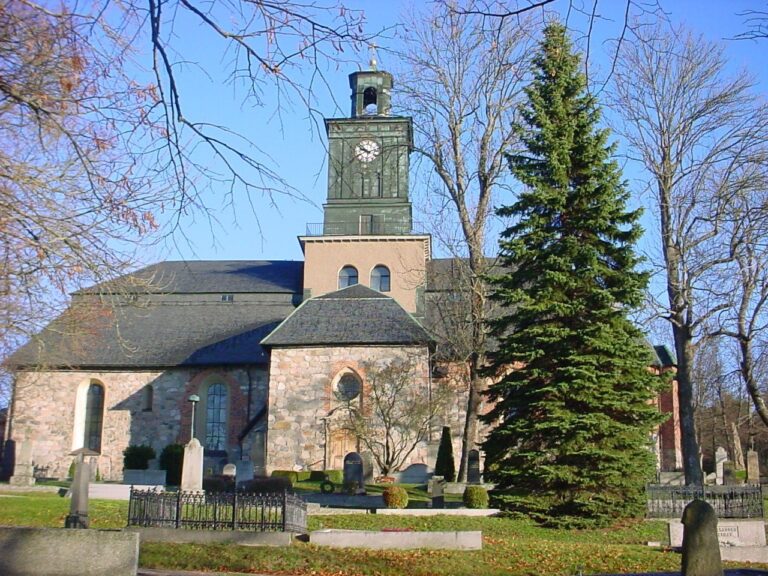
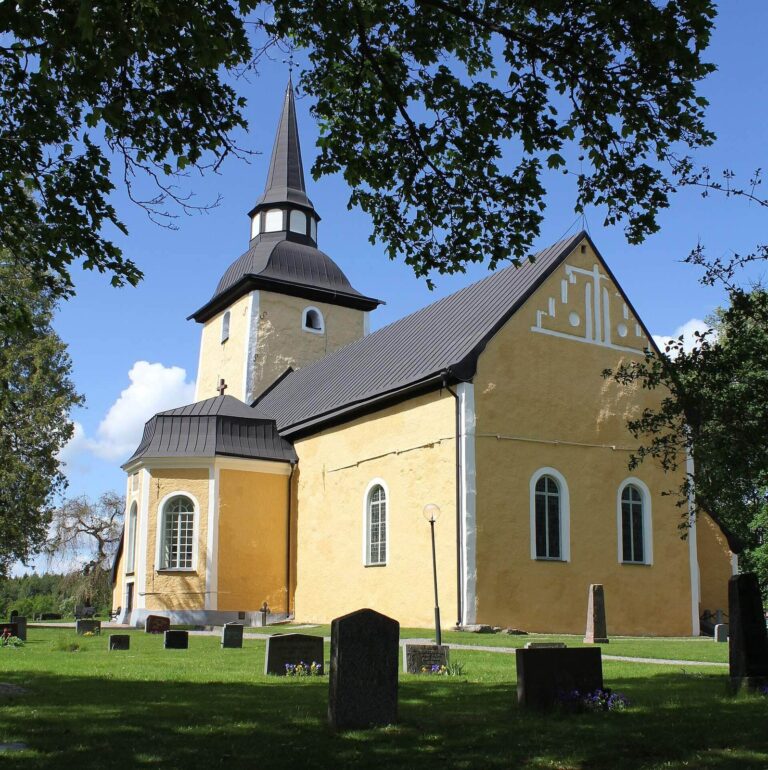
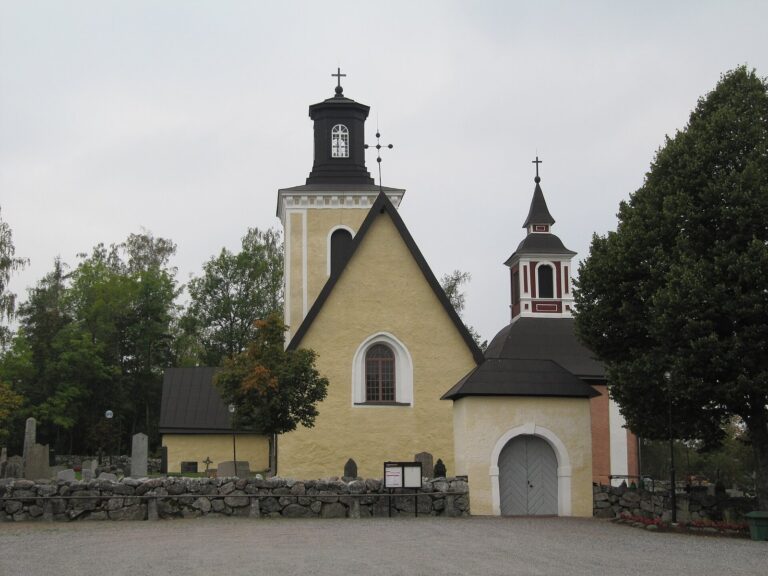
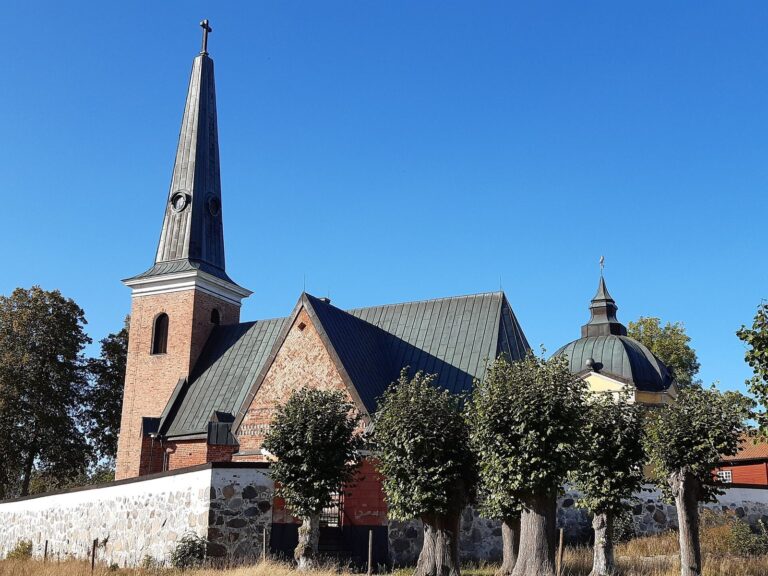
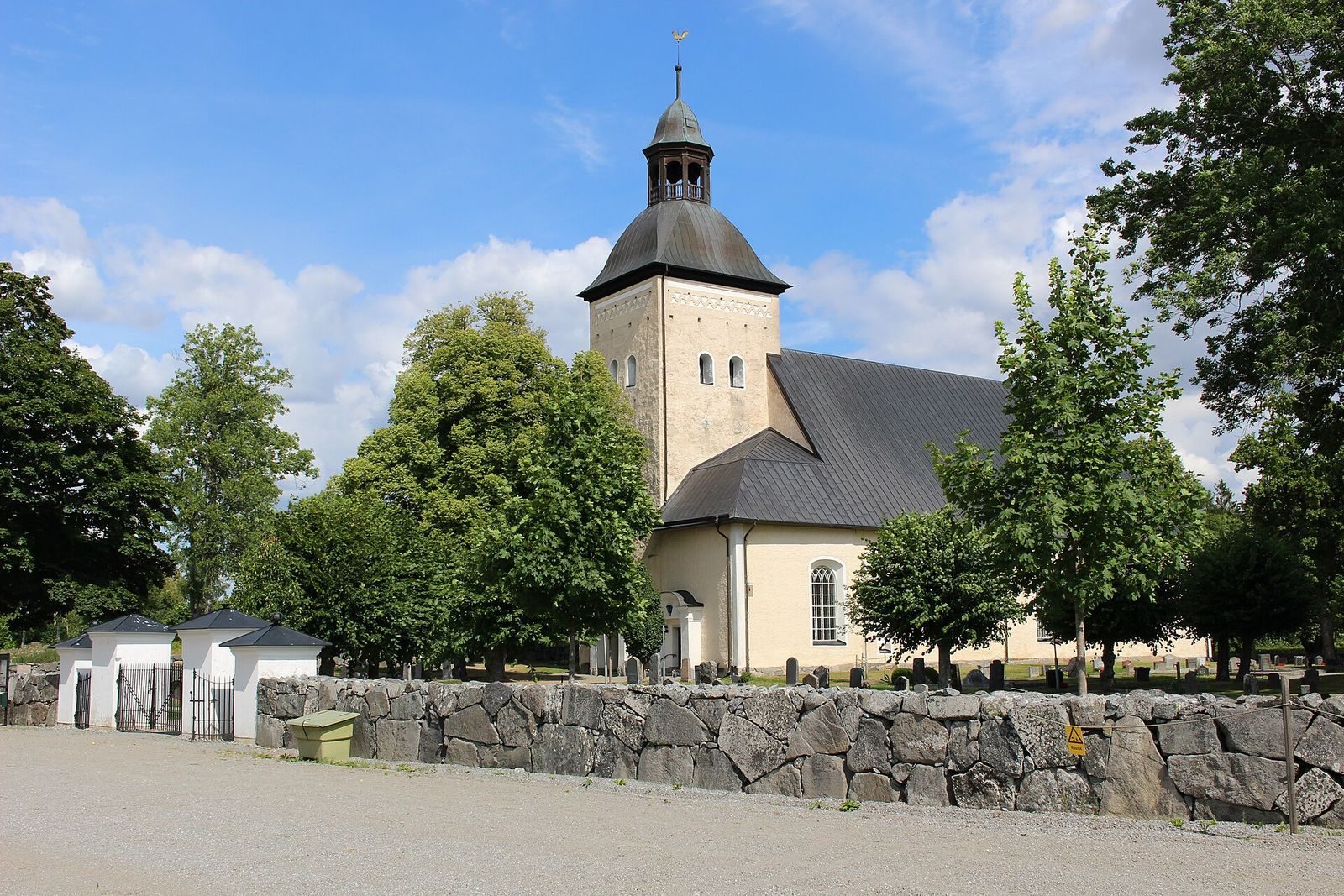
The church has a nave with a straight-ended chancel of equal width at the east end and a sacristy attached north of the chancel. At the west end, the tower and porch stand beside one another, with the porch to the south; both have west-facing entrances. The walls are mainly natural stone beneath plaster. The gable ends, the upper part of the tower, and the porch are brick. The nave and sacristy have gabled roofs, the porch has a roof with two slopes, and the tower is topped by a curved roof and lantern.
Exterior fabric and neighboring buildings
Medieval fabric and tower
The original tower and parts of the nave’s north and west walls survive from the church built around 1200. The west side of the tower has two portals, with runestone U 785 standing between them. A runestone is a stone bearing an inscription in runes; U 785 is its catalogue designation.
Buildings beside the church
A mortuary northeast of the church was built around 1950. The nearby parsonage has a main house erected as a single-storey dwelling around 1800, with another storey added in the 1860s. Houses at the former bell-ringer’s farm beside the church date from the eighteenth century.
Interior furnishings and artworks
Chancel windows and paintings
The two chancel windows contain stained glass made by Eigil Schwab in 1927. The north window shows the Magi honouring the infant Jesus, as described in Matthew 2:11; the south depicts the risen Jesus appearing to two disciples at Emmaus, the episode related in Luke 24:13–35. Two oil paintings by Schwab, depicting the Ascension and the Annunciation, are displayed in the western part of the church.
Altarpiece and pulpit
The altarpiece is an oil painting of Jesus on the cross with Mary and John. Painter Anders Eklund gave it to the church in 1767. Two wooden sculptures, probably carved by Caspar Schröder and donated in 1703, now flank the painting; they formerly stood beside the chancel entrance. The pulpit, installed in 1754, incorporates medieval carvings reused from two altarpieces. One of those altarpieces had been bought from Ängsö Church, while the other was probably Tillinge’s own and was retired when the present altarpiece was installed. The pulpit it replaced dated from 1632.
Baptismal font
The font has a plain bowl dating to around 1200 and a somewhat later foot. Its bowl has a drain hole and no decoration. A brass baptismal dish, acquired in 1943 and made to designs by Erik Sand of Strängnäs, bears the words, “Let the children come to me and do not hinder them” (Mark 10:14).
Organ
The organ’s history includes a repair by Johan Schirmer in 1713 and a renovation by Niclas Söderström of Nora in 1766, when it had eight stops. Gustaf Andersson of Stockholm built a new organ in 1827. Daniel Wallenström rebuilt and enlarged it in 1876, leaving it with thirteen stops, one manual, and a pedal. The present organ was built by A. Magnussons Orgelbyggeri in 1954 and renovated by the same firm in 1988. Its façade and six stops come from the 1827 instrument. It has mechanical action, pneumatic registration, slider chests, 56 manual keys and 30 pedal keys, two free combinations, and a tutti coupler.
Bells
Both bells are housed in the tower. A parish inventory from 1790 preserves a tradition that the great bell had been taken during the siege of Thorn, now Toruń in Poland, and given to the parish by a King Gustaf Adolf, probably Gustaf IV Adolf, who ruled Sweden from 1792 to 1809. Gerhard Horner of Stockholm recast the great bell in 1813; Johan A. Beckman & Co. recast it again in 1899. It was recast further after cracking.
The same 1790 inventory describes the small bell as having been cast in 1649 by Anders Rik. Carl Fredrik Grönwall recast it in 1797, and his son Samuel Christopher Grönwall did so again in 1838. It may also have been recast earlier after cracking.
Lighting and vestments
The church has three metal chandeliers and one crystal chandelier. One metal chandelier bears the date 1699, and another was acquired in 1666. Two black chasubles, sleeveless outer garments worn by a priest during the Eucharist, date from 1815 and 1823.